Opening Essay
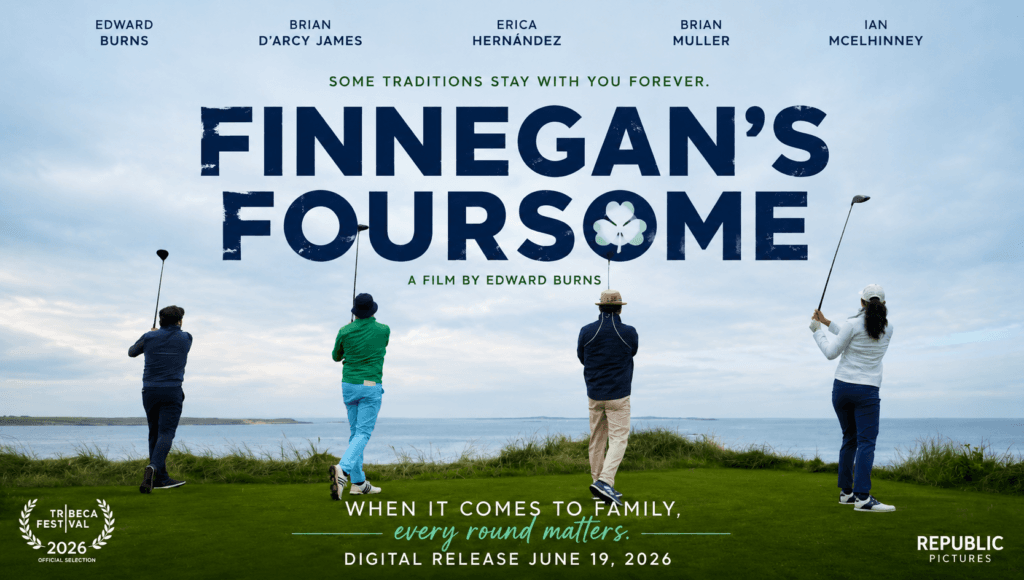
Every family has a tradition that quietly shapes its identity. Sometimes it’s a holiday meal, an old photograph, or a yearly reunion. In Finnegan’s Foursome, that tradition is golf. Yet this isn’t a sports movie in the conventional sense. Golf serves as the language through which love, resentment, grief, pride, and forgiveness are expressed. Every swing, every missed putt, and every walk across the windswept Irish fairways reflects emotions that the characters struggle to put into words.
Edward Burns has built much of his filmmaking career around ordinary people facing extraordinary emotional crossroads. His stories rarely depend on explosive twists or grand spectacles. Instead, they focus on quiet conversations, unresolved family tensions, and the complicated bonds that hold people together even when they drift apart. With Finnegan’s Foursome, Burns returns to familiar territory while giving the story a fresh setting and a heartfelt emotional core.
Ireland becomes far more than a beautiful backdrop. The country’s rugged coastline, historic golf courses, and rolling green landscapes evoke memories of heritage and belonging. For the Finnegan family, this journey is more than a vacation—it is a return to their roots and an opportunity to confront years of unresolved pain.
The film begins with what appears to be a simple family trip. Two brothers and their adult children travel across the Atlantic to honor the final wish of the family’s late patriarch. His request seems straightforward: return to Ireland and scatter his ashes on the coastal golf course he loved most. But as anyone who has experienced family loss knows, fulfilling a final wish is rarely just about completing a task. It often forces those left behind to revisit old memories, settle lingering arguments, and discover truths they never expected to face.
What makes Finnegan’s Foursome immediately engaging is its refusal to portray grief as constant sadness. Instead, the film recognizes that families often laugh while mourning, argue while healing, and find comfort in traditions that continue long after someone is gone. Burns balances heartfelt emotion with gentle humor, allowing each character’s flaws to feel genuine rather than exaggerated.
By using golf as the central metaphor, the film quietly suggests that life resembles the sport itself. Every round includes moments of confidence and frustration. Every mistake presents another chance to recover. Winning is satisfying, but perseverance often matters more than the final score. Likewise, the Finnegan family discovers that healing doesn’t come from perfection. It comes from continuing the journey together, even after years of emotional distance.
Rather than delivering an emotional spectacle, Finnegan’s Foursome invites viewers to appreciate quieter moments—shared memories, difficult conversations, awkward silences, and unexpected laughter. It reminds us that some of life’s greatest victories are invisible to everyone except the people who experience them.
Finnegan’s Foursome (2026): Movie Information
| Information | Details |
| Title | Finnegan’s Foursome |
| Genre | Comedy, Drama, Sports |
| Director | Edward Burns |
| Writer | Edward Burns |
| Producers | Aaron Lubin, Ellen H. Schwartz, Edward Burns |
| Production Companies | Wild Atlantic Pictures, Marlboro Road Gang Productions |
| Distributor | Republic Pictures |
| Runtime | 122 minutes |
| Language | English |
| Country | United States |
| Release Date | June 19, 2026 (Digital/Limited Release) |
| Festival Premiere | Tribeca Festival – June 7, 2026 |
| Streaming / Digital | Available digitally from June 19, 2026 |
| Filming Locations | Dublin, County Wicklow, County Mayo (including Carne Golf Links), Ireland |
| MPA Rating | R (Language) |
The Story Without Spoilers
At first glance, Finnegan’s Foursome appears to be another road-trip comedy built around golf. However, the film quickly reveals itself as something much more intimate.
The story centers on the Finnegan family, whose relationships have become strained after years of misunderstandings and emotional distance. Freddy and Teddy, two middle-aged brothers, carry old resentments that have never fully healed. Their adult children enter the journey with their own expectations, unaware that the trip will challenge not only family history but also their understanding of one another.
Their destination is Ireland, the homeland that shaped generations of the Finnegan family. They are not traveling for sightseeing or a luxury golf vacation. They have come to fulfill the final request of their late father, a passionate golfer whose connection to Ireland remained deeply personal throughout his life.
His wish is beautifully simple: scatter his ashes on the coastal golf course that always felt like home.
That single request becomes the emotional heartbeat of the film.
What begins as a straightforward memorial slowly transforms into a week filled with unexpected conversations, awkward reunions, comic mishaps, and emotional discoveries. Along the way, every family member is forced to confront memories they have long avoided.
Edward Burns wisely avoids rushing the emotional beats. Instead of relying on dramatic confrontations, the screenplay allows relationships to evolve naturally through long walks, shared meals, rounds of golf, and quiet moments overlooking Ireland’s breathtaking coastline.
One of the film’s greatest strengths is its ability to keep viewers curious without depending on mystery. The audience isn’t watching to uncover a secret or solve a puzzle. Instead, they become invested in a far more relatable question:
Can this family finally learn how to move forward together?
That emotional uncertainty gives Finnegan’s Foursome its gentle but compelling momentum.
Why Golf Matters More Than Winning
Most sports movies celebrate competition. They build toward a championship, a final match, or an underdog victory. Finnegan’s Foursome deliberately moves in another direction.
Here, golf is not the destination. It is the conversation.
The game becomes a quiet metaphor for family life itself. A golfer spends most of the round walking rather than swinging. Those long walks create opportunities for conversation, reflection, and silence. Burns uses those moments to explore relationships that have remained emotionally unfinished for years.
The course itself becomes symbolic. Every hole represents another stage of the family’s emotional journey. Some are smooth and straightforward, while others demand patience and resilience. Like life, no round is ever perfect.
The father’s love for golf also reveals something deeper about his character. He never viewed the game as simply keeping score. For him, it represented discipline, friendship, and time spent with the people he loved. Even after his death, golf continues to bring the family together, proving that traditions often survive the people who begin them.
The film also explores generational differences through the sport. The older generation sees golf as a lifelong ritual rooted in patience and respect. The younger family members initially approach it with skepticism or indifference, only gradually coming to understand why it mattered so deeply to their father and grandfather.
Perhaps the film’s most powerful idea is that forgiveness resembles golf more than many people realize. Every player eventually hits a poor shot. Dwelling on that mistake only guarantees another one. Success depends on accepting imperfections and moving forward with renewed focus.
The Finnegans slowly discover the same lesson. Years of resentment cannot be erased overnight, but healing begins the moment someone chooses to take the next step rather than replay the previous mistake.
By the time viewers understand why the family’s annual golf tradition mattered so much, the sport has become something entirely different. It is no longer about birdies, pars, or scorecards.
It has become a language of memory.
A ritual of remembrance.
And ultimately, an act of love that continues long after the final round has ended.
Character Analysis
One of Finnegan’s Foursome’s greatest strengths is that it never treats its characters as heroes or villains. They are ordinary people carrying emotional baggage that has accumulated over decades. Every member of the Finnegan family arrives in Ireland with a different understanding of loss, responsibility, and forgiveness. By the end of the journey, none of them becomes a completely different person, but each learns to see the others with greater empathy.
Freddy: The Weight of Being the Responsible Son
Freddy has spent much of his life believing that responsibility means carrying every burden alone. As one of the family’s central figures, he often tries to keep everyone together while quietly suppressing his own emotions. That habit has made him dependable, but it has also created distance between him and the people he loves.
Throughout the trip, Freddy appears practical and organized, focusing on completing his father’s final wish rather than discussing his own grief. Yet beneath that calm exterior lies years of unresolved sadness. He struggles with the feeling that he could have done more for his father and wonders whether he truly understood the man behind the family traditions.
Ireland slowly challenges Freddy’s emotional restraint. Familiar landscapes and shared memories remind him that strength is not measured by silence. Instead of solving every problem, he gradually learns that healing begins when people are willing to speak honestly about their pain.
His transformation is subtle rather than dramatic, making it one of the film’s most believable emotional journeys.
Teddy: The Brother Searching for Peace
If Freddy represents responsibility, Teddy represents unfinished business. The brothers have spent years carrying on disagreements that once seemed important but now feel insignificant compared to the reality of losing their father.
Teddy often masks uncomfortable emotions with humor. His jokes lighten the mood, but they also reveal a man who has never fully confronted his regrets. Like many siblings, he finds it easier to argue than to admit vulnerability.
The trip to Ireland forces Teddy to revisit memories he has avoided for years. Walking the same paths his father once walked makes him realize that time has quietly changed the meaning of old conflicts.
Rather than portraying Teddy as stubborn for the sake of drama, the film recognizes that reconciliation is rarely instant. Forgiveness is presented as a series of small decisions instead of one emotional breakthrough.
That realism makes Teddy one of the story’s most relatable characters.
Frankie: Discovering a Family History He Never Fully Knew
Frankie belongs to the younger generation, giving him a perspective that differs from his elders. Unlike Freddy and Teddy, he did not experience every chapter of the family’s history firsthand. Many of the stories surrounding his grandfather exist only through memories shared by others.
At first, the trip feels more like an obligation than a personal mission. As the journey unfolds, however, Frankie begins to understand that family history is not simply inherited—it must be experienced.
Watching the older generation reconnect allows him to see his relatives as individuals rather than simply parents, uncles, or grandparents. Their flaws become easier to understand once he realizes they have spent decades carrying emotional burdens that were never fully discussed.
Frankie’s emotional growth reflects a universal experience. Every generation eventually reaches a point where childhood assumptions give way to adult understanding.
Marie: Quiet Strength in a Family of Strong Personalities
Marie serves as one of the emotional anchors of the story. While louder personalities dominate conversations, she often observes before speaking. Her patience allows her to recognize emotions that others overlook.
She understands that grief affects everyone differently. Rather than forcing reconciliation, Marie creates opportunities for honest conversations to happen naturally.
Her strength comes not from controlling situations but from listening without judgment. She reminds the family that compassion often accomplishes more than confrontation.
In many ways, Marie represents the emotional maturity that the other characters gradually learn throughout the journey.
Jack: Carrying the Legacy Forward
Jack embodies the bridge between generations. He respects family traditions while questioning what they truly mean in the modern world.
Initially, he views the annual golf tradition as something belonging to older relatives. Ireland changes that perspective by showing him that traditions survive because each generation chooses to continue them.
Jack gradually understands that legacy is not about repeating the past exactly as it happened. Instead, it involves preserving the values that made those traditions meaningful in the first place.
His journey offers hope that the family’s story will continue long after this particular trip ends.
Ireland as an Invisible Character
Many films use beautiful locations simply to impress the audience. Finnegan’s Foursome takes a different approach. Ireland is not merely where the story happens—it actively shapes the emotional experience of every character.
The country’s rolling green hills, dramatic coastlines, ancient villages, and world-famous golf courses create an atmosphere that feels both peaceful and deeply reflective. Rather than overwhelming the story, these landscapes encourage moments of silence where characters can process emotions they have avoided for years.
Ireland also symbolizes the family’s origins. For the Finnegans, returning to their ancestral homeland is more than crossing an ocean. It is an attempt to reconnect with the people and traditions that shaped previous generations.
Every village carries echoes of history.
Every coastal breeze seems to preserve forgotten memories.
Every golf course reminds the family that some traditions endure long after the people who began them are gone.
The film repeatedly contrasts Ireland’s timeless landscapes with the temporary nature of human conflict. Family arguments that once felt overwhelming appear remarkably small when viewed against cliffs that have stood for centuries.
This contrast gives the story much of its emotional power.
Ireland encourages reflection rather than distraction.
Its slower pace invites conversations that everyday life often postpones.
Meals last longer.
Walks become opportunities for storytelling.
Silence no longer feels uncomfortable.
Even the unpredictable weather contributes to the film’s atmosphere. Sunshine, mist, and rain arrive naturally, reminding viewers that life itself rarely follows a predictable pattern. Just as golfers adapt to changing conditions, families must learn to adapt to changing circumstances.
Perhaps the most beautiful aspect of Ireland’s role is that it never attempts to solve the family’s problems. The country simply provides the space where healing becomes possible.
By the end of the journey, viewers understand that the Finnegans did not merely visit Ireland.
They rediscovered a forgotten part of themselves.
Themes Hidden Beneath the Comedy
Although Finnegan’s Foursome contains plenty of warmth and humor, its emotional depth comes from the universal themes quietly woven into the story. Rather than delivering dramatic speeches about life’s biggest questions, the film allows these ideas to emerge naturally through conversations, shared experiences, and moments of reflection.
Grief That Evolves Instead of Disappearing
The film refuses to portray grief as something that ends after a funeral. Instead, it suggests that loss changes over time. Memories become less painful, but they never lose their importance.
Each family member carries grief differently. Some avoid discussing it, while others openly embrace memories of the past. Neither approach is presented as right or wrong.
The film simply acknowledges that healing follows a different path for everyone.
Family Expectations
Parents often imagine futures for their children, while children spend years trying either to fulfill or escape those expectations.
The Finnegan family illustrates how those expectations can create both motivation and emotional distance.
As the journey progresses, the characters begin recognizing one another as imperfect individuals rather than idealized family roles. This shift allows genuine understanding to replace long-held assumptions.
Sibling Rivalry
Few relationships are as complicated as those between brothers and sisters.
Freddy and Teddy demonstrate how childhood competition can quietly continue into adulthood. Their disagreements no longer concern the original issues that started them. Instead, the conflict has become part of their relationship.
The film suggests that reconciliation rarely requires forgetting the past.
It simply requires choosing not to let it define the future.
Aging and Legacy
The father’s absence reminds every character that time moves forward whether families are prepared or not.
His final wish encourages the family to consider the legacy they hope to leave behind.
Legacy, the film argues, is measured less by achievements than by the memories we create and the traditions we pass on.
Reconciliation
Perhaps the film’s strongest message is that reconciliation is rarely dramatic.
It happens through ordinary acts.
Sharing a meal.
Walking together.
Listening instead of interrupting.
Laughing at an old story.
Remembering someone who is no longer present.
These seemingly small moments gradually repair relationships that once appeared beyond saving.
Tradition as Emotional Memory
Throughout the film, traditions become living memories.
The annual golf outing is no longer simply a recreational activity.
It becomes a reminder that families stay connected through rituals repeated across generations.
Every time the tradition continues, the father’s influence quietly remains part of the family’s future.
Masculinity and Emotional Honesty
Without becoming preachy, Finnegan’s Foursome also examines traditional ideas of masculinity.
Many of the male characters initially believe strength means hiding emotion.
The story gently challenges that belief.
Real courage, the film suggests, comes from admitting regret, expressing affection, and asking for forgiveness before time runs out.
Emotional Healing
Ultimately, Finnegan’s Foursome is not about golf.
Nor is it simply about honoring a father’s final request.
It is about recognizing that healing rarely arrives through one life-changing moment.
Instead, it happens gradually—conversation by conversation, memory by memory, and step by step.
By blending heartfelt comedy with thoughtful reflection, Edward Burns creates a story that feels deeply personal while remaining universally relatable. The film reminds viewers that every family carries invisible scars, but those same families also possess an extraordinary capacity for forgiveness when they choose understanding over pride.
That quiet optimism is what lingers long after the credits begin to roll.
Ending Explained (Spoilers)
⚠️ Spoiler Warning: The following section discusses the ending of Finnegan’s Foursome (2026) and reveals major story developments. Skip this section if you haven’t watched the film.
The emotional payoff of Finnegan’s Foursome doesn’t come from a dramatic final golf tournament or a shocking twist. Instead, it comes from something much more human—the realization that grief cannot be completed like a checklist, and that honoring someone’s memory often means changing the way we live rather than simply fulfilling their last request.
Throughout the film, the Finnegan family believes their mission is straightforward. They have traveled to Ireland to fulfill their late father’s wish of returning him to the place that meant the most to him. They focus on the destination, carefully planning every step of the journey as though completing the task will finally bring emotional closure.
But as the days pass, something unexpected happens.
The destination gradually becomes less important than the journey itself.
The family members begin spending time together without the distractions of everyday life. Old conversations are revisited. Long-held assumptions are challenged. Moments of laughter quietly replace years of emotional distance.
By the time they reach the moment of honoring their father’s memory, the audience realizes that the father understood something his children did not.
His final wish was never only about Ireland.
It was about bringing his family back together.
The golf course serves as the perfect setting because it represents patience, tradition, and shared experience. It is a place where generations walked together long before this final journey began.
As the family gathers to fulfill his request, every character has changed in subtle but meaningful ways.
Freddy no longer feels responsible for carrying every emotional burden alone. He finally understands that leadership within a family does not require emotional silence.
Teddy lets go of resentments that had quietly shaped his relationship with both his brother and his father. Rather than searching for someone to blame, he begins accepting that every family carries misunderstandings that cannot always be resolved perfectly.
Frankie and Jack gain a deeper appreciation for the people who came before them. What once seemed like outdated traditions now become valuable pieces of family identity.
Marie continues serving as the emotional center, gently reminding everyone that healing often happens through listening rather than speaking.
The film wisely avoids presenting reconciliation as complete perfection. Years of history cannot disappear overnight, and Edward Burns never pretends otherwise. Instead, the ending suggests that forgiveness begins the moment people choose connection over pride.
That message feels remarkably authentic.
Many family dramas rely on one dramatic speech where every conflict suddenly disappears.
Finnegan’s Foursome takes the opposite approach.
Healing occurs through ordinary moments.
Shared memories.
Quiet apologies.
Small gestures of kindness.
Those understated choices make the ending feel earned rather than manufactured.
What Does the Father’s Final Wish Really Mean?
On the surface, his request appears simple.
Return to Ireland.
Visit the golf course.
Honor his memory.
Symbolically, however, the wish represents something much larger.
The father understands that families often become disconnected not because they stop loving one another but because everyday life slowly pulls them in different directions.
His final journey creates one last opportunity for everyone to reconnect.
Rather than leaving behind money or possessions, he leaves behind an experience.
That experience becomes his true inheritance.
His greatest legacy is not the game of golf.
It is the family that chooses to remain together after he is gone.
Why the Ending Feels So Satisfying
The conclusion succeeds because it avoids easy sentimentality.
No miraculous reconciliation erases decades of complicated emotions.
Instead, the film acknowledges that healing is an ongoing process.
The family leaves Ireland carrying the same memories they brought with them.
The difference is that those memories no longer divide them.
They unite them.
By ending on hope rather than certainty, Edward Burns delivers a finale that feels emotionally honest.
Viewers are left believing these characters will continue facing life’s challenges together—not because every problem has been solved, but because they have finally remembered what family truly means.
Hidden Meanings & Symbolism
One reason Finnegan’s Foursome lingers in the mind long after the credits is its thoughtful use of symbolism. Nearly every recurring image carries emotional meaning beyond its literal purpose.
The Golf Course: Life Without Shortcuts
The golf course is much more than the film’s primary setting.
It symbolizes life’s unpredictable journey.
No golfer plays a perfect round.
Unexpected obstacles appear without warning.
Recovery matters more than perfection.
Edward Burns uses this familiar rhythm as a reflection of family relationships.
Everyone makes mistakes.
Everyone says things they regret.
What matters most is choosing the next shot wisely instead of remaining trapped by the previous one.
Ashes: Letting Go Without Forgetting
The father’s ashes symbolize memory rather than loss.
They remind the family that love continues even after physical absence.
The act of fulfilling his final wish is not about saying goodbye forever.
It is about accepting that someone can remain emotionally present even after death.
The film suggests that remembrance is an active choice rather than a passive emotion.
Ireland’s Landscapes: Returning to Identity
Ireland represents home in its broadest emotional sense.
Even family members born elsewhere discover a powerful connection to the country’s history, traditions, and natural beauty.
The landscape encourages reflection.
Wide coastal views remind viewers that individual conflicts appear small when placed within the larger story of generations.
The journey home ultimately becomes a journey inward.
Family Trophies and Memories
Objects connected to golf quietly represent shared history.
Unlike expensive possessions, these items have emotional value because they preserve moments spent together.
The film repeatedly suggests that memories become a family’s greatest inheritance.
Silence Between Brothers
One of the film’s strongest storytelling techniques is its use of silence.
Freddy and Teddy often communicate more through pauses than dialogue.
Those quiet moments reveal years of unresolved emotion that words alone could never express.
As the story progresses, silence gradually transforms from emotional distance into peaceful understanding.
That subtle change reflects the brothers’ growing acceptance of one another.
Tradition as a Living Legacy
The annual golf trip is not preserved because every family member loves the sport.
It survives because traditions allow loved ones to remain part of future generations.
Every repeated ritual becomes another conversation between the past and the present.
The father’s influence therefore continues long after his physical absence.
Forgiveness Is the Real Trophy
Although golf traditionally rewards winners with trophies, the film presents forgiveness as the greatest achievement.
No scoreboard can measure reconciliation.
No championship equals the value of restoring broken relationships.
That quiet message gives the film lasting emotional power.
Cinematography & Direction
Edward Burns approaches Finnegan’s Foursome with remarkable restraint.
Rather than overwhelming viewers with dramatic visual flourishes, he allows natural performances and carefully chosen locations to carry the emotional weight.
The camera frequently lingers on wide Irish landscapes before returning to intimate conversations between family members.
This contrast emphasizes one of the film’s central ideas: human conflicts are temporary, while family history stretches across generations.
The cinematography favors soft natural lighting that enhances Ireland’s beauty without turning every location into a postcard.
Morning mist, changing weather, and golden evening light create an atmosphere that feels authentic rather than overly polished.
The pacing reflects the story’s emotional priorities.
Instead of rushing toward its conclusion, the film allows conversations to unfold naturally.
Walks across golf courses become opportunities for reflection.
Meals become moments of reconciliation.
Long silences become just as meaningful as dialogue.
Burns’ screenplay avoids exaggerated emotional speeches.
Characters speak like real family members—sometimes awkwardly, sometimes humorously, and sometimes with painful honesty.
This naturalistic approach gives the film much of its authenticity.
The music also deserves recognition.
Rather than manipulating the audience’s emotions, the score quietly complements the story, allowing the performances to remain the emotional focus.
Overall, Edward Burns once again demonstrates his ability to tell deeply personal stories without relying on melodrama.
His direction trusts viewers to recognize emotional truth without constant explanation.
That confidence is one of the film’s greatest strengths.
Performances
The success of Finnegan’s Foursome ultimately depends on the cast’s ability to make an ordinary family feel completely believable.
Fortunately, the ensemble rises to that challenge.
Edward Burns
As both director and actor, Edward Burns delivers a grounded performance that perfectly matches the film’s intimate tone.
Rather than dominating scenes, he allows relationships to develop naturally, portraying grief with subtle expressions instead of dramatic outbursts.
His performance feels lived-in, capturing the quiet exhaustion of someone trying to keep a family together while carrying his own emotional burdens.
Brian d’Arcy James
Brian d’Arcy James brings warmth and complexity to his role.
His character balances humor with vulnerability, creating someone who often hides emotional pain behind quick wit.
James’ understated performance makes moments of reconciliation especially effective because they never feel forced.
Erica Hernández
Erica Hernández provides emotional stability throughout the story.
Her character listens more than she speaks, but every conversation feels meaningful.
She offers compassion without becoming overly sentimental, making her one of the film’s most quietly powerful presences.
Brian Muller
Brian Muller captures the uncertainty of the younger generation with authenticity.
His performance reflects someone gradually discovering that family history is far richer and more complicated than childhood memories suggested.
His emotional growth unfolds naturally throughout the journey.
Ian McElhinney
Although his screen presence is closely tied to the family’s memories and legacy, Ian McElhinney’s influence extends throughout the entire film.
His character’s values, traditions, and final wish shape every decision the family makes.
Even in his absence, he remains the emotional heart of the story.
An Ensemble Built on Authenticity
No performance in Finnegan’s Foursome feels designed to steal attention from the others.
Instead, every actor contributes to a believable family dynamic built on affection, frustration, humor, and forgiveness.
That sense of authenticity allows viewers to recognize pieces of their own families within the Finnegans.
By the time the credits roll, the audience is unlikely to remember individual speeches or dramatic confrontations.
Instead, they remember conversations.
Shared laughter.
Quiet forgiveness.
And the comforting reminder that even imperfect families can find their way back to one another.
Budget & Box Office Status
One of the most common questions surrounding independent films is whether they managed to recover their production costs or become commercial successes. In the case of Finnegan’s Foursome, that question cannot yet be answered using verified financial data.
As of this publication, Republic Pictures, the filmmakers, and the production companies have not officially disclosed the production budget, opening weekend earnings, domestic box office, or worldwide box office revenue. The film received its world premiere at the Tribeca Festival before debuting on digital platforms, making traditional theatrical box office reporting less comprehensive than for a wide theatrical release.
Official Financial Status
| Category | Status |
| Production Budget | Not officially announced |
| Opening Weekend | Not officially reported |
| Domestic Box Office | Not officially reported |
| International Box Office | Not officially reported |
| Worldwide Box Office | Not officially reported |
| Digital / VOD Revenue | Not publicly disclosed |
This section will be updated if Republic Pictures or official industry tracking services release verified financial information.
Was Finnegan’s Foursome a Hit or Flop?
Judging an independent film solely by its box office would ignore the realities of today’s film industry. Many smaller productions are designed for film festivals, premium video-on-demand (PVOD), and streaming audiences rather than blockbuster theatrical runs.
From that perspective, Finnegan’s Foursome should be evaluated using several factors beyond ticket sales.
Festival Reception
The film premiered at the Tribeca Festival, one of North America’s most respected showcases for independent cinema. A Tribeca premiere often signals that a film is targeting prestige and audience appreciation rather than blockbuster commercial performance.
Critical Response
Critical reception has been mixed.
Several reviewers praised Edward Burns for continuing to tell intimate, character-driven stories with emotional honesty and for making effective use of Ireland’s scenic locations. Others felt the film leaned too heavily on golf and lacked enough dramatic momentum for viewers who are not interested in the sport.
Audience Appeal
The film is likely to resonate most with viewers who enjoy:
- Family dramas
- Independent cinema
- Character-focused storytelling
- Irish settings
- Golf culture
- Edward Burns’ previous films
Those expecting a fast-paced sports movie or a broad comedy may find its slower rhythm less engaging.
Digital Performance
Because the movie was released primarily through digital platforms shortly after its festival premiere, there are currently no verified public viewing figures available. Any claims about streaming viewership would therefore be speculative and should be avoided until official data is released.
Verdict
Current Verdict: Critical Success (Too Early for Commercial Judgment)
Based on the information available today, Finnegan’s Foursome is best described as a critical and festival-focused independent release. Without official budget, revenue, or streaming numbers, it would be inaccurate to label the film either a commercial hit or a flop. Its long-term reputation will likely depend more on audience appreciation, digital discovery, and word of mouth than on traditional box office totals.
Final Verdict
Edward Burns has never been a filmmaker interested in creating loud blockbusters. Instead, his career has been built around intimate stories about ordinary people facing complicated emotional realities. Finnegan’s Foursome continues that tradition with sincerity and quiet confidence.
At its heart, this is not a movie about golf.
It is a movie about what happens after loss.
It asks how families carry traditions across generations, how siblings move beyond old disagreements, and how memories continue shaping people long after someone they love is gone.
One of the film’s greatest achievements is its authenticity. The Finnegan family never feels like a collection of fictional characters designed to deliver inspirational speeches. They interrupt each other, misunderstand each other, laugh together, and occasionally avoid difficult conversations altogether. Those imperfections make them feel remarkably real.
The Irish setting also elevates the story. Rather than serving as a postcard backdrop, Ireland becomes an emotional landscape that reflects themes of memory, heritage, and belonging. Every coastline, village, and golf course reminds viewers that places can preserve family history just as powerfully as photographs.
The performances remain understated throughout. Edward Burns and the ensemble avoid melodrama, choosing quiet emotional honesty over exaggerated sentiment. This restrained approach may not satisfy viewers looking for major plot twists, but it rewards audiences who appreciate thoughtful character development.
The film’s pacing is likely to divide opinions. Those expecting a sports comedy may find its reflective rhythm slower than anticipated. Likewise, viewers seeking constant conflict or dramatic surprises could feel that the narrative unfolds too gently.
However, for audiences willing to embrace its quieter storytelling style, the film offers genuine emotional rewards.
Perhaps the movie’s greatest strength is its reminder that healing rarely arrives through grand gestures. More often, it begins with a conversation that should have happened years ago, a shared memory that changes someone’s perspective, or a simple decision to forgive.
That message gives Finnegan’s Foursome lasting emotional resonance.
Who Should Watch It?
Recommended for:
- Fans of Edward Burns’ filmmaking
- Viewers who enjoy independent dramas
- Families looking for thoughtful emotional storytelling
- Audiences interested in Irish culture and landscapes
- Golf enthusiasts seeking a story where the sport serves an emotional purpose
It May Not Be for You If:
- You expect an action-driven sports movie.
- You prefer fast-paced comedies.
- You want major plot twists or suspense.
- You are looking for a conventional Hollywood crowd-pleaser.
Overall Rating
★★★★☆ (4/5)
Finnegan’s Foursome is a heartfelt meditation on family, memory, and forgiveness. Its emotional honesty, beautiful Irish setting, and understated performances make it one of Edward Burns’ more personal films. While its deliberate pacing may not appeal to everyone, viewers who connect with its themes will find a story that lingers long after the final scene.
Frequently Asked Questions (FAQ)
Is Finnegan’s Foursome based on a true story?
No. It is an original screenplay written by Edward Burns. While inspired by themes of family, tradition, and golf, it is not based on a specific true story.
Where was Finnegan’s Foursome filmed?
The movie was filmed in Ireland, including locations in Dublin, County Wicklow, and County Mayo, with scenes shot at Carne Golf Links.
What does the ending mean?
The ending suggests that the father’s final wish was ultimately about reuniting his family rather than simply returning to Ireland. The journey becomes one of emotional healing and reconciliation.
Is there a post-credit scene?
No. There is no reported post-credit or mid-credit scene.
Is Finnegan’s Foursome worth watching?
Yes, especially if you enjoy thoughtful independent dramas, family stories, Edward Burns’ films, or emotionally driven character pieces.
Where can you watch Finnegan’s Foursome?
The film was released digitally by Republic Pictures on June 19, 2026, and is available through major Video-on-Demand platforms.
Who directed Finnegan’s Foursome?
Edward Burns wrote and directed the film.
What is the runtime?
The official runtime is approximately 121 minutes.
Is the movie family-friendly?
The film is rated R for language. Parents should review the rating guidance before watching with younger viewers.
Will there be a sequel?
There has been no official announcement regarding a sequel.
Internal Links
Add natural links within your article to related content on MovieExplainedHub.com:
- The Death of Robin Hood (2026) Explained
- Girls Like Girls (2026) Explained
- Toy Story 5 (2026) Explained
- Color Book (2026) Explained
- Backrooms (2026) Explained
Official Outbound Sources
- IMDb – Finnegan’s Foursome (2026)
- https://www.imdb.com/title/tt23039114/
- Use for: Cast, runtime, production details.
- Tribeca Festival – Finnegan’s Foursome
- https://tribecafilm.com/
- Use for: Festival premiere information (search for the film on the official Tribeca site).
- Republic Pictures (Official Distributor)
- https://www.republicpictures.com/
- Use for: Official distributor information and future updates.
- Paramount Pictures
- https://www.paramount.com/
- Republic Pictures is owned by Paramount, and official digital release information may also appear here.
- Official Trailer
- Search YouTube for “Finnegan’s Foursome Official Trailer Republic Pictures” or use the official trailer released through Republic Pictures/Fandango channels.
Additional Authoritative Sources (Optional)
- Variety Review
- https://variety.com/
- Link to the film’s review if you reference critical reception.
- Decider Review