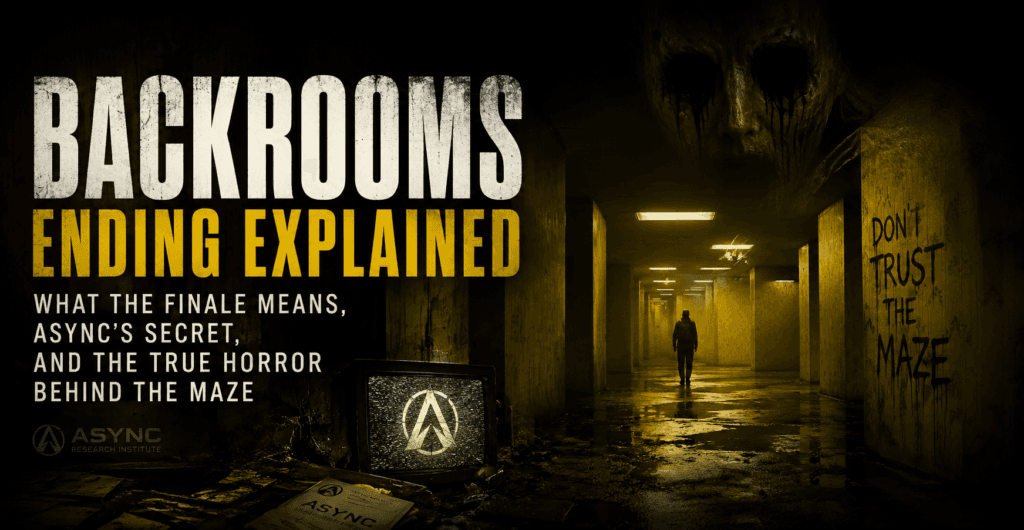
Featured Snippet: What Happens at the End of Backrooms?
At the end of Backrooms, the mystery surrounding Async and the endless maze reaches its most disturbing point. Rather than providing clear answers, the film suggests that the Backrooms are more than a physical location. The finale hints that the maze may preserve memories, absorb identities, and reshape reality itself. The ending leaves viewers questioning whether the characters escaped, became trapped forever, or became part of the Backrooms themselves.
ALSO READ:- https://movieexplainedhub.com/backrooms-cast-and-character-guide/
Backrooms Ending Explained: The Horror Isn’t the Monster
Most horror movies teach us to fear what’s hiding in the dark.
Backrooms does something far more unsettling.
It teaches us to fear empty spaces.
Long before the creatures appear.
Long before the chase sequences begin.
Long before reality starts breaking apart.
The movie creates discomfort simply by showing hallways.
Yellow walls. Backrooms Ending Explained
Fluorescent lights.
Office rooms that seem strangely familiar.
And honestly?
That’s what makes Backrooms one of the most fascinating horror films in recent years.
Because the film understands something many modern horror movies forget:
The unknown is often scarier than the monster.
At first glance, Backrooms appears to be a simple survival story. People enter a strange dimension and try to escape.
But by the time the credits roll, the movie reveals itself to be something much deeper.
A story about obsession.
Memory.
Isolation.
Curiosity.
And humanity’s desperate need to understand things that may never be understood.
That’s why the ending has generated so many theories.
The film doesn’t simply ask whether the characters survive.
It asks whether survival was ever possible.
Quick Movie Overview
| Category | Details |
| Movie | Backrooms |
| Genre | Horror, Mystery, Science Fiction |
| Director | Kane Parsons |
| Based On | The viral Backrooms internet phenomenon |
| Main Theme | Isolation, memory, obsession |
| Central Mystery | What are the Backrooms? |
| Main Organization | Async Research Institute |
What Are the Backrooms?
Before discussing the ending, it’s important to understand what the Backrooms actually are.
Or at least what the movie wants us to believe they are.
According to Async, the Backrooms represent a hidden space beyond normal reality.
A place where physical laws become unstable.
A place disconnected from the world we understand.
The maze consists of endless rooms connected through impossible architecture.
Doors lead nowhere.
Hallways loop infinitely.
Rooms appear where rooms shouldn’t exist.
Time behaves strangely.
Distance becomes meaningless.
At first, Async treats the discovery as a scientific breakthrough.
But as the story progresses, the organization slowly realizes it may have discovered something far more dangerous.
Because the Backrooms aren’t merely a location.
They’re a mystery that seems capable of changing anyone who enters.
The Timeline of the Ending
Let’s break down the final act step by step.
Phase 1: Async Loses Control
The deeper researchers explore, the less predictable the Backrooms become.
Rooms begin changing.
Navigation systems fail.
Certain areas appear capable of altering themselves.
The environment stops behaving like architecture.
It begins behaving like an organism.
That shift is critical.
Because it suggests the Backrooms are not passive.
They respond.
Phase 2: Clark’s Obsession Grows
Clark enters the Backrooms believing he can understand them.
At first, he behaves like a scientist.
Collect data.
Observe patterns.
Document findings.
But gradually his curiosity transforms into obsession.
He stops exploring because he wants answers.
He starts exploring because he needs them.
The distinction matters.
Because obsession becomes one of the movie’s central themes.
Phase 3: Mary Enters the Maze
Dr. Mary Kline initially serves as a voice of reason.
Unlike Clark, she approaches the mystery cautiously.
But eventually she enters the Backrooms herself.
This decision changes everything.
Because the environment immediately begins reacting differently.
The maze no longer feels random.
It begins feeling personal.
Phase 4: Reality Starts Breaking
The final sequence becomes increasingly surreal.
Hallways connect impossibly.
Rooms merge together.
Past and present appear to overlap.
Several locations seem connected to personal memories.
The movie deliberately stops distinguishing physical reality from psychological reality.
That ambiguity is crucial to understanding the finale.
Backrooms Ending Explained
The simplest interpretation is that the characters become trapped.
But I don’t think that’s what the movie is really saying.
The final act repeatedly suggests that the Backrooms do more than trap people.
They preserve them.
Store them.
Remember them.
Throughout the film, abandoned objects appear everywhere.
Furniture.
Documents.
Personal belongings.
These items feel less like clutter and more like evidence.
Evidence that other people have entered before.
Evidence that traces remain behind.
By the ending, Mary appears to become part of that process.
The Backrooms don’t destroy her.
They absorb her.
Not physically.
Psychologically.
The architecture itself feels like a living archive.
An endless collection of memories, identities, and experiences.
That interpretation transforms the ending from simple horror into existential horror.
Because the question stops being:
“Can Mary escape?”
And becomes:
“Can anyone truly leave?”
The Real Meaning Behind Async
One of the most overlooked aspects of Backrooms is Async.
Most viewers see the organization as a research company.
But I think Async represents something larger.
Human ambition.
Human curiosity.
Human arrogance.
The company repeatedly ignores warning signs.
Researchers disappear.
Reality becomes unstable.
Psychological damage increases.
Yet exploration continues.
Why?
Because discovery becomes addictive.
Async cannot stop.
Even when it should.
That obsession mirrors Clark’s personal journey.
And that’s not accidental.
The company and the individual become reflections of each other.
Both believe they can understand something fundamentally unknowable.
Both pay the price.
The Emotional Core of the Film
This is where Backrooms surprised me.
I expected horror.
I expected mystery.
I expected monsters.
What I didn’t expect was sadness.
Many scenes feel strangely melancholic.
The Backrooms are terrifying.
But they’re also lonely.
Every room feels abandoned.
Every hallway feels forgotten.
Every space feels disconnected from human life.
The movie repeatedly asks a simple question:
What happens to places nobody remembers?
That idea may sound strange.
But it’s at the heart of the film.
The Backrooms feel like forgotten memories made physical.
And that’s one reason they remain so haunting.
They’re not completely alien.
They’re familiar.
Just distorted.
And familiarity often creates stronger fear than the unknown.
Scene-by-Scene Ending Breakdown
The Corridor Sequence
One of the most unsettling moments in the film comes during the endless corridor sequence.
At first, the hallway appears ordinary.
The familiar yellow walls return.
The fluorescent lights continue buzzing overhead.
Yet something feels different.
The corridor seems longer than before.
Distances no longer make sense.
The deeper the characters travel, the more the environment appears to resist logic.
This scene is important because it demonstrates a key Backrooms rule:
The maze is not static.
It changes.
Whether those changes are physical or psychological remains one of the movie’s biggest mysteries.
The Async Facility Reveal
The Async reveal changes how viewers interpret the entire story.
Until this point, the organization appears to be a scientific research group attempting to understand the anomaly.
But the deeper we look, the more troubling Async becomes.
Researchers continue entering dangerous areas.
Experiments continue despite mounting risks.
Warning signs are ignored.
The reveal suggests Async may have known more than they admitted.
Rather than simply studying the Backrooms, they may have helped create the conditions that allowed the nightmare to grow.
The Creature Encounter
The creature sequence delivers one of the film’s most memorable scares.
But beyond the horror, the encounter raises important questions.
The creature does not behave like a traditional monster.
It feels almost unfinished.
Its movements appear unnatural.
Its form seems partially human and partially distorted.
That design choice may be intentional.
Rather than representing a physical threat alone, the creature could symbolize what happens when people become consumed by the Backrooms.
The Final Room
The final room may be the most symbolic location in the entire movie.
Unlike earlier areas, this space feels strangely personal.
The environment appears connected to memory rather than architecture.
Objects seem meaningful.
Details feel familiar.
The room creates the impression that the Backrooms are preserving something.
Not just people.
Their experiences.
Their identities.
Their histories.
The Last Shot Explained
The final shot refuses to provide easy answers.
Some viewers interpret it as death.
Others view it as imprisonment.
My interpretation is different.
The final image suggests assimilation.
The Backrooms do not merely trap people.
They absorb them.
The maze grows larger with every person who enters.
And that possibility makes the ending far more disturbing.
The Creature Explained
One of the most common questions surrounding Backrooms is simple:
What exactly is the creature?
The movie never provides a complete explanation.
And honestly, that may be the right choice.
Fear often becomes less effective once everything is explained.
Still, several theories stand out.
Theory 1: A Former Researcher
The creature may be someone who entered the Backrooms long ago and never escaped.
Years of exposure could have transformed them into something unrecognizable.
Theory 2: A Manifestation of the Maze
The entity may not be a living creature at all.
Instead, it could be an extension of the Backrooms themselves.
A defense mechanism.
A warning.
A physical representation of the maze’s influence.
Theory 3: Human Fear Given Form
Another interpretation suggests the creature represents psychological collapse.
It looks almost human because it reflects humanity.
But something about it is wrong.
Just like the Backrooms.
Hidden Meanings & Symbolism
The Yellow Walls
The yellow walls are deceptively important.
Yellow is usually associated with warmth and comfort.
But inside the Backrooms, that comfort feels artificial.
The color creates a false sense of safety.
And that’s exactly why it becomes unsettling.
The Fluorescent Lights
The constant buzzing lights create anxiety throughout the film.
They never truly switch off.
They never provide comfort.
Instead, they remind viewers that the Backrooms are always watching.
Endless Hallways
The hallways symbolize uncertainty.
No matter how far characters travel, answers remain distant.
The journey never ends.
That mirrors the characters’ obsession with understanding the maze.
Empty Offices
The abandoned office spaces may represent modern isolation.
These are locations designed for people.
Yet nobody remains.
The result feels strangely haunting.
| Mystery | Possible Meaning | Why It Matters |
| The Creature | Psychological collapse | Represents what happens when people lose themselves inside the Backrooms |
| Async | Human ambition | Shows humanity’s obsession with knowledge and control |
| Yellow Walls | False comfort | Familiar surroundings that feel subtly wrong |
| Endless Hallways | Fear of uncertainty | Symbolize a search for answers that never ends |
| Final Room | Memory archive | Suggests the Backrooms preserve identities and experiences |
| Fluorescent Lights | Constant anxiety | Create tension and reinforce the feeling of being watched |
| Empty Offices | Modern isolation | Reflect loneliness and disconnected human spaces |
| The Maze Itself | The unknown | Represents mysteries that cannot be fully understood |
Top 5 Most Disturbing Scenes Ranked
5. The Empty Hallway Discovery
Simple.
Quiet.
Deeply uncomfortable.
4. The First Async Exploration
The moment viewers realize something is fundamentally wrong.
3. The Creature Chase
One of the film’s most intense sequences.
2. Reality Collapse Scene
The point at which the movie stops following conventional logic.
1. The Ending
Because uncertainty often creates stronger horror than answers.
Could Backrooms Become a Franchise?
Absolutely.
The Backrooms mythology is enormous.
Potential future stories could explore:
- Other levels
- Missing researchers
- Async’s origins
- Additional entities
- Other dimensions connected to the maze
The universe feels much larger than a single movie.
Easter Eggs & Hidden Details
Several details reward attentive viewers:
- Async logos hidden throughout environments
- VHS-style visual presentation
- References to the original internet lore
- Architectural designs inspired by real office spaces
- Repeating patterns suggesting loops within the maze
These details strengthen the feeling that the Backrooms have existed long before the story begins.
What the Finale Really Means
The ending is not really about survival. Backrooms Ending Explained
It’s about obsession.
Every major character wants answers.
Async wants knowledge.
Researchers want discovery.
Viewers want explanations.
The Backrooms refuse to provide certainty.
And that may be the movie’s most important message.
Some mysteries cannot be solved.
Some places cannot be understood.
And sometimes the search for answers becomes more dangerous than the mystery itself.
Key Characters Explained
Before diving deeper into the Backrooms mythology, it’s worth looking at the characters who drive the story.
Clark Explained
Clark represents curiosity taken to its extreme.
At first, he approaches the Backrooms like a scientist.
He wants answers.
He wants evidence.
He wants understanding.
But the deeper he travels, the more those goals become an obsession.
Clark’s journey isn’t simply about survival.
It’s about humanity’s inability to leave a mystery unsolved.
Dr. Mary Kline Explained
Mary serves as the emotional anchor of the story. Backrooms Ending Explained
Unlike Clark, she approaches the Backrooms with caution.
She’s skeptical.
Grounded.
Rational.
That’s exactly why her eventual confrontation with the maze feels so powerful.
Her story reflects what happens when logic encounters something beyond explanation.
Async Researchers
The researchers represent institutional obsession.
Their goal is discovery.
But their actions repeatedly demonstrate how dangerous curiosity can become.
The deeper Async explores, the less control they maintain.
And that’s precisely the point.
The Backrooms expose human arrogance.
Why Backrooms Feels Different From Other Horror Movies
One reason Backrooms stands out is because it doesn’t rely entirely on monsters. Backrooms Ending Explained
Instead, it relies on atmosphere.
Let’s compare it with other horror films.
Unlike many horror movies, Backrooms often makes empty spaces feel more threatening than the creatures themselves.
That’s incredibly difficult to achieve.
And it’s one reason the movie remains so memorable.
ALSO READ:-https://movieexplainedhub.com/backrooms-cast-and-character-guide/
ALSO READ:-https://movieexplainedhub.com/the-breadwinner-2026-trailer-breakdown-ending-predictions/
ALSO READ:- https://movieexplainedhub.com/speed-demon-2026-trailer-breakdown/
Further Reading & Sources
- IMDb – Backrooms (2026): https://www.imdb.com/
- Kane Parsons Official YouTube Channel: https://www.youtube.com/@kaneparsons
- Backrooms Original Internet Lore (Know Your Meme): https://knowyourmeme.com/memes/the-backrooms
- Backrooms Wiki: https://backrooms.fandom.com/wiki/Backrooms_Wiki
FAQ
What happens at the end of Backrooms?
The ending suggests the Backrooms are more than a physical maze. The finale hints that memories, identities, and reality itself may become absorbed into the environment.
What does the Backrooms ending mean?
The ending explores themes of obsession, isolation, memory, and humanity’s desire to understand the unknown.
Who is Clark in Backrooms?
Clark is one of the central characters whose growing obsession with the Backrooms drives much of the story’s conflict.
What is Async?
Async is the organization responsible for researching and exploring the Backrooms. Their experiments may have contributed to the dangers encountered throughout the film.
What is the creature in Backrooms?
The creature’s true nature remains unclear. It may be a former researcher, a manifestation of the maze, or a symbol of psychological collapse.
Is Backrooms based on internet lore?
Yes. The movie expands upon the famous Backrooms internet phenomenon that became popular through online horror communities.
Will there be a Backrooms sequel?
While no sequel has been officially confirmed, the ending leaves plenty of room for future stories involving Async, additional levels, and unexplored parts of the maze.
Can people escape the Backrooms?
The film intentionally leaves this question unanswered. The ending suggests that escaping may be far more difficult than simply finding an exit.
Backrooms Ending Theories
Theory 1: Mary Became Part of the Maze
The Backrooms preserve identities rather than killing people.
Theory 2: Async Created the Problem
The organization may have accidentally expanded the Backrooms.
Theory 3: The Creature Was Once Human
The creature could be a former explorer transformed by years of exposure.