Introduction
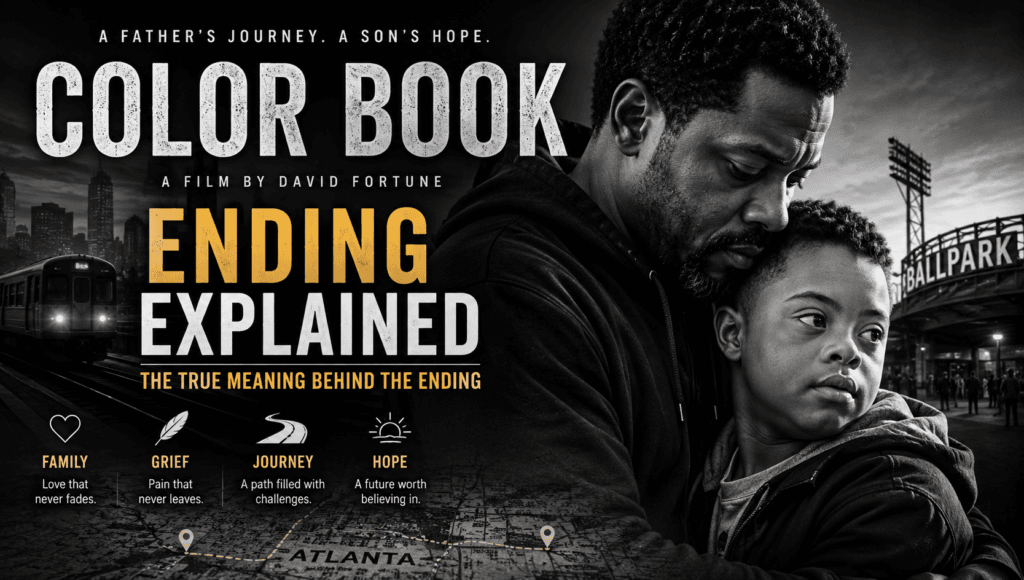
Not every memorable film relies on shocking twists or action-packed finales. Some leave a lasting impression simply by telling an honest human story. Color Book is one of those rare films. Color Book Ending Explained
Directed by David Fortune in his feature-film debut, this intimate black-and-white drama follows a recently widowed father and his young son as they attempt what should be a simple day trip across Atlanta. Yet that journey becomes much more than reaching a baseball stadium—it becomes a story about grief, resilience, fatherhood, and learning how to move forward after unimaginable loss.
Unlike many modern dramas that depend on dramatic confrontations, Color Book finds its emotional power in ordinary moments: waiting for a train, sharing a quiet conversation, or facing an unexpected setback together. Those seemingly small experiences gradually reveal the emotional transformation of its two main characters.
In this article, we’ll recap the story, explain what happens at the end, explore the film’s deeper meaning, examine its central themes, and share Movie Explained Hub’s interpretation of why the ending resonates so strongly.
Movie Information
| Category | Details |
| Movie | Color Book |
| Director | David Fortune |
| Writer | David Fortune |
| Cast | William Catlett, Jeremiah Daniels, Brandee Evans, Terri J. Vaughn |
| Genre | Drama |
| Runtime | 99 minutes |
| Distributor | Netflix |
| Release Date | June 19, 2026 |
| Country | United States |
| Language | English |
| Filming Style | Black-and-white cinematography |
| Main Themes | Grief, Fatherhood, Family, Resilience, Hope |
What Is Color Book About?
At its heart, Color Book is the story of Lucky, a devoted father whose life changes forever after the death of his wife, Tammy. Suddenly responsible for raising his eleven-year-old son, Mason, who has Down syndrome, Lucky finds himself navigating parenthood while carrying the emotional weight of grief.Color Book Ending Explained
Rather than telling this story over several years, director David Fortune chooses a more intimate approach. Most of the film unfolds during a single day as Lucky and Mason travel across Metro Atlanta to attend Mason’s first baseball game.
What sounds like a straightforward outing quickly becomes an emotional journey filled with obstacles, unexpected encounters, and quiet moments that reveal how both father and son are learning to live without Tammy.
The baseball game may be their destination, but the emotional journey is the film’s true focus.
Meet the Main Characters
Lucky (William Catlett)
Lucky is a caring father doing everything he can to keep his family together after his wife’s death. Color Book Ending Explained
Although he appears strong on the outside, every decision he makes is shaped by grief. He worries about providing for Mason, fears making mistakes as a single parent, and struggles with the reality that life will never be the same.
Throughout the film, Lucky learns that being a good father isn’t about having all the answers—it’s about continuing to show up, even on the hardest days.
Mason (Jeremiah Daniels)
Mason is an imaginative eleven-year-old boy with Down syndrome whose curiosity and warmth become the emotional center of the film.
While adults around him often focus on his disability, the movie presents Mason as much more than that. He is thoughtful, observant, creative, and deeply connected to the memories of his mother.
His perspective frequently reminds Lucky—and the audience—that healing doesn’t always happen through words.
Tammy (Brandee Evans)
Although Tammy is no longer alive when the story begins, her presence is felt throughout the film.
Photographs, keepsakes, memories, and conversations continually remind Lucky and Mason that she remains an important part of their lives. Color Book Ending Explained
Rather than treating Tammy as a forgotten character, the film shows how love continues even after someone is gone.
Story Recap: A Father and Son Begin Their Journey
The film opens with a heartbreaking contrast.
Early memories show Mason sharing quiet, happy moments with his mother, Tammy. Those scenes establish the warmth and stability their family once enjoyed. The story then shifts to the present, where Lucky has taken on the responsibilities of raising Mason alone following Tammy’s death.
Soon after, friends and family gather to celebrate Tammy’s life during a memorial. Instead of focusing solely on sadness, the gathering honors her memory with stories, shared laughter, and balloons released into the sky. Mason chooses to keep his balloon rather than let it go, a small but emotionally significant moment that hints at how differently he processes grief.
Wanting to create a new memory with his son, Lucky decides to take Mason to his very first professional baseball game. The outing isn’t just about sports—it represents a fresh start and an opportunity for the two of them to build traditions of their own.
However, almost immediately, the journey becomes far more complicated than either of them expected.
What begins as an ordinary trip slowly turns into a test of patience, determination, and unconditional love. Color Book Ending Explained
The Father and Son’s Journey Begins
Lucky first tries to make the trip by car, hoping the drive will be simple and enjoyable. But like many challenges in the film, even the smallest plans don’t go as expected.
Transportation problems force the pair to adapt repeatedly, sending them across buses, trains, and unfamiliar parts of Atlanta instead of taking the direct route they had imagined. Along the way, they encounter strangers who offer kindness, friends who check in on Lucky’s emotional well-being, and moments that quietly reveal how grief continues to shape both of their lives.
As each obstacle appears, the film asks an important question:
Can a father who is still grieving learn to guide his son through a future that neither of them expected?
That question becomes the emotional foundation for everything that follows.
Story Recap (Spoilers): The Conflict Leading to the Climax
As Lucky and Mason continue their journey across Atlanta, what begins as a simple trip to a baseball game slowly becomes a test of their patience, resilience, and relationship. Color Book Ending Explained
The journey is filled with unexpected setbacks. Transportation problems repeatedly force them to change their plans, making what should have been a straightforward outing increasingly complicated. Every delay adds pressure on Lucky, who is already carrying the emotional burden of losing his wife.
Unlike many dramas, Color Book doesn’t introduce a traditional villain. Instead, the greatest obstacle is everyday life itself.
Missing transportation.
Running out of time.
Making difficult decisions.
Trying to care for a child while grieving.
These ordinary challenges create the emotional tension that drives the story.
Throughout the day, Lucky meets people who respond differently to Mason. Some show kindness and patience, while others underestimate him because of his disability. These encounters remind Lucky that raising Mason means constantly advocating for his son while also learning when to step back and allow him to experience the world independently.
Meanwhile, Mason remains focused on the one thing that matters most to him—reaching the baseball game.
For him, the journey isn’t about the obstacles.
It’s about hope.
That optimism slowly begins changing Lucky’s perspective.
Instead of seeing every setback as another reminder of his difficult life, he gradually starts appreciating the time they’re spending together.
The Emotional Build-Up
As the day progresses, Lucky’s exhaustion becomes increasingly visible.
The audience understands that he isn’t simply tired from traveling.
He’s emotionally exhausted.
Every challenge reminds him that he no longer has Tammy beside him.
The responsibilities that were once shared now belong entirely to him.
At several points, Lucky questions whether he’s doing enough as a father.
Can he give Mason the life he deserves?
Can he protect him without limiting his independence?
Can he move forward without feeling guilty for leaving the past behind?
These questions quietly build toward the film’s emotional climax.
Rather than relying on dramatic confrontations, Color Book allows its emotional weight to grow through small, believable moments.
What Actually Happens at the End?
By the final act, Lucky and Mason finally overcome the day’s many obstacles.
Reaching their destination represents much more than simply arriving at a baseball stadium.
It symbolizes perseverance.
Throughout the film, every setback has tested their relationship.
Yet neither father nor son gives up.
The closing scenes focus less on whether everything unfolds perfectly and more on how the journey changes Lucky’s outlook.
By the end of the day, he begins to understand that being a good father doesn’t require perfection.
It requires presence.
He realizes that Mason doesn’t need someone who can solve every problem.
He needs someone who will continue to show up, listen, encourage, and share life’s experiences alongside him.
The film closes on an emotionally hopeful note, suggesting that while grief remains part of their lives, it no longer prevents them from creating new memories together.
Ending Explained
The ending of Color Book isn’t built around a surprising revelation.
Instead, it’s built around emotional transformation.
At the beginning of the film, Lucky believes his responsibility is to shield Mason from every hardship.
By the end, he realizes something more meaningful.
His role isn’t to control every situation.
His role is to walk beside his son through life’s uncertainties.
That shift may appear subtle, but it represents the film’s most important character development.
The baseball game itself becomes symbolic.
It isn’t simply the destination.
It represents a promise.
A promise that life can still contain joy after unimaginable loss.
For Mason, attending the game fulfills a dream.
For Lucky, it becomes proof that moving forward doesn’t mean forgetting Tammy.
It means honoring her memory by continuing to build a loving life for their son.
Why Does the Ending Matter?
Many family dramas conclude by solving every conflict.
Color Book deliberately avoids that approach.
The ending acknowledges that grief doesn’t disappear overnight.
Lucky doesn’t suddenly stop missing his wife.
Mason doesn’t suddenly stop feeling her absence.
Instead, the film presents healing as an ongoing process.
By sharing one meaningful day together, father and son begin creating a new foundation for their relationship.
The ending suggests that healing isn’t about replacing what has been lost.
It’s about finding the courage to keep living while carrying those memories with you.
That quiet message is what gives the conclusion its emotional strength.
The Father’s Greatest Victory
Lucky’s greatest achievement isn’t reaching the baseball game.
It isn’t overcoming transportation problems.
It isn’t proving himself to anyone else.
His greatest victory is learning to become emotionally available again.
Throughout much of the story, grief keeps him emotionally guarded.
By the end, he reconnects with Mason more deeply.
Rather than focusing on what they have lost, he begins appreciating what they still have.
That emotional shift becomes the true resolution of the film.
The audience isn’t asked to celebrate a dramatic triumph.
Instead, we’re invited to recognize something much more relatable:
Sometimes the bravest thing a parent can do is simply keep moving forward with their child, one day at a time.
Character Analysis: Why Every Character Matters
Although Color Book centers on a father and son, each major character plays an important role in shaping the film’s emotional message.
Lucky: A Father Learning to Live Again
At the beginning of the film, Lucky is overwhelmed.
His wife’s death has left him carrying responsibilities that once belonged to two people. Every decision now feels heavier because there is no one beside him to share the burden.
Instead of openly expressing his grief, Lucky focuses on practical problems. He worries about transportation, schedules, and keeping Mason safe. On the surface, these concerns seem ordinary, but they also reveal how grief has changed him. Controlling every situation becomes his way of coping with uncertainty.
As the story progresses, Lucky slowly realizes that he cannot plan away sadness or protect Mason from every disappointment.
His greatest transformation isn’t becoming a perfect father.
It’s accepting that being emotionally present is more valuable than appearing emotionally strong.
By the end of the film, Lucky begins trusting both himself and his son more than he did at the beginning.
Mason: The Heart of the Story
Mason is much more than the child at the center of the narrative.
He becomes the emotional compass of the film.
While adults often focus on his diagnosis, Color Book consistently reminds viewers that Mason is an individual with dreams, emotions, humor, and resilience.
He experiences grief differently from Lucky.
Rather than expressing constant sadness, he continues looking forward to meaningful experiences, especially attending his first baseball game.
His optimism doesn’t erase the family’s pain.
Instead, it reminds Lucky that hope and grief can exist at the same time.
One of the film’s greatest strengths is that Mason is never portrayed simply as someone who needs protection.
He also becomes the person helping his father heal.
Tammy: The Presence That Never Leaves
Although Tammy appears primarily through memories and the lasting impact she had on her family, her influence shapes every decision Lucky makes.
She represents the emotional foundation that once held the family together.
Rather than presenting her as someone who belongs only to the past, the film suggests that loved ones continue influencing our lives through memory, values, and shared experiences.
Tammy’s absence is painful, but her love continues to guide both Lucky and Mason.
Hidden Themes You May Have Missed
1. Grief Doesn’t Follow a Timeline
One of the film’s most realistic ideas is that grief doesn’t unfold according to a schedule.
Lucky and Mason process the same loss in completely different ways. Color Book Ending Explained
Neither approach is presented as right or wrong.
Instead, the story encourages viewers to recognize that everyone heals differently.
ALSO READ:- https://movieexplainedhub.com/grogu-star-wars-future-without-din-djarin/
2. Fatherhood Is About Presence, Not Perfection
Many films portray parents as heroes who always know the right answer.
Color Book rejects that idea.
Lucky makes mistakes.
He becomes frustrated.
He feels uncertain.
Yet he continues showing up for Mason.
The film suggests that consistency, patience, and love matter more than perfection. Color Book Ending Explained
3. Small Moments Can Change Lives
The movie rarely relies on dramatic speeches or life-changing revelations.
Instead, its emotional impact comes from everyday experiences.
A conversation.
A shared smile.
A quiet walk.
These moments gradually rebuild the connection between father and son.
The film reminds us that meaningful relationships are often strengthened through ordinary acts of kindness rather than extraordinary events. Color Book Ending Explained
Symbolism Explained
Like many thoughtful dramas, Color Book uses visual storytelling more than direct explanation.
Some of the following interpretations are not explicitly confirmed within the film but are reasonable ways to understand its imagery.
The Journey
The trip across Atlanta can be interpreted as more than a physical journey.
It also reflects Lucky’s emotional transition from surviving each day to slowly accepting that life can continue after loss.
Every obstacle mirrors the emotional barriers he must overcome. Color Book Ending Explained
The Baseball Game
On the surface, the baseball game is Mason’s goal.
On a deeper level, it represents hope.
For Mason, attending the game fulfills an important dream.
For Lucky, reaching the stadium demonstrates that difficult days can still end with meaningful moments.
The destination matters.
But what truly changes them is everything they experience along the way.
The Film’s Black-and-White Cinematography
One of Color Book’s most distinctive creative choices is its black-and-white presentation.
The filmmakers have not stated that the visuals represent a single specific idea.
However, one interpretation is that removing color encourages viewers to focus on facial expressions, relationships, and emotion instead of visual spectacle.
Another interpretation is that the monochrome imagery reflects the emotional simplicity of the story, allowing themes of love, grief, and hope to take center stage. Color Book Ending Explained
Rather than distracting audiences with vibrant visuals, the cinematography draws attention to the human connection.
Hidden Details Worth Noticing
If you watch Color Book a second time, you’ll notice several recurring ideas that quietly reinforce the film’s message.
- Every day interruptions become opportunities for connection rather than simple inconveniences.
- Lucky gradually speaks with greater patience as the story progresses, reflecting his emotional growth.
- Mason often notices details that adults overlook, reminding viewers that perspective shapes how we experience the world.
- The film rarely rushes emotional scenes, allowing silence to communicate feelings that words cannot.
These subtle storytelling choices help explain why the film resonates with many viewers despite its simple premise.
Movie Explained Hub’s Interpretation
Our Interpretation Color Book Ending Explained
At Movie Explained Hub, we believe Color Book is less about reaching a baseball game and more about learning how to carry love after loss.
The film never suggests that grief disappears.
Instead, it argues that grief changes shape over time.
Lucky begins the story believing his responsibility is to replace everything Mason has lost.
By the end, he understands something much more powerful.
He cannot replace Tammy.
He cannot erase painful memories.
What he can do is continue creating new ones.
That realization transforms the meaning of the entire journey.
The baseball game becomes a symbol of moving forward without leaving the past behind.
The film quietly suggests that healing isn’t measured by how quickly people stop grieving.
It’s measured by their willingness to keep loving, keep hoping, and keep sharing life’s ordinary moments with the people who remain.
For us, that’s what makes Color Book such an emotionally satisfying drama.
Its greatest message isn’t about loss.
It’s about choosing connection over isolation, hope over despair, and presence over perfection.
Those ideas continue long after the credits roll.
Is Color Book’s Ending Happy or Sad?
The ending of Color Book is best described as bittersweet but ultimately hopeful.
On one hand, the film never asks viewers to forget the pain that Lucky and Mason have experienced. Tammy’s absence continues to shape their lives, and the movie honestly acknowledges that grief doesn’t disappear after a single meaningful day.
On the other hand, the ending offers something equally important—hope.
By the time the credits roll, Lucky has stopped measuring his success as a father by whether he can solve every problem. Instead, he realizes that simply being present for Mason is the greatest gift he can offer.
Likewise, Mason reminds both his father and the audience that happiness can still exist alongside sadness.
The baseball game doesn’t erase their loss.
It represents the beginning of a new chapter.
That quiet optimism is what makes Color Book’s conclusion so emotionally satisfying.
Final Interpretation
One of the reasons Color Book resonates so deeply is because it refuses to provide easy answers.
There is no miraculous cure for grief.
There is no dramatic speech that suddenly heals the family.
Instead, the film celebrates something much more authentic.
It celebrates ordinary love.
Throughout the story, Lucky learns that moving forward doesn’t mean leaving Tammy behind. Her love continues to shape the family, not through physical presence, but through memories, values, and the bond she helped create.
The final scenes suggest that healing is not about forgetting those we’ve lost.
It’s about carrying their love into the future while continuing to build new memories.
That message feels universal, which is why the film connects with parents, children, and anyone who has experienced loss.
For us, Color Book succeeds because it understands that life’s greatest victories often happen quietly.
Sometimes the most courageous thing a person can do is wake up, keep going, and continue loving the people who need them most.
Verdict
⭐⭐⭐⭐⭐ 4.5/5
Color Book isn’t a film driven by shocking twists or spectacular action.
Instead, it offers something much rarer—a sincere, emotionally honest portrait of fatherhood, resilience, and hope.
William Catlett delivers a deeply affecting performance as Lucky, while Jeremiah Daniels brings warmth, authenticity, and joy to Mason. Director David Fortune also makes an impressive feature debut, using restrained storytelling and striking black-and-white cinematography to keep the focus on the characters and their emotional journey.
If you’re looking for a thoughtful drama that stays with you long after the credits roll, Color Book is well worth watching.
Frequently Asked Questions (FAQ)
1. What is the main message of Color Book?
The film explores grief, fatherhood, resilience, and unconditional love. It suggests that healing doesn’t come from forgetting painful memories but from learning to move forward while keeping loved ones close in your heart.
2. Is Color Book based on a true story?
No. Color Book is a fictional drama written and directed by David Fortune. However, its themes and emotional experiences are grounded in situations that many families can relate to.
3. Why is the movie called Color Book?
The title is never explicitly explained within the film.
One possible interpretation is that it reflects the idea of filling life’s blank pages with new memories after loss. Rather than erasing grief, the characters gradually add new experiences that become part of their shared story.
4. Does Lucky find peace at the end?
Lucky doesn’t completely overcome his grief.
Instead, he reaches a healthier emotional place where he accepts that healing is an ongoing process and chooses to focus on being present for Mason.
5. What happens in the final scene?
The ending leaves viewers with a sense of hope rather than complete closure.
After overcoming numerous challenges together, Lucky and Mason demonstrate that they can continue building a meaningful future despite the pain of losing Tammy.
6. Is Color Book’s ending happy or sad?
The ending is bittersweet.
While the family’s loss remains real, the story concludes on an optimistic note, emphasizing resilience, love, and new beginnings.
7. Where can you watch Color Book?
Color Book is available to stream on Netflix.
8. Is Color Book worth watching?
Yes.
If you enjoy emotionally grounded dramas such as The Pursuit of Happyness, Minari, or Manchester by the Sea, Color Book offers a heartfelt story with excellent performances and an uplifting message.
Official Sources
For more information about the film, visit these official resources:
- Netflix: https://www.netflix.com/title/82049240 (check your region if unavailable)
- IMDb: https://www.imdb.com/title/tt32150360/
- Official Trailer: https://www.youtube.com/results?search_query=Color+Book+Official+Trailer
Related Articles You May Like
If you enjoyed this ending breakdown, you may also like:
Author
Written by Luke D
Lokesh Dhanure is the founder and editor of Movie Explained Hub, where he explores movie endings, hidden meanings, fan theories, and cinematic storytelling. His goal is to help viewers better understand the deeper messages behind films while providing accurate, reader-friendly explanations supported by verified information.
Final Thoughts
Color Book reminds us that the strongest families aren’t those who avoid hardship—they’re the ones who face it together.
Its emotional ending doesn’t depend on grand revelations or dramatic twists. Instead, it leaves viewers with a simple but powerful truth:
Love doesn’t end when someone is gone. It continues through the memories we cherish, the lessons we carry, and the people we choose to love every single day.
That’s what makes Color Book one of the most quietly powerful dramas of the year.