Editorial Note: This article combines audience reactions, publicly available information, and critical analysis. Opinions discussed reflect both audience sentiment and the author’s interpretation. Disclosure Day vs Close Encounters
One criticism appears repeatedly among audience reactions: Disclosure Day vs Close Encounters
Disclosure Day doesn’t feel as big as its premise.
That’s a surprising complaint for a Steven Spielberg science-fiction movie, especially one released in the IMAX era.
One viewer described the film as:
“A mid-tier X-Files episode where they don’t want to show the repercussions or don’t have the budget to.”
While harsh, that criticism highlights an interesting debate.
Why do some audiences feel Disclosure Day lacks the cinematic impact of Close Encounters?
The answer may have less to do with visual effects and more to do with expectations.
Close Encounters Created Wonder Through Spectacle
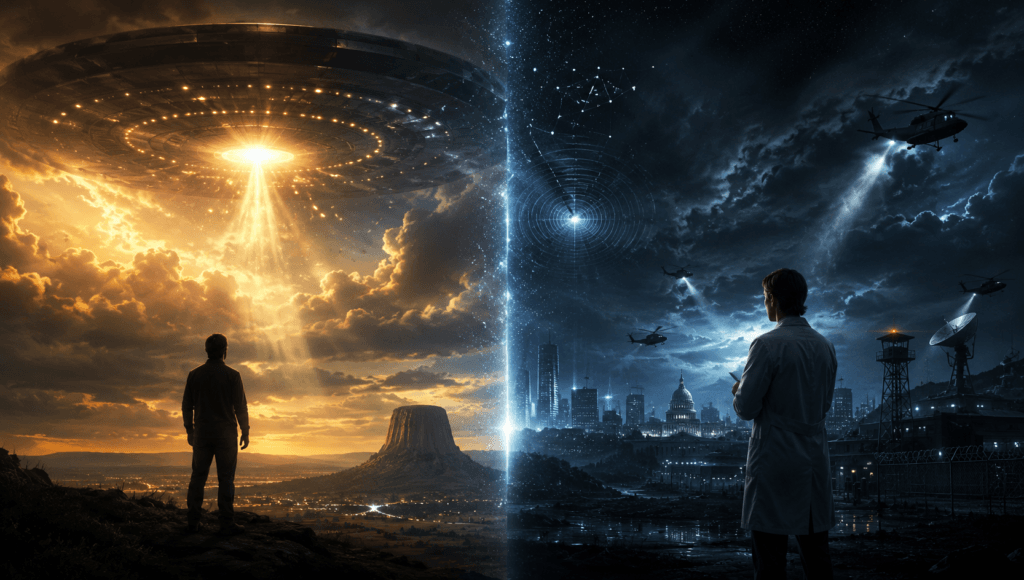
When Roy Neary first encounters UFOs in Close Encounters of the Third Kind, the experience feels genuinely transformative. Disclosure Day vs Close Encounters
As the story progresses, his obsession becomes increasingly visible.
One of the film’s most memorable sequences shows Roy building Devil’s Tower inside his own home using dirt, mud, and household objects.
It’s strange.
It’s emotional.
And it visually communicates his psychological transformation without lengthy exposition.
Later, Spielberg delivers one of the most iconic moments in science fiction history:
The musical communication sequence between humans and extraterrestrials.
Instead of lasers, battles, or destruction, the climax revolves around communication.
Then comes the legendary mothership reveal.
Even decades later, the scale of that sequence remains breathtaking.
The audience isn’t simply watching aliens arrive.
They’re witnessing humanity experience wonder.
Disclosure Day Chooses Restraint Instead
Disclosure Day appears intentionally less spectacular.Disclosure Day vs Close Encounters
Rather than emphasizing visual awe, the film focuses on uncertainty, secrecy, and consequences.
For some viewers, that approach feels mature.
For others, it feels small.
One audience member argued that despite watching the movie in IMAX, it never fully utilized the scale of the format.
Unlike Close Encounters, where Spielberg repeatedly encouraged audiences to look upward, Disclosure Day often turns inward, focusing on conversations, ethical dilemmas, and institutional conflict.
The result is a very different cinematic experience.
Modern Competition Changes Expectations
Another reason Disclosure Day faces tougher criticism is timing.
Today’s audiences compare every major science-fiction release to modern blockbusters.
Recent films such as:
- Sinners
- Project Hail Mary
- Interstellar
- Oppenheimer
- Dune: Part Two
have conditioned audiences to expect massive visual spectacle combined with emotional storytelling.
Christopher Nolan, Denis Villeneuve, and other contemporary filmmakers frequently create experiences specifically designed for premium formats like IMAX.
As a result, audiences may judge Disclosure Day against modern expectations rather than Spielberg’s artistic intentions.
Spielberg’s Goal May Be Different
One possible interpretation is that Spielberg isn’t trying to compete with modern spectacle.
He’s attempting something more reflective. Disclosure Day vs Close Encounters
Close Encounters asked:
“What if we’re not alone?”
Disclosure Day appears to ask:
“What happens after we discover we’re not alone?”
One question inspires wonder.
The other creates anxiety.
That difference may explain why some viewers feel a sense of loss while others appreciate the film’s philosophical approach.
| Category | Close Encounters of the Third Kind (1977) | Disclosure Day (2026) |
| Core Theme | Discovery and wonder | Truth and consequences |
| Main Question | Are we alone in the universe? | What happens after disclosure? |
| Tone | Optimistic and mysterious | Reflective and uncertain |
| Visual Style | Bright lights, awe, spectacle | Muted colors, realism, tension |
| Character Focus | Roy Neary’s personal obsession | Society’s reaction to hidden truths |
| Emotional Impact | Sense of wonder and curiosity | Anxiety and philosophical reflection |
| Alien Concept | Communication and understanding | Secrecy and revelation |
| Spectacle | Large-scale cinematic moments | More restrained and dialogue-driven |
| IMAX Experience | Designed to overwhelm audiences with visual wonder | Focused on ideas rather than visual grandeur |
| Audience Reaction | Widely celebrated as a sci-fi classic | More divisive among audiences and critics |
Audience Reactions: Evolution Or Decline?
Perhaps the most interesting aspect of Disclosure Day is how strongly it divides viewers.
One longtime Spielberg fan wrote that they began noticing a creative decline during the early 2000s, but didn’t fully question it until Ready Player One.
Their argument wasn’t about visual effects or technical filmmaking.
Instead, they felt Spielberg had lost the emotional heart that once defined his best work.
The viewer explained:
“He always found the heart at the center of the chaos.”
That observation cuts to the center of the debate.
Many fans don’t simply miss spectacle.
They miss emotional connection.
Meanwhile, supporters argue that Spielberg hasn’t lost his heart.
He’s simply exploring different themes.
The youthful wonder of Close Encounters has evolved into the mature uncertainty of Disclosure Day.
Whether audiences embrace that evolution remains the central question.
READ MORE:- https://movieexplainedhub.com/signal-one-2026-littlemouth-mystery-explained/
https://movieexplainedhub.com/disclosure-day-ending-explained
Frequently Asked Questions
Is Disclosure Day similar to Close Encounters?
Both films explore humanity’s relationship with the unknown, but they approach the subject differently. Close Encounters emphasizes wonder and discovery, while Disclosure Day focuses on secrecy, consequences, and uncertainty.
Why are audiences comparing Disclosure Day to Close Encounters?
Both films involve Spielberg’s fascination with extraterrestrial ideas and humanity’s response to them. Many viewers see Disclosure Day as a modern reflection of themes first explored in Close Encounters.
Is Disclosure Day Spielberg’s best sci-fi film?
Opinions vary. Some viewers praise its ambition and philosophical themes, while others believe films like Close Encounters, E.T., Jurassic Park, and Minority Report remain stronger works.
Why do some viewers dislike Disclosure Day?
Common criticisms include slow pacing, limited character development, muted visuals, and a perceived lack of spectacle compared to Spielberg’s earlier classics.
Why do other viewers praise Disclosure Day?
Supporters appreciate its mature themes, ethical questions, ambiguity, and willingness to prioritize ideas over action.
Does Disclosure Day feel like a Spielberg movie?
Yes, although it reflects a different stage of Spielberg’s career. The film replaces youthful wonder with reflection, uncertainty, and philosophical questions.
What makes Close Encounters special?
Its emotional storytelling, groundbreaking visual effects, iconic musical communication sequence, and unforgettable mothership reveal continue to inspire audiences decades later.
Has Steven Spielberg lost his passion for filmmaking?
There is no evidence to support that claim. However, some fans feel his recent work lacks the emotional energy of his earlier classics, while others believe his storytelling has simply evolved.
Is Disclosure Day worth watching?
If you enjoy thoughtful science fiction focused on ideas, ethics, and mystery, Disclosure Day is likely worth your time. Those expecting nonstop spectacle may feel differently.
What is the biggest difference between Disclosure Day and Close Encounters?
Close Encounters celebrates discovery. Disclosure Day explores the consequences of discovery.
Steven Spielberg Biography
Anchor Text: Steven Spielberg
Link: https://www.britannica.com/biography/Steven-Spielberg
Example:
Steven Spielberg’s career has spanned more than five decades, making him one of Hollywood’s most influential filmmakers.
2. Close Encounters of the Third Kind (IMDb)
Anchor Text: Close Encounters of the Third Kind
Link: https://www.imdb.com/title/tt0075860/
Example:
Close Encounters of the Third Kind remains one of Spielberg’s most celebrated science-fiction films.
3. E.T. The Extra-Terrestrial (IMDb)
Anchor Text: E.T. The Extra-Terrestrial
Link: https://www.imdb.com/title/tt0083866/
4. Minority Report (IMDb)
Anchor Text: Minority Report
Link: https://www.imdb.com/title/tt0181689/
5. Encyclopaedia Britannica Article on Science Fiction
Anchor Text: science fiction cinema
Link: https://www.britannica.com/art/science-fiction