
Introduction
For decades, humanity has looked toward the stars with one question in mind: Are we alone? But what if we’ve been asking the wrong question all along? What if intelligent life has always been there, patiently waiting, while humanity lacked the ability to recognize it? Signal One (2026) Explained
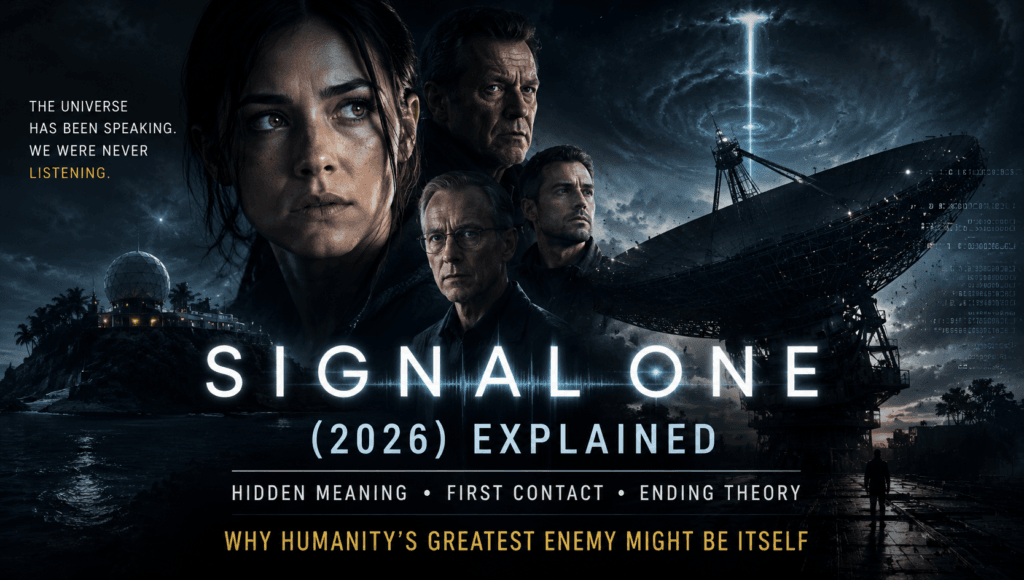
That unsettling premise forms the foundation of Signal One (2026), a thought-provoking science fiction thriller directed by Jonathan Sobol. Starring Isabelle Fuhrman, Dennis Quaid, David Thewlis, and Josh Hutcherson, the film moves away from traditional alien invasion spectacles and instead explores the ethics of communication, scientific ambition, and the dangers of knowledge without responsibility.
Unlike action-heavy extraterrestrial blockbusters, Signal One thrives on atmosphere, philosophical debate, and psychological tension. Every decision made by its characters raises larger questions about whether humanity is truly prepared for first contact and whether some discoveries should remain unknown. Signal One (2026) Explained
Editorial Note: This analysis is based on officially available information, promotional material, the released trailer, published reviews, and publicly confirmed details. Interpretations and fan theories are clearly identified as speculation rather than established fact.
What Is Signal One About?
At its core, Signal One is a story about curiosity colliding with consequence.
The narrative follows Dr. Annika Cask, an exceptionally gifted computer scientist whose groundbreaking work attracts the attention of billionaire entrepreneur Sam Houston. She is invited to a highly classified research facility located on a secluded Caribbean island, where a team of scientists believes they are on the verge of making history.
Leading the project is eccentric physicist Perry Glassner, whose revolutionary invention known as Littlemouth is designed to communicate with intelligent civilizations beyond Earth.
Initially, the mission appears simple:
Find proof that humanity is not alone.
However, the project gradually evolves into something far more dangerous when the team decides not only to listen—but to answer. Signal One (2026) Explained
That decision becomes the emotional and philosophical turning point of the entire story.
Plot Breakdown
Annika’s Journey Begins
Annika is introduced as more than a brilliant scientist. She represents humanity’s endless desire to understand the unknown.
Unlike stereotypical genius characters, she approaches problems with both logic and empathy. Published reviews suggest that personal tragedy shaped her worldview, making discovery not merely an academic pursuit but a deeply personal mission.
This emotional complexity makes her the audience’s anchor throughout the film.
The Secret Island Facility
The Caribbean research station immediately creates an atmosphere of isolation.
Separated from civilization and operating under strict secrecy, the scientists exist inside their own intellectual bubble.
The location itself becomes symbolic.
Just as the island is surrounded by an endless ocean, Earth itself drifts through an even greater cosmic ocean filled with unanswered questions.
Meeting Perry Glassner
Perry Glassner quickly establishes himself as one of the film’s most fascinating figures.
Brilliant yet unpredictable, he believes humanity’s greatest weakness is its inability to see beyond its own assumptions.
His philosophy can be summarized through one memorable analogy:
Searching for aliens without changing our methods is like scooping water from the ocean and concluding whales don’t exist because none appear in the bowl.
The comparison perfectly captures the film’s challenge to conventional thinking.
Littlemouth Explained
The mysterious machine called Littlemouth is arguably the film’s most important symbol.
On a technical level, it functions as a communication system intended to detect and interact with extraterrestrial intelligence.
On a symbolic level, however, its name carries a deeper meaning.
A “little mouth” suggests something small attempting to speak into an unimaginably vast universe.
Rather than representing power, it represents vulnerability.
Humanity isn’t shouting into space.
It’s whispering.
The Biggest Twist: Communication Changes Everything
Most science fiction stories revolve around discovering aliens.
Signal One proposes something entirely different.
The greatest risk isn’t finding another civilization.
It’s allowing another civilization to find us. Signal One (2026) Explained
When the project shifts from passive observation to active communication, every ethical question changes.
Listening carries relatively little danger.
Answering may alter humanity forever.
This idea mirrors ongoing real-world debates among scientists regarding Active SETI and whether broadcasting Earth’s existence could expose civilization to unknown risks.
Is Signal One Really About Aliens?
Perhaps not.
One compelling interpretation is that extraterrestrials merely serve as a narrative device.
The true subject is humanity itself.
Every conflict emerges because people disagree about responsibility.
Annika values caution.
Perry values understanding.
Sam values achievement.
The collision between these perspectives generates more tension than any alien creature could.
Hidden Meaning Behind the Title
Many viewers naturally assume “Signal One” refers to humanity receiving its first extraterrestrial message.
But another interpretation deserves consideration.
Signal One may actually represent humanity’s first outgoing transmission.
Instead of celebrating discovery, the title could symbolize commitment.
The moment humanity sends that first message, there is no undo button.
The decision permanently changes civilization’s relationship with the universe.
Although this interpretation is speculative, it aligns remarkably well with the themes presented throughout the trailer and official premise.
Ending Theory Explained
A Story About Choice
Without access to every scene, the available material suggests that the climax revolves less around defeating an enemy and more around making an irreversible decision.
Annika appears forced to weigh scientific advancement against existential risk.
The greatest victory may not involve making contact.
It may involve knowing when not to continue.
What If Nobody Is Evil?
One of the film’s most intriguing possibilities is that no external villain exists.
The aliens may be peaceful.
The technology may function perfectly.
The catastrophe could arise entirely from human arrogance.
If so, Signal One transforms into a cautionary tale where civilization becomes its own worst enemy.
Character Analysis
Dr. Annika Cask
Annika embodies responsible curiosity.
She believes knowledge matters but recognizes that wisdom must guide discovery.
Her greatest strength isn’t intelligence.
It’s restraint.
Unlike characters driven solely by ambition, she constantly questions whether humanity deserves every answer it seeks.
Perry Glassner
Perry is simultaneously visionary and deeply cynical.
His speeches criticize humanity’s environmental destruction, violence, and inability to cooperate.
Ironically, despite distrusting people, he dedicates his life to expanding human understanding.
He represents the contradiction between pessimism and hope.
Sam Houston
Sam symbolizes the modern billionaire innovator.
His willingness to finance impossible ideas demonstrates optimism, yet his confidence raises uncomfortable questions about concentrated power.
Should private individuals control discoveries capable of affecting the entire species?
The film quietly invites audiences to consider that issue.
Charlie Kaminsky
Charlie serves as an emotional balance.
Where Annika analyzes, and Perry theorizes, Charlie reacts like an ordinary person confronted with extraordinary events.
His perspective grounds the audience throughout the narrative. Signal One (2026) Explained
https://movieexplainedhub.com/signal-one-2026-littlemouth-mystery-explained/
https://movieexplainedhub.com/masters-of-the-universe-2026-guide/
https://movieexplainedhub.com/signal-one-2026-explained/
https://movieexplainedhub.com/jonathan-sobols-vision-for-signal-one/
Jonathan Sobol’s Direction
Jonathan Sobol avoids spectacle in favor of atmosphere.
Rather than overwhelming viewers with visual effects, he creates suspense through uncertainty.
Long conversations become more important than explosions.
Close-up shots emphasize emotional conflict.
Silence becomes as powerful as dialogue.
This restrained approach places Signal One closer to films like Arrival, Contact, and Ex Machina than traditional alien invasion stories.
Cinematography Analysis
The isolated island functions almost like another character.
Wide landscape shots reinforce humanity’s insignificance against nature.
Interior laboratories contrast cold technology with emotional vulnerability.
Lighting frequently shifts between bright scientific environments and shadow-filled corridors, reflecting the tension between knowledge and uncertainty.
These visual choices subtly reinforce the film’s philosophical themes.
Sound Design
One overlooked strength appears to be the careful use of silence.
Rather than relying on loud orchestral cues, quiet moments encourage audiences to focus on tiny details.
Every electronic pulse, radio frequency, and mechanical vibration becomes significant.
In a film about listening, sound itself becomes storytelling.
Real Science Behind Signal One
SETI
The Search for Extraterrestrial Intelligence has spent decades scanning the skies for artificial signals.
Unlike fictional portrayals, scientists generally listen rather than transmit.
Signal One imagines the consequences of changing that policy.
Active SETI
Some researchers argue humanity should deliberately announce its presence.
Others warn this could expose Earth to unknown civilizations.
The film dramatizes that exact debate.
The Fermi Paradox
If intelligent life should be common, why hasn’t humanity found evidence?
Signal One offers a fascinating possibility:
Perhaps evidence surrounds us constantly, but our methods of detection are fundamentally flawed.
Artificial Intelligence
Machine learning increasingly helps scientists identify unusual astronomical patterns.
The film extends this concept by imagining AI becoming humanity’s translator for civilizations operating beyond normal human comprehension.Signal One (2026) Explained
Themes and Symbolism
Curiosity vs. Responsibility
Knowledge always carries consequences.
The film asks whether scientific progress should ever have limits.
Isolation
The island mirrors Earth’s own cosmic loneliness.
Both are tiny points surrounded by overwhelming emptiness.
Communication
The greatest challenge isn’t transmitting information.
It’s understanding what another intelligence actually means.
Technology
Machines expand possibilities but cannot replace moral judgment.
Human wisdom remains the deciding factor.
Fan Theory: Humanity Was Being Observed All Along
Interpretation Only
One fascinating possibility is that extraterrestrials never needed humanity to find them.
Instead, they patiently observed while waiting for civilization to reach technological maturity.
In this reading, the first transmission isn’t humanity discovering aliens.
It’s humanity proving itself ready to join a larger conversation.
Easter Eggs and Hidden Details
- The name “Littlemouth” may symbolize humanity’s tiny voice in an incomprehensibly large universe.
- The isolated island reflects Earth’s own position within the cosmos.
- Perry’s whale analogy foreshadows the limitations of human perception.
- The repeated emphasis on communication suggests misunderstanding, not hostility, may be the greatest danger.
- Scientific instruments occupy the center of many shots, reinforcing the tension between observation and intervention.
Why Signal One Feels Different
Most alien movies answer questions.
Signal One raises better ones.
Instead of asking whether extraterrestrials exist, it asks:
- Are humans emotionally prepared?
- Who should control discovery?
- Should we announce ourselves?
- Can intelligence exist without wisdom?
- Is silence actually safer?
Those philosophical questions give the story a lasting impact.
Final Verdict
Signal One succeeds because it transforms first contact into a moral dilemma rather than an action spectacle.
Its greatest strength lies in shifting attention away from aliens and toward humanity’s own choices.
Whether viewed as a science-fiction thriller, philosophical drama, or cautionary tale about technological ambition, the film encourages audiences to reconsider what discovery truly means.
Perhaps the most unsettling idea isn’t that someone might answer humanity’s call.
It’s that the universe has been speaking all along—and we’re only now beginning to learn how to listen.
Frequently Asked Questions
Is Signal One based on a true story?
No. The film is fictional but draws inspiration from real scientific discussions surrounding SETI, radio astronomy, and extraterrestrial communication.
What is Littlemouth?
Littlemouth is the experimental communication system designed to establish contact with intelligent life beyond Earth.
What does the title “Signal One” mean?
While never explicitly confirmed, it may refer either to humanity’s first received signal or its first transmitted message to another civilization.
Is the movie about aliens or humanity?
Both. On the surface, it explores extraterrestrial communication, but beneath that it examines ethics, ambition, and responsibility.
Does the movie suggest humans should contact aliens?
Rather than providing an answer, it invites audiences to debate whether making contact is worth the potential consequences.
About the Author
Lokesh Dhanure is the founder and editor of Movie Explained Hub, where he specializes in analyzing movie endings, symbolism, hidden meanings, fan theories, and cinematic storytelling. His goal is to bridge entertainment with real-world science, philosophy, and narrative analysis, helping readers discover deeper layers beneath every story.