
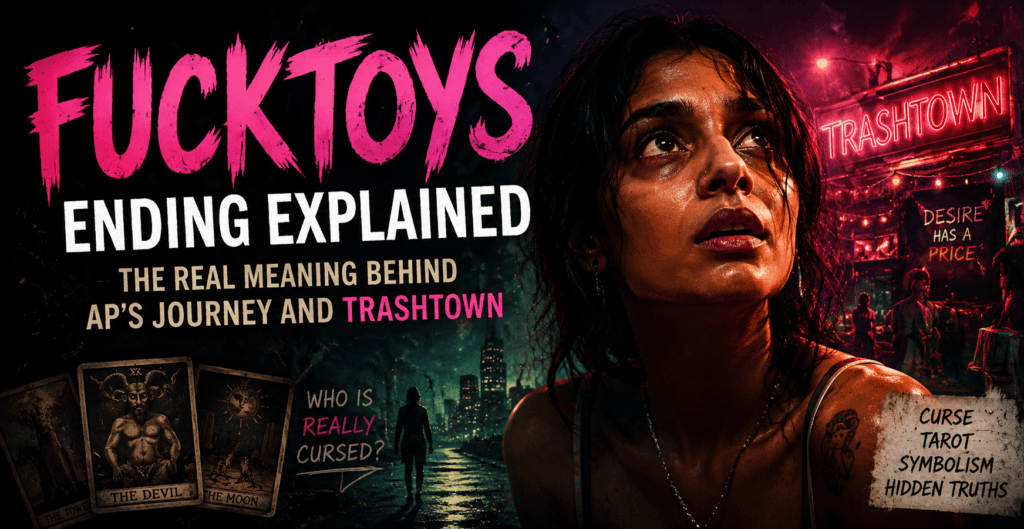
Fucktoys Ending Explained (Quick Answer)
Quick Answer: The ending of Fucktoys suggests that AP’s curse may never have been real. Instead, the film uses the curse as a metaphor for insecurity, loneliness, and the human desire to find meaning in suffering. Whether the ritual succeeds is less important than the emotional transformation AP experiences throughout her journey. The movie ultimately explores how people seek hope, purpose, and redemption in a world where nearly everything has become transactional.
A Movie That Looks Like Chaos but Feels Surprisingly Human
The easiest way to misunderstand Fucktoys is to judge it by its title.
The second easiest way is to watch the first fifteen minutes and assume you already know what kind of movie it is.
On the surface, Annapurna Sriram’s directorial debut appears to be a neon-colored sex comedy filled with bizarre characters, outrageous situations, and grindhouse energy.
And to be fair, some of that description is accurate.
There are psychics.
There are hustlers.
There are eccentric clients.
There are absurd encounters that feel pulled from a fever dream.
But underneath all of that is a surprisingly emotional story about survival.
The deeper the film goes, the less interested it becomes in shock value and the more interested it becomes in loneliness, self-worth, and the stories people tell themselves in order to keep moving forward.
Personally, I think that’s what makes Fucktoys work.
Many filmmakers can create strange worlds.
Very few can create strange worlds that still feel emotionally recognizable.
AP’s journey through Trashtown may look surreal, but the emotions driving her are painfully real.
Who hasn’t wanted someone to tell them that all their problems have a solution?
Who hasn’t searched for meaning during a difficult period of life?
Those questions sit at the heart of the film.
And that’s why the movie has stayed with so many viewers long after the credits roll.
SXSW Buzz: Why Everyone Was Talking About Fucktoys
[IMAGE: SXSW Premiere Photo]
When Fucktoys premiered at the 2025 SXSW Film Festival, it quickly became one of the most discussed films at the event.
Part of the attention came from the title alone.
Let’s be honest—any movie called Fucktoys is going to generate curiosity.
But curiosity only gets people through the door.
The reason people kept talking about it afterward was that the movie turned out to be far more ambitious than expected.
Sriram didn’t just write the film.
She directed it.
Produced it.
And starred in it.
That creative control gives the movie a very specific voice.
Whether audiences loved or hated it, most agreed that it didn’t feel like anything else playing at the festival.
Some critics praised its originality and visual style.
Others found its structure messy and intentionally chaotic.
Interestingly, both groups were often describing the same qualities.
The difference was whether they saw those qualities as flaws or strengths.
I suspect that split reaction is exactly what cult movies need.
Cult classics rarely arrive with universal praise.
They arrive with strong opinions.
And Fucktoys generates plenty of those.
Cast and Character Guide
One reason the movie feels so alive is its memorable cast.
Annapurna Sriram as AP
AP is the emotional center of the film.
She is funny, vulnerable, impulsive, optimistic, and occasionally frustrating.
What makes her compelling is that she never fully becomes a victim or a hero.
She exists somewhere in between.
She makes mistakes.
She believes questionable people.
She continues moving forward even when logic suggests she should stop.
That combination makes her feel genuinely human.
Sadie Scott as Danni
Danni functions as one of the film’s most important supporting characters.
She understands the world AP is navigating because she is trapped inside the same system.
Their interactions provide some of the movie’s most grounded moments.
In a world filled with performances, Danni often feels refreshingly honest.
Big Freedia as The Psychic
The Psychic serves as the catalyst for the entire story.
Without the prophecy, there is no journey.
Without the curse, there is no mission.
Whether the character is a spiritual guide or a manipulative hustler becomes one of the movie’s biggest questions.
Brandon Flynn as James Francone
James Francone represents a different side of Trashtown.
He exists within the world of performance, status, and image.
Several of his scenes highlight the strange power dynamics that define the movie’s universe.
François Arnaud and Supporting Players
Many supporting characters appear briefly but leave lasting impressions.
That’s one of the film’s strengths.
Even minor figures often feel like they have entire lives beyond the scenes we see.
The result is a world that feels larger than the actual runtime.
What Is Trashtown?
[IMAGE: AP Riding Through Trashtown]
Before discussing the plot, it’s important to understand Trashtown itself.
Trashtown isn’t just a location.
It’s arguably the movie’s most important character.
The city exists somewhere between fantasy and reality.
It feels familiar enough to recognize but strange enough to seem disconnected from normal life.
Neon signs glow against rundown environments.
Old technology coexists with newer aesthetics.
Everything appears slightly out of place.
At first, I thought the production design was simply trying to create a weird atmosphere.
The more I thought about it, the more intentional it seemed.
Trashtown feels like a city built from discarded dreams.
People aren’t just struggling financially.
They’re struggling emotionally.
Nearly everyone is searching for something.
Money.
Love.
Validation.
Escape.
Purpose.
And because everyone is searching, everyone is vulnerable to manipulation.
That’s where the movie’s social commentary begins.
Fucktoys Plot Explained
The Curse That Starts Everything
The story begins when AP visits a psychic.
During the reading, she learns something that immediately changes the course of her life.
According to the psychic, AP is cursed.
The only way to remove that curse is through a ritual involving a baby lamb and a significant amount of money.
The price is beyond what AP can comfortably afford.
Most people would probably question the prophecy.
AP doesn’t.
Instead, she accepts the challenge and begins searching for a way to raise the money.
That decision drives the entire movie.
AP’s Journey Through Trashtown
As AP moves through the city, she encounters a series of increasingly strange people and situations.
Some offer opportunities.
Others create obstacles.
Many seem eager to profit from her desperation.
What’s fascinating is how often AP encounters people who claim to have answers.
The psychic claims to understand fate.
Clients claim to understand desire.
Artists claim to understand truth.
Yet almost everyone expects payment in return.
The movie repeatedly asks an uncomfortable question:
What happens when hope itself becomes a product?
That’s where Fucktoys becomes more than a simple road movie.
It becomes a critique of systems that monetize vulnerability.
Why AP Keeps Believing
One of the smartest choices in the film is that it never portrays AP as foolish.
She’s not stupid.
She’s desperate.
Those are very different things.
There’s a scene early in the story where AP seems genuinely convinced that lifting the curse will solve everything.
And honestly, that’s understandable.
When life feels overwhelming, people often search for a single explanation.
A single cause.
A single solution.
The curse provides exactly that.
Instead of confronting countless complicated problems, AP can focus on one objective.
Raise the money.
Complete the ritual.
Fix her life.
The simplicity of that goal becomes incredibly seductive.
And that’s what makes her journey so emotionally engaging.
Why the Movie Feels Bigger Than Its Plot
On paper, the story is relatively simple.
A woman believes she’s cursed and tries to gather enough money to break that curse.
That’s the plot.
But the movie uses that simple structure to explore much larger ideas.
It explores:
- belief
- loneliness
- economic survival
- identity
- performance
- self-worth
By the midpoint, the curse almost becomes secondary.
The real story is about how people navigate a world where every relationship seems transactional.
And that’s where the film begins revealing its deeper themes.
Fucktoys Ending Explained: The Real Meaning Behind AP’s Journey
The Ending Isn’t About the Curse
If there’s one thing viewers should understand about the ending of Fucktoys, it’s this:
The movie is not actually asking whether the curse is real.
It’s asking why AP needs the curse to be real.
That’s a subtle but important distinction.
By the final act, AP has spent nearly the entire movie chasing a solution to a problem she cannot prove exists.
She’s traveled across Trashtown.
She’s met strangers.
She’s accepted jobs.
She’s endured humiliation.
She’s sacrificed time, energy, dignity, and emotional stability.
All for the promise that a ritual might finally change her life.
When you step back, the question becomes uncomfortable:
Would AP’s life really be different if the curse disappeared?
Or would the same problems still exist?
The film never provides a clear answer.
And that’s exactly what makes the ending effective.
Why the Ending Feels So Emotional
Many movies build toward a physical goal.
A treasure.
A victory.
An escape.
A final confrontation.
Fucktoys builds toward something much more abstract.
Hope.
AP desperately wants to believe that her suffering has a cause.
Because if suffering has a cause, then maybe it also has a solution.
That idea becomes increasingly heartbreaking as the movie progresses.
The deeper I looked, the more tragic AP’s situation became.
She isn’t simply chasing money.
She’s chasing certainty.
She’s chasing reassurance.
She’s chasing the promise that her struggles are temporary.
In many ways, that’s one of the most relatable aspects of the entire movie.
Most people have experienced moments where they wanted life to make sense.
AP simply takes that desire to an extreme.
The Baby Lamb Symbolism Explained
[IMAGE: Baby Lamb Symbolism Graphic]
The lamb may be the single most important symbol in the entire film.
At a literal level, it’s part of the ritual needed to remove AP’s curse.
But symbolically, it carries much deeper meaning.
Interpretation 1: Innocence
Traditionally, lambs represent innocence.
Throughout the film, AP maintains a surprising amount of optimism despite her circumstances.
She continues trusting people.
She continues believing things can improve.
She continues hoping.
The lamb may represent innocence.
The ritual then becomes a question:
What must AP sacrifice in order to survive?
Interpretation 2: Redemption
Lamb imagery has strong religious associations.
In many traditions, lambs symbolize sacrifice and redemption.
Viewed through that lens, AP’s quest becomes almost spiritual.
She’s searching for salvation.
Not necessarily from a supernatural curse.
But from disappointment, instability, and emotional exhaustion.
Interpretation 3: The Cost of Hope
My favorite interpretation is simpler.
The lamb represents the price of hope.
Every step of AP’s journey involves paying for belief.
She pays emotionally.
She pays financially.
She pays psychologically.
The lamb becomes the final expression of that transaction.
Nothing in Trashtown is free.
Not even redemption.
Did The Curse Ever Exist?
This is the question most viewers ask after the credits roll.
The film deliberately refuses to answer it.
Let’s explore the possibilities.
Theory 1: The Curse Never Existed
Personally, I think this is the strongest interpretation.
Throughout the movie, AP repeatedly encounters people selling solutions.
The psychic sells spiritual guidance.
Clients sell fantasies.
Artists sell meaning.
Everyone claims to have answers.
Everyone wants something in return.
Seen through this lens, the curse is simply another product.
A problem was invented to create demand for a solution.
The tragedy is not that AP is cursed.
The tragedy is that she’s vulnerable enough to believe she is.
Theory 2: The Curse Represents Anxiety
Another interpretation views the curse as psychological rather than supernatural.
AP carries enormous emotional weight throughout the film.
Financial stress.
Relationship struggles.
Loneliness.
Uncertainty.
Instead of confronting these issues individually, the curse allows her to combine them into a single explanation.
Everything becomes a curse.
Everything becomes connected.
This makes her world easier to understand.
The ritual provides something anxiety often craves:
Control.
Theory 3: The Curse Is Real
The film also leaves room for a supernatural reading.
Tarot symbolism appears constantly.
Coincidences feel meaningful.
Certain encounters seem almost guided by fate.
If you accept the movie’s mystical framework, it’s possible that AP truly is trapped within a spiritual cycle.
What’s fascinating is that the film never mocks this possibility.
It treats belief seriously.
Even when it questions it.
AP’s Emotional Transformation
The most important change isn’t external.
It’s internal.
At the beginning of the movie, AP believes solutions exist outside herself.
The psychic has answers.
The ritual has answers.
The money has answers.
Someone else always seems to possess the key.
By the end, that certainty begins to crack.
Whether the curse disappears or not becomes less important.
The real transformation is AP’s relationship with herself.
She begins the movie searching for permission to feel worthy.
She ends it understanding that worth cannot be purchased.
That’s what makes the ending unexpectedly moving.
The Hidden Meaning of the Final Act
One reason the ending remains memorable is that it refuses traditional catharsis.
Hollywood often rewards protagonists with clear victories.
Fucktoys doesn’t.
Instead, it leaves viewers in a space between resolution and uncertainty.
Some audience members find that frustrating.
I understand why.
But I think the ambiguity is essential.
Life rarely provides perfect answers.
People often move forward without knowing whether they made the correct choice.
AP’s ending reflects that reality.
The uncertainty isn’t a flaw.
It’s the point.
Why the Finale Divides Audiences
The finale has become one of the movie’s most debated elements.
Viewers who wanted clear explanations sometimes leave disappointed.
Viewers interested in symbolism and emotional interpretation often love it.
That divide comes from expectations.
If you watch Fucktoys as a mystery, the ending may feel incomplete.
If you watch it as a character study, the ending feels much richer.
The movie ultimately cares less about solving a puzzle and more about understanding a person.
The Four Biggest Fucktoys Theories
Theory 1: The Curse Was A Scam
The psychic knowingly manipulated AP.
Everything that follows stems from that deception.
This theory transforms the movie into a critique of industries that profit from insecurity.
Theory 2: The Entire Movie Is A Tarot Journey
AP’s adventure mirrors the Fool’s Journey found in tarot symbolism.
Each encounter represents a lesson.
Each character reflects a card.
Each setback becomes part of a larger cycle of growth.
This theory connects many of the film’s recurring visual motifs.
Theory 3: Every Major Character Is An Archetype
The Psychic = High Priestess
AP = The Fool
Danni = The Lovers
James Francone = The Devil
Maternal Figures = The Empress
Viewed this way, the film functions almost like a living tarot deck.
Theory 4: Trashtown Isn’t A Real Place
This remains my favorite interpretation.
Trashtown feels too dreamlike to function as a conventional city.
Time seems distorted.
Reality feels flexible.
Characters appear and disappear with an unusual rhythm.
Perhaps Trashtown is less a location and more an emotional landscape.
A physical representation of instability, loneliness, and survival.
That reading explains why the setting feels simultaneously real and unreal.
My Personal Take On The Ending
Honestly, I don’t think the movie is interested in proving whether magic exists.
I think it’s interesting to explore why people need magic.
Not literal magic.
The emotional kind.
The belief that life can change.
The belief that suffering has meaning.
The belief that tomorrow might be different from today.
AP’s journey works because it understands that hope can be both beautiful and dangerous.
Hope keeps her moving.
Hope also makes her vulnerable.
That tension powers the entire film.
And it’s why the ending lingers long after the credits finish rolling.
Tarot Symbolism, Trashtown Explained, Hidden Details & Final Verdict
Tarot Symbolism Explained
One of the reasons Fucktoys rewards repeat viewings is its extensive use of tarot symbolism.
You don’t need to understand tarot to follow the story.
However, once you begin noticing the patterns, the movie becomes even more interesting.
Personally, I think the tarot elements are less about predicting the future and more about understanding AP’s emotional state.
The cards become a language for explaining her journey.
The Fool: AP’s Entire Story
The Fool is arguably the most important tarot card in the film.
Traditionally, The Fool represents:
- new beginnings
- innocence
- risk
- faith
- uncertainty
That description perfectly fits AP.
She begins the movie believing a stranger’s prophecy.
She sets out on a journey without fully understanding where it will lead.
She repeatedly takes risks.
She repeatedly trusts people.
She repeatedly moves forward despite uncertainty.
Many viewers interpret The Fool as stupidity.
That’s not what the card means.
The Fool represents courage.
The willingness to step into the unknown.
AP embodies that energy throughout the film.
The Empress: Feminine Power In Trashtown
Traditional tarot often connects The Empress with fertility, creativity, and abundance.
Fucktoys presents a more complicated version.
The women in Trashtown are survivors.
They’re resourceful.
They’re vulnerable.
They’re powerful.
But their power exists inside systems that constantly try to exploit them.
That complexity makes the symbolism feel modern rather than traditional.
Death: Transformation Rather Than Endings
One of the biggest misconceptions about tarot is that the Death card represents literal death.
Usually, it represents transformation.
That’s exactly how the movie uses it.
Throughout AP’s journey, pieces of her worldview begin to disappear.
By the end of the story, she’s not the same person she was at the beginning.
The old version of AP dies.
A new version emerges.
The Lovers: Intimacy vs Transaction
The Lovers card becomes especially interesting inside a film centered around sex work.
Most movies would treat intimacy and commerce as opposites.
Fucktoys isn’t that simple.
The film repeatedly asks:
Can genuine connection exist inside transactional systems?
Can people still care for one another when money is involved?
The movie never provides easy answers.
That’s what makes the question powerful.
The Wheel of Fortune: Why Nobody Escapes Easily
The Wheel of Fortune may be the film’s most depressing symbol. Fucktoys Ending Explained
Characters seem trapped inside repeating cycles.
Financial cycles.
Relationship cycles.
Emotional cycles.
Hope.
Disappointment.
Hope again.
The wheel keeps turning.
The question becomes whether AP can finally step off it. Fucktoys Ending Explained
Trashtown Explained
[IMAGE: AP Riding Through Trashtown]
Trashtown isn’t just where the story happens.
Trashtown is what the story is about.
At first glance, it looks like a bizarre grindhouse playground.
Neon lights.
Eccentric personalities.
Absurd situations.
But beneath the surface is a surprisingly sharp critique of modern life.
A City Built On Transactions
Almost every interaction in Trashtown involves exchange.
Money.
Attention.
Sex.
Validation.
Status.
Nothing feels entirely free.
Even kindness often seems connected to some hidden expectation.
That’s why the setting feels so uncomfortable.
It exaggerates realities that already exist.
The Capitalism Interpretation
One of the strongest readings of the movie is that Trashtown represents late-stage capitalism.
People constantly perform versions of themselves. Fucktoys Ending Explained
Everyone is trying to survive.
Everyone is selling something.
The city becomes a distorted mirror of real-world economic anxiety.
The film doesn’t preach.
It simply presents a world where everything feels monetized.
The result is surprisingly effective.
My Favorite Theory
Personally, I think Trashtown functions as both a real location and an emotional state.
The city feels like a physical representation of:
- debt
- loneliness
- insecurity
- instability
- longing
That’s why it feels dreamlike.
It’s less concerned with realism than emotional truth.
Scene Breakdown: The Most Important Moments
The Psychic Scene
This scene changes everything.
Without it, AP’s journey never begins.
What’s fascinating is how the movie presents the psychic.
The character feels both trustworthy and suspicious at the same time.
That ambiguity becomes the foundation of the entire story.
The audience is never fully sure whether to believe them.
Neither is AP.
The Moped Sequences
Initially, the moped scenes feel playful. Fucktoys Ending Explained
Almost carefree.
But their meaning changes over time.
One of the most interesting aspects of these sequences is how often AP is moving without actually arriving anywhere emotionally.
The city changes.
The scenery changes.
The people change.
Yet her internal struggles remain.
The movement becomes symbolic.
The more she rides, the more trapped she appears.
AP And Danni’s Conversations
These scenes provide some of the movie’s strongest emotional grounding.
In a world full of exaggerated personalities, their interactions often feel the most authentic.
They remind viewers that beneath the surrealism are real people trying to survive.
The Final Ritual
The final ritual transforms the movie.
By this point, viewers are no longer focused solely on whether the curse exists.
Instead, the central question becomes:
Why did AP need to believe in it?
That shift elevates the ending from a plot resolution into a character study.
Hidden Details And Easter Eggs
The film contains numerous recurring visual motifs.
Lamb Imagery
The lamb appears as both a literal object and symbolic idea.
It may represent:
- innocence
- sacrifice
- redemption
- hope
Circular Visual Patterns
Several scenes emphasize circles and cycles.
This connects directly to Wheel of Fortune symbolism.
Characters appear trapped inside repeating patterns.
Color Symbolism
Bright neon colors often contrast with emotional despair.
The visual design creates tension between appearance and reality.
Things look exciting.
They rarely feel stable.
The Unicorn Moped
One interpretation is that AP’s unicorn-decorated moped represents her refusal to surrender optimism.
Even in difficult circumstances, she continues believing things can improve.
That optimism may be naïve.
But it’s also admirable.
Cinematic Analysis
Super 16mm Cinematography
One of the film’s greatest strengths is its visual texture. Fucktoys Ending Explained
The grainy Super 16mm format gives the world physicality.
Everything feels tangible.
Sweaty.
Messy.
Alive.
A cleaner digital presentation might have weakened the atmosphere.
Grindhouse Influences
The influence of cult cinema is impossible to ignore.
Elements of:
- John Waters
- Gregg Araki
- underground exploitation cinema
all appear throughout the movie.
Yet Fucktoys never feels like imitation.
It feels like a modern reinterpretation.
Camp With Emotional Weight
Many films successfully achieve camp. Fucktoys Ending Explained
Fewer manage to combine camp with genuine emotional resonance.
That’s where Fucktoys stands out.
The movie is funny.
Absurd.
Provocative.
Yet surprisingly sincere.
Why Critics Are Praising Fucktoys
[IMAGE: Critical Reception Graphic]
Many critics praised:
- Annapurna Sriram’s performance
- originality
- visual style
- worldbuilding
- emotional honesty
The film’s SXSW recognition helped establish it as one of the breakout indie titles of 2025.
Even critics who disliked aspects of the narrative often admired its ambition.
That’s usually a sign of an interesting movie.
Movies Like Fucktoys
If you enjoyed Fucktoys, consider watching: Fucktoys Ending Explained
- Tangerine
- After Hours
- Good Time
- Pink Flamingos
Each explores chaotic journeys, outsider characters, or surreal urban environments in different ways.
Frequently Asked Questions
What does the ending of Fucktoys mean?
The ending suggests that the curse may symbolize insecurity, anxiety, and the search for meaning rather than a literal supernatural affliction.
Is the curse real?
The movie intentionally leaves this ambiguous.
Both psychological and supernatural interpretations are possible.
Why is the movie called Fucktoys?
The title reflects how people become commodities within transactional systems.
It connects directly to the film’s themes of labor, identity, and exploitation.
What does Trashtown represent?
Trashtown may represent modern capitalism, emotional instability, and survival culture.
What do the tarot cards symbolize?
They mirror AP’s emotional and spiritual journey throughout the film.
Is there a sequel planned?
No official sequel has been announced. Fucktoys Ending Explained
ALSO READ:- https://movieexplainedhub.com/dust-bunny-movie-explained/
ALSO READ:- https://movieexplainedhub.com/godzilla-x-kong-supernova-explained/
ALSO READ:- https://movieexplainedhub.com/spacegodzilla-explained/
ALSO READ:- https://movieexplainedhub.com/remarkably-bright-creatures-netflix-movie/
ALSO READ: –https://movieexplainedhub.com/person-of-interest-explained/
ALSO READ:- https://movieexplainedhub.com/kongs-axe-explained-monsterverse-secrets/
ALSO READ:- https://movieexplainedhub.com/mortal-kombat-2-ending-explained/
ALSO READ:- https://movieexplainedhub.com/upcoming-american-movies-september-2026/
ALSO READ:- https://movieexplainedhub.com/resident-evil-reboot-explained/
ALSO READ:- https://movieexplainedhub.com/upcoming-american-movies-september-2026/
ALSO READ:- https://movieexplainedhub.com/the-sheep-detectives-netflix-mystery/
ALSO READ:- https://movieexplainedhub.com/takeover-explained-may-2026/
ALSO READ:- https://movieexplainedhub.com/swapped-ending-explained/
ALSO READ:- https://movieexplainedhub.com/couples-weekend-hidden-secrets/
ALSO READ:-https://movieexplainedhub.com/obsession-movie-hidden-horror-themes/
ALSO READ:- https://movieexplainedhub.com/something-very-bad-is-going-to-happen-ending-explained/
ALSO READ:- https://movieexplainedhub.com/greenland-migration-ending-explained/
ALSO READ:- http://movieexplainedhub.com/takeover-ending-explained/
ALSO READ:- https://movieexplainedhub.com/takeover-2026-cast/
ALSO READ:- https://movieexplainedhub.com/war-machine-ending-explained/
ALSO READ:- https://movieexplainedhub.com/war-machine-cast-and-filming-locations/
ALSO READ:- https://movieexplainedhub.com/fatherland-2026-release-date-production-details/
ALO READ:- https://movieexplainedhub.com/couples-weekend-hidden-emotional-meaning-explained/
ALO READ:- https://movieexplainedhub.com/influenced-hidden-emotional-meaning-explained/
ALSO READ:- https://movieexplainedhub.com/obsession-underrated-horror-film/
ALSO READ:- https://movieexplainedhub.com/in-the-grey-hidden-meaning-guy-ritchie/
ALSO READ:-https://movieexplainedhub.com/the-sheep-detectives-ending-explained/
ALSO READ:- https://movieexplainedhub.com/fatherland-ending-explained/
ALSO READ:-https://movieexplainedhub.com/in-the-grey-ending-explained/
ALSO READ:-https://movieexplainedhub.com/ladies-first-ending-explained/
ALSO READ:- https://movieexplainedhub.com/office-romance-cast-and-character-guide/
ALSO READ:-https://movieexplainedhub.com/backrooms-cast-and-character-guide/
ALSO READ:-https://movieexplainedhub.com/the-breadwinner-2026-trailer-breakdown-ending-predictions/
ALSO READ:- https://movieexplainedhub.com/speed-demon-2026-trailer-breakdown/
ALSO READ:-https://movieexplainedhub.com/backrooms-ending-explained/.
Final Verdict
Is Fucktoys Worth Watching?
Absolutely—if you’re willing to embrace ambiguity. Fucktoys Ending Explained
Viewers expecting a straightforward narrative may find the film frustrating.
Viewers interested in symbolism, character studies, and unconventional storytelling will likely find much more to appreciate.
Personally, I think the movie works best when it stops trying to shock audiences and starts examining AP’s loneliness.
That’s where Annapurna Sriram’s voice becomes strongest.
That’s where the film becomes genuinely moving.
And that’s why the movie has already started building the kind of passionate fanbase that many cult classics enjoy.
In the end, Fucktoys Ending Explained isn’t really about solving a mystery.
It’s about understanding a person.
A woman searching for answers.
A city built on transactions.
A world where hope can be both empowering and dangerous.
Whether the curse was real almost doesn’t matter.
What matters is that AP believed it was.
And sometimes, belief can change a life just as much as truth.