
Most disaster movies try to overwhelm audiences with destruction. Greenland: Migration Ending Explained.
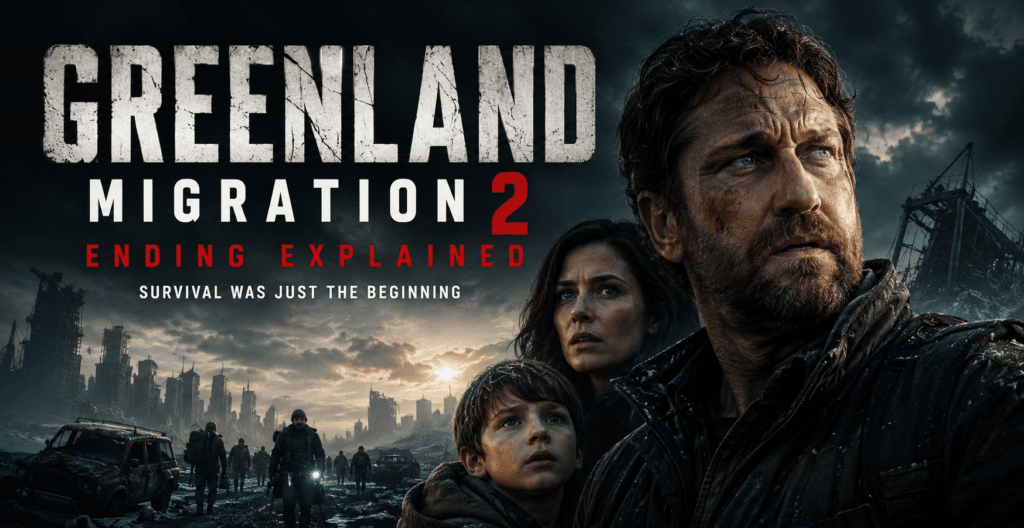
Greenland: Migration becomes much more unsettling after the destruction finally stops.
That’s what surprised me most about the sequel.
The original Greenland was built around panic, collapsing cities, and survival against impossible odds. But Migration takes a very different approach. Instead of asking whether humanity can survive extinction, the sequel asks something quieter and honestly more uncomfortable:
What happens after survival?
Because surviving the end of the world doesn’t automatically mean people know how to rebuild one.
And that emotional shift gives the movie a surprisingly heavy atmosphere at times.
From the opening scenes, the Garrity family no longer feels like people escaping disaster. They feel exhausted. Older. More emotionally fragile. The world outside the shelters may still exist, but it no longer feels familiar or stable.
That lingering tension becomes the movie’s strongest quality.
According to early release information and studio details, Greenland: Migration continues the story of John Garrity and his family after the comet extinction event from the first film, following survivors attempting to migrate across a devastated planet in search of long-term safety.
Why Audiences Are Still Talking About Greenland 2
Released in early 2026, Greenland: Migration brought back Gerard Butler as John Garrity alongside Morena Baccarin and Roger Dale Floyd returning as Allison and Nathan Garrity.
The sequel was directed by Ric Roman Waugh, who also directed the first movie, with a screenplay continuing the grounded survival tone that made the original unexpectedly successful.
Real Production Details
- Director: Ric Roman Waugh
- Lead Cast: Gerard Butler, Morena Baccarin, Roger Dale Floyd
- Genre: Post-apocalyptic survival thriller
- Release Date: January 2026
- Estimated Budget: Around $80–100 million reported across industry discussions
- Distributor: Lionsgate / international distributors
- Streaming & VOD: Expanded heavily after theatrical release
Unlike many modern disaster sequels, the movie avoids becoming a nonstop action spectacle.
Honestly, I expected a louder movie.
Instead, large sections feel strangely quiet and reflective, especially during scenes inside underground shelters and migration camps. That slower pacing will probably divide audiences. Some viewers wanted another high-adrenaline survival thriller like the first film.
Personally, I think the quieter approach mostly works.
The movie feels closer to:
- The Road
- Children of Men
- Leave the World Behind
than a traditional blockbuster disaster sequel.
And honestly, that surprised me in a good way.
Atmosphere & Cinematic Analysis — Why the Movie Feels So Heavy
One thing the sequel does extremely well is atmosphere. Greenland: Migration Ending Explained
The world in Migration doesn’t feel “cinematically destroyed.” It feels abandoned.
There’s a difference.
Cities aren’t exploding constantly anymore. Instead:
- buildings sit frozen and empty
- Highways remain abandoned for miles.
- emergency broadcasts echo through silent shelters
- survivors speak quietly, like they’re afraid hope itself might disappear
The sound design deserves a lot of credit.
Several bunker scenes barely use music at all. You mostly hear:
- ventilation systems
- distant footsteps
- radio static
- coughing
- metal doors shutting
That silence often feels heavier than the actual dialogue.
The lighting also changes significantly compared to the first movie. The original Greenland used fiery destruction and orange skies constantly. Migration replaces that with:
- pale gray snowstorms
- dim underground lighting
- cold blue interiors
- weak natural sunlight
The visual style constantly reinforces the idea that humanity survived physically but still feels emotionally lost.
Act 1 Breakdown — Life After Survival
The opening act immediately shows how different the world has become.
John Garrity and his family are no longer simply trying to stay alive. Now they’re trying to figure out whether civilization itself can realistically recover.
That uncertainty hangs over almost every conversation.
One early sequence that really stood out to me involves Nathan quietly asking whether schools still exist anywhere outside the shelters. Nobody answers him immediately.
It’s a small moment, but it says a lot about the emotional state of the survivors.
The movie keeps returning to one uncomfortable idea:
Survival without stability still feels terrifying.
Hidden Details & Symbolism
- Family photographs repeatedly appear damaged or partially burned.
- Emergency radios constantly interrupt emotional conversations.
- Snow covers destroyed cities, almost like mass graves.
- Underground lighting creates a prison-like atmosphere.
The pacing during the first act is intentionally slow. I do think a few scenes linger slightly too long inside the shelters, but the slower setup helps the emotional tension later feel more believable.
Act 2 Breakdown — Humanity Starts Turning Against Itself
The middle section shifts from environmental survival to social survival. Greenland: Migration Ending Explained
And honestly, this is where the movie becomes much darker than I expected.
Food shortages, migration disagreements, and military-controlled checkpoints gradually create tension between survivor groups. The world doesn’t collapse because of another comet.
It collapses because people stop trusting one another.
One convoy sequence in particular feels incredibly tense despite containing almost no action. Survivors argue quietly over resource distribution while armed guards watch everybody suspiciously.
Nobody screams.
Nobody fights.
But the atmosphere feels ready to explode.
That restraint makes the tension work much better.
I do think the convoy section drags slightly in the middle, especially during some repetitive checkpoint scenes. Still, the emotional payoff later justifies most of it.
Character Analysis — Why the Garrity Family Still Works
John Garrity — Survival Guilt Everywhere
Gerard Butler gives a more restrained performance this time. Greenland: Migration Ending Explained
John no longer feels like an action hero trying to outrun extinction. He feels like somebody carrying years of exhaustion and responsibility.
That change works surprisingly well.
Several scenes quietly suggest John feels guilty for surviving while millions of others didn’t. He constantly watches Nathan and Allison almost protectively, like he’s terrified the world could collapse again at any moment.
That paranoia becomes one of the movie’s strongest emotional themes.
ALSO READ:- https://movieexplainedhub.com/exit-8-ending-explained/
ALSO READ:- https://movieexplainedhub.com/spider-man-brand-new-day-movie-explained/
ALSO READ:- https://movieexplainedhub.com/interstellar-movie-explained/
ALSO READ:- https://movieexplainedhub.com/oppenheimer-movie-explained-full-story-ending-explained-complete-breakdown/
ALSO READ:- https://movieexplainedhub.com/dune-2-movie-explained-full-story-ending/
ALSO READ:- https://movieexplainedhub.com/gladiator-2-movie-explained-ending-breakdown/
ALSO READ:- https://movieexplainedhub.com/18th-rose-ending-explained/
ALSO READ:- https://movieexplainedhub.com/godzilla-x-kong-the-new-empire-explained/
ALSO READ:- https://movieexplainedhub.com/hollow-earth-explained/
ALSO READ:- https://movieexplainedhub.com/scar-king-explained/
ALSO READ:- https://movieexplainedhub.com/godzilla-x-kong-the-new-empire-explained/
ALSO READ:- https://movieexplainedhub.com/monsterverse-movies-in-order/
ALSO READ:- https://movieexplainedhub.com/avatar-movie-ending-explained/
ALSO READ:- https://movieexplainedhub.com/dust-bunny-movie-explained/
ALSO READ:- https://movieexplainedhub.com/godzilla-x-kong-supernova-explained/
ALSO READ:- https://movieexplainedhub.com/spacegodzilla-explained/
ALSO READ:- https://movieexplainedhub.com/remarkably-bright-creatures-netflix-movie/
ALSO READ: –https://movieexplainedhub.com/person-of-interest-explained/
ALSO READ:- https://movieexplainedhub.com/kongs-axe-explained-monsterverse-secrets/
ALSO READ:- https://movieexplainedhub.com/mortal-kombat-2-ending-explained/
ALSO READ:- https://movieexplainedhub.com/upcoming-american-movies-september-2026/
ALSO READ:- https://movieexplainedhub.com/resident-evil-reboot-explained/
ALSO READ:- https://movieexplainedhub.com/upcoming-american-movies-september-2026/
ALSO READ:- https://movieexplainedhub.com/the-sheep-detectives-netflix-mystery/
ALSO READ:- https://movieexplainedhub.com/takeover-explained-may-2026/
ALSO READ:- https://movieexplainedhub.com/swapped-ending-explained/
ALSO READ:- https://movieexplainedhub.com/couples-weekend-hidden-secrets/
ALSO READ:-https://movieexplainedhub.com/obsession-movie-hidden-horror-themes/
ALSO READ:- https://movieexplainedhub.com/something-very-bad-is-going-to-happen-ending-explained/
Allison Garrity — Holding the Family Together
Morena Baccarin’s performance feels more emotionally grounded in the sequel.
Allison often acts as the emotional stabilizer of the family, but the movie also quietly shows how exhausted she has become. One scene where she calmly comforts another survivor while clearly trying not to panic herself genuinely stood out to me.
The movie understands that survival fatigue can become just as dangerous as physical threats.
Nathan Garrity — Childhood After the Apocalypse
Nathan’s storyline might honestly be the saddest part of the movie. Greenland: Migration Ending Explained
The first film focused on saving him.
Migration focuses on what happens after a child survives something no child should ever experience.
Several scenes subtly show Nathan struggling to understand normality anymore.
That idea lingers emotionally long after the movie ends.
Ending Explained — Did Humanity Actually Survive?
The final act shifts heavily toward hope, but it’s a complicated kind of hope.
After reaching one of the migration zones, the survivors discover functioning agricultural systems, partially rebuilt infrastructure, and signs that organized recovery may finally be possible.
But the movie intentionally avoids making the future feel completely safe.
That’s important.
The final scenes repeatedly suggest humanity may survive physically while still remaining emotionally fractured for generations.
The Final Scene Explained
The ending shows the Garrity family stepping outside a newly established settlement while children play nearby for the first time in the movie. Greenland: Migration Ending Explained.
At first, the scene feels optimistic.
Then the camera slowly pulls back and reveals how small the settlement actually is compared to the destroyed landscape surrounding it.
Personally, I think that final image perfectly summarizes the movie’s message.
Humanity survived.
But survival and recovery are not the same thing.
And honestly, I’m still not completely convinced the political rebuilding subplot fully works logically. Some recovery systems seem unrealistically organized, considering how devastated the world became.
Still, emotionally, the ending lands.
That matters more.
The Most Interesting Greenland 2 Fan Theories
1. Humanity Is Repeating Old Mistakes
Several viewers believe the migration camps already show signs of:
- authoritarian control
- class division
- resource inequality
The movie quietly hints that civilization may repeat the same failures that destroyed it before.
2. The Migration Zones Aren’t Truly Safe
Some fans noticed:
- limited medical supplies
- unstable food systems
- restricted movement between camps
The “safe zones” may only be temporary stability rather than permanent recovery.
3. Governments Are Hiding Information
Emergency broadcasts repeatedly cut away before revealing full casualty information.
This has led some viewers to believe survivors still don’t know the true scale of global destruction.
Honestly, this theory feels believable within the movie’s world.
Hidden Symbolism You Probably Missed
Snow & Ash
The constant gray landscapes symbolize emotional numbness and uncertainty rather than simple destruction.
Underground Shelters
The shelters feel protective but also claustrophobic, reinforcing how survival itself can become psychologically exhausting.
Fire & Light Imagery
Small fires repeatedly appear during scenes involving hope or trust between survivors.
That symbolism becomes especially important during the ending.
Emergency Broadcasts
The broadcasts symbolize humanity’s desperate attempt to maintain order even after systems have already collapsed.
Final Thoughts
Greenland: Migration works best when it stops trying to be a disaster movie and starts becoming a story about people emotionally surviving the aftermath of a catastrophe.
Long after viewers forget individual action scenes, they’ll probably remember the uncomfortable silence inside the shelters, the exhausted look on the survivors’ faces, and the feeling that humanity may never fully recover from what happened.
And honestly, that quieter emotional approach is what makes the sequel more memorable than I expected.
- Rotten Tomatoes — https://www.rottentomatoes.com/
- Variety — https://variety.com/
- Reuters — https://www.reuters.com/
- Collider — https://collider.com/
- ScreenRant — https://screenrant.com/
FAQs
Is Greenland 3 happening?
A third film has not been officially confirmed yet, though the ending clearly leaves room for continuation.
What does the ending mean?
The ending suggests humanity survived physically but still faces an uncertain emotional and societal future.
Did humanity fully recover?
Not yet. The movie intentionally shows recovery as fragile and incomplete.
Is Greenland 2 realistic?
Compared to many disaster films, the sequel tries to stay grounded in survival realism and human behavior.
Why is the movie slower than the first Greenland?
Migration focuses more on rebuilding society and emotional survival than on a nonstop disaster spectacle.
Will the Garrity family return?
If a third movie happens, the Garrity family would likely remain central to the story.