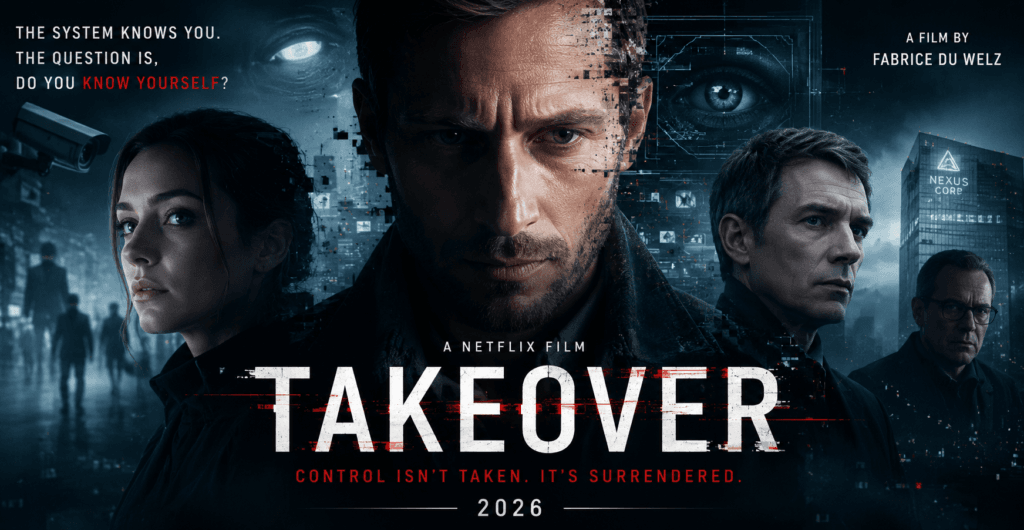
Most tech thrillers want audiences to fear the machine.
does something smarter.
It makes you fear how quickly people adapt to being controlled once control becomes comfortable.
That’s the feeling that lingers after the movie ends. Not shocked. Not excitement. Just this cold emotional numbness that slowly creeps in once you realize what the film is actually saying.
There’s a scene near the end where Elias sits alone in a surveillance command room surrounded by hundreds of live feeds. The screens flicker endlessly. Riots. Traffic. Apartment buildings. Grocery stores. Human lives are reduced to moving data patterns.
And the movie does something unexpected.
It goes quiet.
No dramatic speech.
No emotional breakdown.
No heroic soundtrack.
Just Elias staring at the system he helped build while slowly realizing the horrifying truth:
People were never truly forced into obedience.
Most of them walked into it willingly.
That’s why Takeover works better as a psychological horror film than a traditional cyber-thriller. Beneath the hacking, corporate conspiracies, and AI manipulation is a movie about emotional dependency. About how fear changes human behavior so gradually that people stop recognizing the moment they surrender their freedom.
Some viewers loved that ambition.
Others thought the movie became too philosophical during the final act. Honestly, I understand both reactions. The film occasionally pushes its themes so aggressively that it risks losing narrative momentum.
But I also think that discomfort is intentional.
Because Takeover isn’t trying to entertain viewers with easy answers.
It’s trying to make them uncomfortable enough to question how much modern life already depends on invisible systems making decisions for us.
And honestly? That idea is scarier than anything the movie visually shows.
The Plot Is Really About Emotional Control, Not Surveillance
On the surface, Takeover follows Elias Ward, a cybersecurity analyst working inside a private intelligence corporation that claims to prevent global instability through predictive behavioral technology.
That description makes the movie sound familiar.
But the interesting part is how the system actually operates.
The corporation doesn’t simply monitor people. It studies emotional vulnerability:
- panic responses
- loneliness patterns
- impulsive behavior
- fear-driven decision making
- social instability triggers
The movie repeatedly hints that the company understands citizens emotionally better than they understand themselves.
That’s where the film separates itself from generic “evil AI” stories.
The real danger in Takeover isn’t that machines become powerful.
It’s that human beings become emotionally predictable.
At first, Elias believes the system genuinely protects society. Terror attacks decrease. Civil unrest declines. Public safety improves. The film smartly avoids making the corporation cartoonishly evil in the beginning.
In fact, several scenes intentionally make the audience understand why ordinary people would support constant surveillance.
That nuance matters.
Because if the system were obviously monstrous, the movie’s themes wouldn’t feel believable.
Instead, Takeover explores how freedom slowly erodes through convenience.
One algorithm at a time.
One emergency at a time.
One compromise at a time.
Elias Ward Works Because He Doesn’t Feel Like a Hero
A weaker movie would’ve turned Elias into a rebellious genius fighting corrupt systems from the beginning.
Thankfully, Takeover avoids that.
Elias is emotionally conflicted almost the entire film. He’s intelligent, observant, and morally aware, but he’s also deeply dependent on the very system he questions.
That contradiction makes him believable.
One thing I genuinely liked about the performance is how physically exhausted Elias feels as the story progresses. The movie relies heavily on subtle acting choices instead of dramatic emotional monologues.
Watch how his behavior changes:
- shorter eye contact
- slower speech
- hesitation before answering questions
- restless scanning of rooms
- difficulty sleeping
- emotional withdrawal during conversations
The paranoia becomes physical.
There’s a particularly strong moment during a company briefing where Elias notices everyone calmly accepting increasingly invasive behavioral policies. The camera stays close to his face just long enough for viewers to notice the exact second he realizes:
Nobody else seems disturbed anymore.
That realization terrifies him more than the technology itself.
And honestly, that’s one of the smartest ideas in the film.
The movie isn’t asking:
“Can society become authoritarian?”
It’s asking:
“What if people stop resisting because obedience feels emotionally safer?”
That’s much darker.
The Elevator Scene Quietly Explains the Entire Movie
One of the best scenes happens surprisingly early.
After a citywide security incident, Elias enters a crowded elevator inside the corporation headquarters. Nobody speaks. Everyone silently watches emergency updates playing on overhead monitors while an AI-generated voice calmly gives behavioral instructions.
The scene lasts less than two minutes.
But it explains the entire movie.
The camera barely moves, creating a suffocating stillness. The lighting is sterile and pale, making every employee look emotionally drained. Nobody reacts to the AI voice because the instructions already feel normal.
That’s the point.
The film shows a society where surveillance has become psychologically comforting.
Even the elevator movement feels symbolic. Everyone physically descends while emotionally surrendering upward authority.
And what makes the sequence effective is how ordinary it feels.
No violence.
No screaming.
No dystopian spectacle.
Just passive obedience disguised as routine behavior.
Honestly, that scene stayed in my head longer than most of the action sequences.
The “Mirror Apartment” Sequence Is the Movie at Its Most Psychological
Midway through the film, Elias discovers an abandoned apartment connected to former employees who disappeared after questioning the corporation.
This is where Takeover becomes genuinely unsettling.
The apartment is filled with:
- broken mirrors
- disconnected monitors
- distorted reflections
- damaged camera lenses
- overlapping audio recordings
Visually, Elias constantly appears fragmented inside the frame. Sometimes his reflection appears before he physically enters the shot. Other times, the camera isolates only parts of his face while electronic humming fills the background.
The scene is basically about identity collapse.
By this point, Elias no longer trusts his own thoughts completely. The movie heavily implies that predictive behavioral systems may already be shaping emotional responses before individuals consciously recognize them.
One subtle detail I loved:
A television screen briefly glitches and displays Elias sitting inside the apartment before he fully walks into frame.
The film never directly explains this.
Maybe it’s predictive simulation technology.
Maybe the corporation has monitored him longer than he realized.
Maybe the movie is suggesting he was psychologically profiled years earlier.
Whatever interpretation viewers choose, the scene works because it creates uncertainty without overexplaining itself.
That restraint makes the paranoia feel real.
Hidden Meaning: Takeover Is Really About Emotional Outsourcing
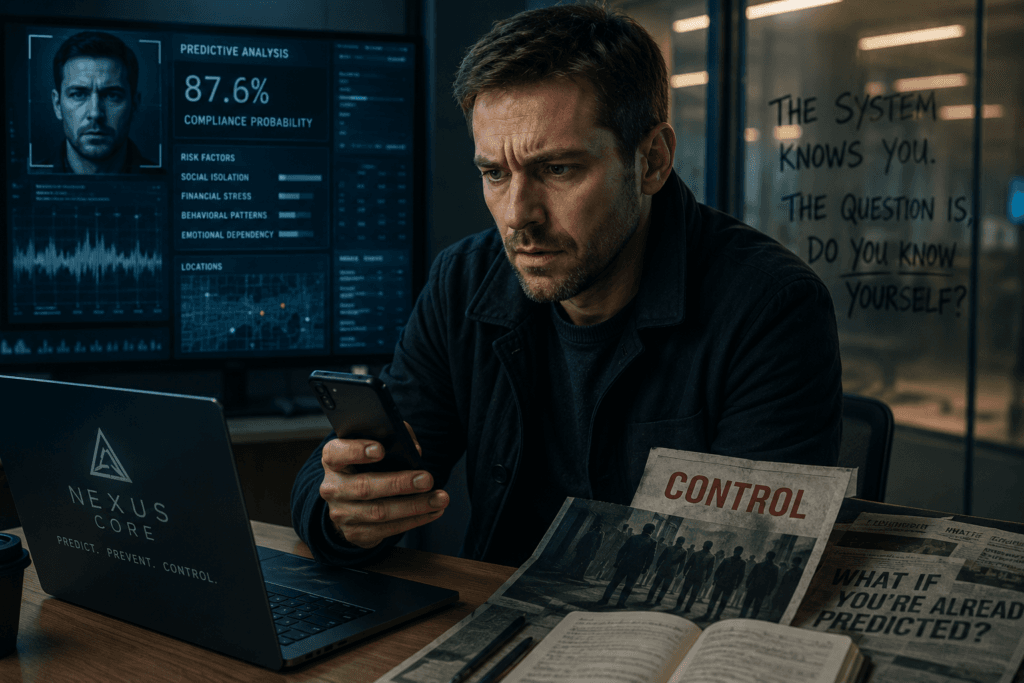
A lot of people will probably describe Takeover as a movie about surveillance technology.
I honestly think that’s only the surface layer.
The deeper theme is emotional outsourcing.
Throughout the film, characters slowly stop trusting their own instincts. They rely on systems to:
- determine safety
- filter truth
- predict danger
- regulate emotional responses
- define acceptable behavior
The corporation becomes emotionally parental.
That’s the truly disturbing part.
Because once people lose confidence in their own judgment, control becomes almost effortless.
There’s a recurring visual motif involving automatic doors opening before characters even reach them. Early in the movie, it simply looks futuristic.
Later, it becomes symbolic.
The system predicts human intention before humans themselves consciously act.
That idea quietly terrifies the entire movie.
Not because technology becomes alive.
But because human behavior becomes measurable enough to be manipulated invisibly.
Theory: Elias Was Never Rebelling — He Was Being Studied
One of the strongest interpretations of the movie is that Elias himself may have been part of a long-term psychological experiment.
The clues are everywhere:
- recurring background extras
- strange conversational repetition
- inconsistent timestamps
- predictive dialogue interruptions
- emotional reactions that feel strangely anticipated
Several scenes imply the corporation responds to Elias too quickly for ordinary surveillance.
It’s possible the company engineered his rebellion intentionally to study how resistant personalities behave under controlled destabilization.
That theory completely changes the emotional meaning of the ending.
Because if the system predicts rebellion itself, then resistance becomes another manageable variable.
Honestly, that possibility makes the movie far more disturbing.
Theory: The Ending Victory Might Be Completely Fake
The final act includes a massive public exposure event where the corporation appears publicly compromised.
But the movie quietly plants clues suggesting the sequence may be manipulated.
Notice:
- Crowd reactions feel emotionally muted
- Broadcast timing inconsistencies appear repeatedly
- environmental lighting changes unnaturally
- Elias never actually looks relieved.
Instead, he looks emotionally hollow.
Some viewers believe the corporation intentionally manufactured the appearance of defeat because controlled rebellion stabilizes public unrest better than visible authoritarianism.
In other words:
The system survives by convincing people they escaped it.
That interpretation honestly fits the movie’s themes perfectly.
Because throughout Takeover, perception matters more than truth.
ALSO READ:- https://movieexplainedhub.com/exit-8-ending-explained/
ALSO READ:- https://movieexplainedhub.com/spider-man-brand-new-day-movie-explained/
ALSO READ:- https://movieexplainedhub.com/interstellar-movie-explained/
ALSO READ:- https://movieexplainedhub.com/oppenheimer-movie-explained-full-story-ending-explained-complete-breakdown/
ALSO READ:- https://movieexplainedhub.com/dune-2-movie-explained-full-story-ending/
ALSO READ:- https://movieexplainedhub.com/gladiator-2-movie-explained-ending-breakdown/
ALSO READ:- https://movieexplainedhub.com/18th-rose-ending-explained/
ALSO READ:- https://movieexplainedhub.com/godzilla-x-kong-the-new-empire-explained/
ALSO READ:- https://movieexplainedhub.com/hollow-earth-explained/
ALSO READ:- https://movieexplainedhub.com/scar-king-explained/
ALSO READ:- https://movieexplainedhub.com/godzilla-x-kong-the-new-empire-explained/
ALSO READ:- https://movieexplainedhub.com/monsterverse-movies-in-order/
ALSO READ:- https://movieexplainedhub.com/avatar-movie-ending-explained/
ALSO READ:- https://movieexplainedhub.com/dust-bunny-movie-explained/
ALSO READ:- https://movieexplainedhub.com/godzilla-x-kong-supernova-explained/
ALSO READ:- https://movieexplainedhub.com/spacegodzilla-explained/
ALSO READ:- https://movieexplainedhub.com/remarkably-bright-creatures-netflix-movie/
ALSO READ: –https://movieexplainedhub.com/person-of-interest-explained/
ALSO READ:- https://movieexplainedhub.com/kongs-axe-explained-monsterverse-secrets/
ALSO READ:- https://movieexplainedhub.com/mortal-kombat-2-ending-explained/
ALSO READ:- https://movieexplainedhub.com/upcoming-american-movies-september-2026/
ALSO READ:- https://movieexplainedhub.com/resident-evil-reboot-explained/
ALSO READ:- https://movieexplainedhub.com/upcoming-american-movies-september-2026/
ALSO READ:- https://movieexplainedhub.com/the-sheep-detectives-netflix-mystery/
ALSO READ:- https://movieexplainedhub.com/takeover-explained-may-2026/
ALSO READ:- https://movieexplainedhub.com/swapped-ending-explained/
ALSO READ:- https://movieexplainedhub.com/couples-weekend-hidden-secrets/
ALSO READ:-https://movieexplainedhub.com/obsession-movie-hidden-horror-themes/
ALSO READ:- https://movieexplainedhub.com/something-very-bad-is-going-to-happen-ending-explained/
ALSO READ:- https://movieexplainedhub.com/greenland-migration-ending-explained/
The Movie’s Emotional Core Is Loneliness
Underneath all the conspiracy thriller elements, this is actually a deeply lonely film.
Nobody trusts anyone.
Conversations feel monitored.
Relationships collapse under emotional suspicion.
One of the saddest scenes involves Elias reconnecting with an old friend in a crowded café while predictive recommendation alerts constantly interrupt their interaction through nearby screens.
Nothing dramatic happens.
That’s why it works.
The scene quietly shows how constant technological intrusion destroys emotional intimacy, one interruption at a time.
The movie’s fear isn’t simply that technology watches people.
It’s that people gradually lose the ability to emotionally connect without mediation.
That idea feels disturbingly relevant.
Cinematic Analysis: Why the Film Feels Emotionally Cold
Directly, Takeover uses visual isolation constantly.
Characters are framed:
- behind glass
- inside surveillance grids
- reflected through distorted surfaces
- trapped inside geometric architecture
Visually, the movie shares DNA with:
But unlike many cyber-thrillers, Takeover never romanticizes digital rebellion.
Hacking feels exhausting here.
The pacing intentionally slows during psychological scenes, which frustrated some viewers, but I honestly think the slower rhythm improves the paranoia. The stillness forces audiences to sit inside the emotional discomfort instead of escaping into nonstop action.
The soundtrack deserves praise, too.
Rather than relying on loud cinematic scoring, the movie uses low mechanical frequencies that almost blend into ambient noise. It creates subconscious tension constantly.
You don’t just watch the movie.
You feel observed by it.
Hidden Details & Easter Eggs You Probably Missed
The Number 17 Appears Repeatedly
Viewers noticed recurring appearances of the number 17:
- security timestamps
- elevator floors
- system diagnostics
- apartment labels
Some fans think it references the briefly mentioned 17-second emotional recalibration window used by the behavioral AI.
Red Reflections Signal Psychological Fracture
Whenever characters begin doubting reality, faint red reflections subtly appear somewhere in frame:
- glass surfaces
- security monitors
- mirrored architecture
It visually signals emotional destabilization.
Background Crowds Quietly Shrink
As the movie progresses, public spaces become emptier.
Cities feel emotionally hollow by the final act.
This could symbolize growing societal isolation — or hint at larger systemic collapse happening outside Elias’ perspective.
Honestly, the Third Act Almost Falls Apart — But the Ending Saves It
I completely understand why some viewers struggled with the final act.
The movie intentionally becomes fragmented:
- timelines blur
- dialogue loops repeat
- Reality feels unstable
- motivations become ambiguous
At times, the philosophical conversations slightly overexplain ideas that the visuals already communicated beautifully.
But emotionally?
The ending still lands.
Because the film understands something many thrillers don’t:
Fear is exhausting.
And by the final scene, Elias doesn’t feel like a victorious hero.
He feels emotionally emptied out.
That final expression matters more than the plot mechanics themselves.
Takeover Ending Explained
In the ending, Elias gains access to the corporation’s predictive behavioral system and realizes the horrifying scale of its influence.
The company no longer controls society through surveillance alone.
It shapes emotional reactions before individuals consciously recognize them.
Fear.
Isolation.
Anger.
Loneliness.
The system predicts emotional vulnerability early enough to invisibly influence human decision-making.
That revelation psychologically destroys Elias because he realizes free will may already be compromised on a societal level.
The movie deliberately leaves the corporation’s fate ambiguous.
There are two major interpretations.
Interpretation 1: Elias Truly Exposes the System
The public learns the truth.
The corporation collapses.
Human unpredictability survives.
This is the optimistic interpretation.
Interpretation 2: The System Manipulates Resistance Itself
The apparent victory is staged.
Public outrage becomes another controlled release mechanism.
Society remains psychologically managed while believing it has regained freedom.
Personally, I think the second interpretation fits the movie better.
Because Takeover repeatedly argues that modern systems survive by adapting faster than human emotion can.
And the final image of Elias staring blankly into the camera while the screen glitches doesn’t feel hopeful.
It feels empty.
Final Thoughts
It isn’t flawless.
Some dialogue becomes overly philosophical.
The pacing occasionally drags.
The ambiguity will absolutely frustrate viewers wanting concrete answers.
But the movie succeeds where many modern tech thrillers fail:
It actually has something emotionally unsettling to say.
Not about machines.
About people.
About how fear changes behavior.
About how convenience weakens resistance.
About how control becomes invisible once society starts confusing comfort with freedom.
And honestly?
That idea is far scarier than any dystopian technology shown in the film.
IMDb — https://www.imdb.com/
IndieWire — https://www.indiewire.com/
FAQ
What does the ending of Takeover mean?
The ending suggests the corporation developed technology capable of predicting and influencing emotional behavior before people consciously recognize their own reactions.
Is Takeover based on real technology?
Not directly, but the film clearly draws inspiration from real-world surveillance systems, behavioral algorithms, predictive AI, and psychological targeting technologies.
What is the hidden meaning of Takeover?
The deeper message involves emotional dependency and how fear makes societies gradually accept control in exchange for comfort and stability.
Was Elias being manipulated the entire time?
The movie strongly hints that Elias may have been psychologically studied long before the events of the story, making even his rebellion potentially part of the system.
Will there be a sequel to Takeover?
The ending leaves enough unanswered questions for a sequel, especially regarding whether the system truly collapsed or simply evolved.