
Introduction
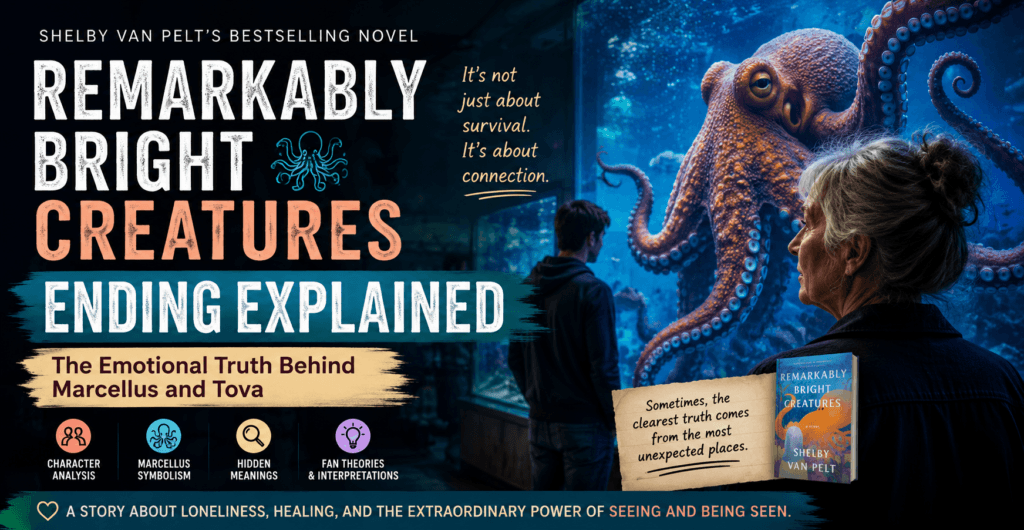
The saddest part of Remarkably Bright Creatures isn’t the mystery surrounding Erik’s disappearance. It’s the feeling that almost every character has quietly stopped expecting life to surprise them anymore. Remarkably Bright Creatures ending explained.
That’s what stayed with me after finishing the novel.
Not the twist.
Not even Marcellus, somehow.
It’s the loneliness.
Shelby Van Pelt’s 2022 novel became unexpectedly beloved because it approaches grief differently from most emotional mystery stories. It doesn’t treat pain like a dramatic explosion. Instead, grief exists like background noise. Something people slowly organize their routines around until emotional isolation starts feeling normal.
And honestly, that subtlety is what makes the novel work.
On the surface, Remarkably Bright Creatures sounds almost strange to explain: an elderly widow working night shifts at an aquarium slowly forms a connection to an unusually intelligent octopus while a drifting young man searches for meaning and family. That premise could have easily become overly sentimental or quirky in a forced way.
Somehow, it doesn’t.
The deeper the story goes, the more it becomes about aging, emotional avoidance, regret, and the terrifying possibility that life can still change when people think it’s already emotionally over.
The novel has been compared to books like A Man Called Ove and The Midnight Library because of its emotional warmth and melancholy tone. But personally, Remarkably Bright Creatures feels quieter and more intimate than either of those stories.
There’s something deeply melancholic about the aquarium setting itself.
The glowing tanks.
The dark hallways during Tova’s cleaning shifts.
The rainy coastal atmosphere.
The silence between conversations.
Even when characters are speaking, they often feel emotionally miles apart.
And then there’s Marcellus.
Honestly, I expected the “highly intelligent octopus narrator” concept to eventually feel gimmicky. Somewhere halfway through the novel, though, that completely disappeared. Marcellus somehow becomes the emotional center of the story without the novel ever forcing it.
That’s surprisingly difficult to pull off.
Atmosphere & Storytelling Analysis
One of the smartest things about Remarkably Bright Creatures is how restrained it feels emotionally.
The novel rarely pushes scenes too aggressively. It trusts silence. It trusts pauses. It trusts awkward conversations where characters carefully avoid saying what they actually mean.
That restraint gives the story an oddly cinematic feeling. Remarkably Bright Creatures ending explained
Some of the most emotionally effective moments aren’t dramatic revelations at all. They’re small scenes where Tova quietly cleans the aquarium late at night while exhausted blue light reflects through empty hallways. After a while, those scenes stop feeling like routine work and start feeling like emotional survival.
The aquarium itself becomes symbolic almost immediately.
Everything inside it is beautiful, contained, and lonely.
That includes the people.
Tova moves through life almost mechanically at times, using routine to avoid emotional collapse. Cameron drifts through temporary jobs and awkward social interactions without ever fully understanding what he’s searching for. Even side characters often seem emotionally disconnected from their own lives.
And the novel notices those details constantly.
One of the most emotionally realistic parts of the story is how conversations often feel unfinished. Tova especially speaks like someone carefully rationing emotion. Even during quieter conversations with Ethan, there’s a sense that entire emotional histories exist underneath the dialogue without fully surfacing.
The silence after conversations often matters more than the conversations themselves.
Personally, I think the slower pacing mostly works because the emotional atmosphere is so carefully built. Still, I’d be lying if I said the middle section never drifts slightly. Readers expecting a stronger mystery structure may become impatient during some of Cameron’s wandering storylines.
But even then, the emotional texture keeps the novel engaging.
And then Marcellus changes the tone completely.
Some of the novel’s best moments happen when Marcellus silently observes humans through the aquarium glass while they fail to communicate honestly with each other. Oddly enough, the octopus becomes the clearest observer of human loneliness.
That contrast gives the story much of its emotional power.
Full Story Breakdown
Tova’s Quiet Routine
Tova begins the novel emotionally frozen.
Years earlier, her son Erik disappeared under mysterious circumstances, and although life continued afterward, emotionally, she never fully moved forward. The later death of her husband only deepened that isolation.
What makes Tova compelling is that she doesn’t present herself as openly broken.
She functions.
She works.
She keeps routines.
But routines become emotional armor in this story.
The late-night aquarium cleaning scenes become strangely heartbreaking after a while. Tova moves through glowing hallways surrounded by sleeping sea creatures, quietly scrubbing tanks in near silence, and eventually the routine starts feeling less like work and more like a coping mechanism she cannot emotionally survive without.
There’s one especially effective emotional detail throughout these scenes: Tova rarely allows herself stillness. She keeps moving constantly because stopping would force her to emotionally confront things she has spent decades avoiding.
The novel also handles aging surprisingly well.
It doesn’t romanticize loneliness among older adults. Instead, it subtly reveals how easily society can overlook isolated individuals altogether.
That realism gives Tova’s storyline emotional weight. Remarkably Bright Creatures ending explained
Cameron’s Directionless Life
Cameron initially feels almost frustratingly immature.
He drifts between jobs, relationships, apartments, and responsibilities without stability or long-term direction. Early on, his storyline almost feels disconnected from the emotional depth surrounding Tova.
Honestly, I wasn’t fully invested in Cameron immediately.
But gradually, the story reveals that his lack of direction comes from emotional abandonment and unresolved identity confusion.
He spends much of the novel searching for belonging without realizing that’s what he’s doing.
There’s an important contradiction inside Cameron’s character: he desperately wants connection while constantly sabotaging opportunities for stability. He avoids responsibility partly because he’s terrified of rejection and failure.
Some readers will probably find sections of his storyline repetitive midway through the book. I honestly did at times. Certain scenes of him drifting between uncertainty and self-pity stretch slightly too long.
Still, the emotional payoff eventually justifies much of that slower buildup.
One small detail I really liked is how awkward Cameron often feels socially. The novel doesn’t romanticize him as some misunderstood genius. He can be impulsive, immature, and frustratingly passive.
That imperfection makes him feel human.
Marcellus Notices Everything
Marcellus might genuinely be one of the most emotionally effective non-human narrators in recent fiction.
What makes him work isn’t simply intelligence.
It’s an observation.
Even small moments — like Marcellus quietly watching visitors through aquarium glass while Tova cleans tanks alone nearby — reinforce the feeling that he understands emotional isolation better than the humans themselves.
He notices loneliness immediately.
He notices emotional repression immediately.
He notices the things humans avoid saying.
Ironically, despite being physically trapped inside a tank, Marcellus often feels emotionally freer than the actual people around him.
His escape scenes initially feel humorous and whimsical, almost like brief moments of relief from the heavier emotional atmosphere. But underneath that humor is sadness.
Marcellus knows he’s nearing the end of his life. Remarkably Bright Creatures ending explained.
And he knows it long before the humans emotionally understand their own situations.
That awareness slowly transforms his narration from charming to heartbreaking.
Personally, I think the novel becomes significantly stronger every time Marcellus appears because he introduces emotional clarity that the human characters often lack.
Character Analysis
Tova: Grief Hidden Inside Routine
Tova’s biggest fear isn’t loneliness.
It’s an emotional reopening.
She has structured her entire life around controlled emotional distance because confronting Erik’s disappearance directly would force her to revisit pain she has spent decades containing.
What makes her compelling is that she’s simultaneously resilient and emotionally exhausted.
The novel never turns her into a stereotypical grieving mother constantly expressing sadness outwardly. Instead, the grief exists underneath everything she does — in the pauses, the routines, the emotional restraint, and the quiet way she keeps other people at a distance.
There’s also guilt buried inside her character.
Not explicit guilt necessarily, but the kind of unresolved tragedy that naturally creates. The feeling that maybe something important was missed.
That emotional uncertainty quietly shapes her entire life.
Cameron: Searching for Belonging
Cameron’s emotional conflict revolves around identity.
He wants purpose but doesn’t fully believe he deserves stability. That contradiction defines many of his bad decisions throughout the story.
What makes him emotionally effective is how recognizable his insecurity feels. He masks loneliness through humor, avoidance, impulsiveness, and constant movement.
Underneath all of that, though, he desperately wants family.
The possibility that he may unknowingly be emotionally connected to Tova transforms his entire storyline into something much sadder and more meaningful.
Marcellus: The Emotional Truth Teller
Marcellus functions almost like an emotional conscience within the novel.
He observes humans with amusement, frustration, and sympathy. Ironically, despite being physically trapped, he understands emotional freedom better than most of the humans around him.
There’s something quietly devastating about how temporary his existence feels compared to the people he’s helping reconnect emotionally.
His intelligence matters less than his emotional honesty.
That’s why readers connect with him so strongly.
He isn’t just “the smart octopus.”
He’s the only character consistently willing to recognize loneliness honestly.
Symbolism Explained
The Aquarium
The aquarium represents emotional containment.
Everything inside it is visible yet unreachable.
That perfectly mirrors the characters themselves. They can see each other emotionally, but a genuine connection remains difficult because everyone carries unresolved grief, fear, guilt, or isolation.
After a while, the glowing tanks almost start feeling emotionally claustrophobic.
Water & Emotional Distance
Water appears constantly throughout the novel.
Not violently. Quietly.
It separates people emotionally while simultaneously connecting them symbolically. The ocean becomes tied to memory, disappearance, uncertainty, and emotional depth that characters struggle to confront directly.
Erik’s disappearance especially transforms water into something haunting.
Marcellus as Symbolism
Marcellus represents emotional honesty.
Unlike the humans around him, he sees patterns clearly. He notices lies, emotional repression, avoidance, and loneliness immediately.
Personally, I think the novel intentionally uses an octopus because octopuses symbolize intelligence, adaptability, emotional complexity, and observation — all qualities the human characters struggle with despite supposedly being emotionally more advanced.
Routine & Aging
The repetitive nature of Tova’s life reflects how grief slowly becomes ritualistic.
The novel also explores aging in surprisingly realistic ways. Older characters aren’t reduced to wise mentors or inspirational figures. They’re lonely, stubborn, emotionally defensive, exhausted, and still searching for connection.
That honesty gives the novel emotional authenticity.
ALSO READ:- https://movieexplainedhub.com/exit-8-ending-explained/
ALSO READ:- https://movieexplainedhub.com/spider-man-brand-new-day-movie-explained/
ALSO READ:- https://movieexplainedhub.com/interstellar-movie-explained/
ALSO READ:- https://movieexplainedhub.com/oppenheimer-movie-explained-full-story-ending-explained-complete-breakdown/
ALSO READ:- https://movieexplainedhub.com/dune-2-movie-explained-full-story-ending/
ALSO READ:- https://movieexplainedhub.com/gladiator-2-movie-explained-ending-breakdown/
ALSO READ:- https://movieexplainedhub.com/18th-rose-ending-explained/
ALSO READ:- https://movieexplainedhub.com/godzilla-x-kong-the-new-empire-explained/
ALSO READ:- https://movieexplainedhub.com/hollow-earth-explained/
ALSO READ:- https://movieexplainedhub.com/scar-king-explained/
ALSO READ:- https://movieexplainedhub.com/godzilla-x-kong-the-new-empire-explained/
ALSO READ:- https://movieexplainedhub.com/monsterverse-movies-in-order/
ALSO READ:- https://movieexplainedhub.com/avatar-movie-ending-explained/
ALSO READ:- https://movieexplainedhub.com/dust-bunny-movie-explained/
ALSO READ:- https://movieexplainedhub.com/godzilla-x-kong-supernova-explained/
ALSO READ:- https://movieexplainedhub.com/spacegodzilla-explained/
ALSO READ:- https://movieexplainedhub.com/remarkably-bright-creatures-netflix-movie/
ALSO READ: –https://movieexplainedhub.com/person-of-interest-explained/
ALSO READ:- https://movieexplainedhub.com/kongs-axe-explained-monsterverse-secrets/
ALSO READ:- https://movieexplainedhub.com/mortal-kombat-2-ending-explained/
ALSO READ:- https://movieexplainedhub.com/upcoming-american-movies-september-2026/
ALSO READ:- https://movieexplainedhub.com/resident-evil-reboot-explained/
ALSO READ:- https://movieexplainedhub.com/upcoming-american-movies-september-2026/
ALSO READ:- https://movieexplainedhub.com/the-sheep-detectives-netflix-mystery/
ALSO READ:- https://movieexplainedhub.com/takeover-explained-may-2026/
ALSO READ:- https://movieexplainedhub.com/swapped-ending-explained/
ALSO READ:- https://movieexplainedhub.com/couples-weekend-hidden-secrets/
ALSO READ:-https://movieexplainedhub.com/obsession-movie-hidden-horror-themes/
ALSO READ:- https://movieexplainedhub.com/something-very-bad-is-going-to-happen-ending-explained/
ALSO READ:- https://movieexplainedhub.com/greenland-migration-ending-explained/
Fan Theories & Interpretations
Theory 1: Marcellus Represents Emotional Honesty
One interpretation is that Marcellus symbolizes the emotional truth everyone else avoids confronting.
Evidence:
- He notices hidden emotional connections immediately.
- He recognizes loneliness constantly.
- He acts as an emotional catalyst for the story.
Contradiction:
The novel still clearly treats him as literally intelligent rather than purely symbolic.
Personally, I think the story works best when both interpretations coexist.
Theory 2: The Aquarium Represents Emotional Imprisonment
Almost every major character is emotionally trapped.
Tova is trapped by grief.
Cameron is confused about identity.
Marcellus by literal confinement.
The aquarium visually mirrors all of them.
Theory 3: The Story Is More About Grief Than Mystery
The mystery surrounding Erik matters structurally, but emotionally, the novel cares far more about healing than solving.
Honestly, once the emotional arcs become clearer, the actual mystery almost feels secondary.
And I think that’s intentional.
Theory 4: Cameron Mirrors Erik
Cameron reflects the life Erik never got the chance to fully live.
Both are emotionally restless young men searching for belonging and direction. That parallel makes the eventual revelations emotionally devastating rather than simply surprising.
Remarkably Bright Creatures Ending Explained
The ending of Remarkably Bright Creatures works because it finally allows characters to emotionally reconnect after years of isolation.
Literally, the story reveals the hidden connection involving Erik and Cameron, confirming long-suspected emotional truths surrounding Tova’s loss. But importantly, the reveal isn’t handled like a dramatic thriller twist.
It unfolds quietly.
Painfully.
Almost cautiously.
That restraint matters.
The revelation forces Tova to emotionally confront something she has avoided for decades: the possibility that life still contains connection even after unimaginable grief.
Cameron’s resolution is equally emotional because his entire identity crisis suddenly gains context. Throughout the novel, he moves through life feeling disconnected from family, purpose, and stability without fully understanding why.
The ending finally gives him emotional grounding.
But what makes the conclusion work is that the novel never pretends emotional healing is instant or perfect.
There’s still sadness lingering underneath everything.
That’s why the ending feels believable.
Personally, I think the story wisely avoids turning reconciliation into magical emotional repair. Tova’s grief doesn’t disappear. Cameron’s insecurity doesn’t suddenly vanish. Instead, the ending suggests that emotional isolation can slowly soften through connection.
That’s much more honest.
And then there’s Marcellus.
His role in the ending is honestly heartbreaking.
By the final section of the novel, Marcellus has spent so much time quietly observing human loneliness that his eventual absence feels emotionally enormous. In many ways, he becomes the bridge reconnecting people emotionally before disappearing himself.
There’s something deeply bittersweet about that.
I’m still slightly conflicted about whether parts of the emotional resolution become a little too sentimental near the end. A few scenes lean heavily into emotional catharsis in ways that may feel overly neat for certain readers.
But emotionally?
It still works.
Because the novel understands something important:
People don’t heal because mysteries are solved.
They heal because someone finally sees them clearly.
That’s the real emotional meaning behind the ending.
Not the reveal itself.
Recognition.
Connection.
The terrifying possibility that life can still emotionally change even after years of numb routine.
And honestly, that idea lingers much longer than the mystery ever does.
Criticism & Imperfections
Even though I admired the novel emotionally, it isn’t flawless.
The pacing occasionally drifts, especially during some middle sections involving Cameron’s wandering storyline. Readers expecting a stronger mystery structure may become impatient.
Certain reveals also become somewhat predictable once the emotional clues start aligning.
And while the emotional sincerity mostly works beautifully, a few scenes approach sentimental territory a little too aggressively.
Still, I’d rather a story risk emotional vulnerability than emotional emptiness.
That sincerity is ultimately what makes Remarkably Bright Creatures memorable. Remarkably Bright Creatures ending explained.
Final Thoughts
Long after readers forget the specific mystery details, they’ll probably remember the emotional feeling this story leaves behind.
Not sadness exactly.
Something quieter. Remarkably Bright Creatures ending explained.
A lingering awareness of how many people move through life emotionally unseen while pretending they’re fine.
Remarkably Bright Creatures understands that loneliness rarely looks dramatic. Sometimes it just looks like routine. Silence. Work. Conversations where people carefully avoid the thing they actually want to say.
And somehow, through an aging octopus observing humanity from behind aquarium glass, the novel becomes unexpectedly compassionate about all of it.
That’s why the ending stays with people.
Not because it surprises them.
Because it understands them.
Official / Book Sources
- Goodreads – Remarkably Bright Creatures
https://www.goodreads.com/book/show/58733693-remarkably-bright-creatures - Penguin Random House Book Page
https://www.penguinrandomhouse.com/books/646495/remarkably-bright-creatures-by-shelby-van-pelt/
Entertainment / Industry Sources
- IMDb
https://www.imdb.com/ - Variety
https://variety.com/ - Collider
https://collider.com/ - ScreenRant
https://screenrant.com/ - IndieWire
https://www.indiewire.com/ - Deadline Hollywood
https://deadline.com/
FAQ Section
What does the ending of Remarkably Bright Creatures mean?
The ending represents emotional reconnection, healing, and finally confronting unresolved grief after years of emotional isolation.
Is Marcellus symbolic?
Yes. Marcellus symbolizes emotional honesty, observation, intelligence, and the ability to recognize loneliness that humans try to hide.
Is Remarkably Bright Creatures based on a true story?
No, the novel is fictional, though its emotional themes feel grounded in very real human experiences.
What happened to Erik?
The novel gradually reveals the truth surrounding Erik’s disappearance and its connection to Cameron, emotionally reshaping Tova’s understanding of her past.
Why is the story emotionally powerful?
Because it treats loneliness and grief realistically rather than melodramatically. The emotional pain feels quiet, ordinary, and deeply human.
Is there a sequel planned?
As of now, no direct sequel has been officially announced.
What does the aquarium represent?
The aquarium symbolizes emotional confinement, observation, loneliness, and the invisible barriers separating people emotionally.