“Every year, a handful of films attempt to tackle important social issues. The India Story.
The India Story: Slow Poison in Progress is shaping up to be exactly that kind of disruptor.
| Movie | The India Story: Slow Poison in Progress |
|---|---|
| Release Date | July 24, 2026 |
| Director | Chettan DK |
| Cast | Kajal Aggarwal, Shreyas Talpade |
| Genre | Social Drama, Courtroom Thriller |
| Languages | Hindi, Tamil, Telugu |
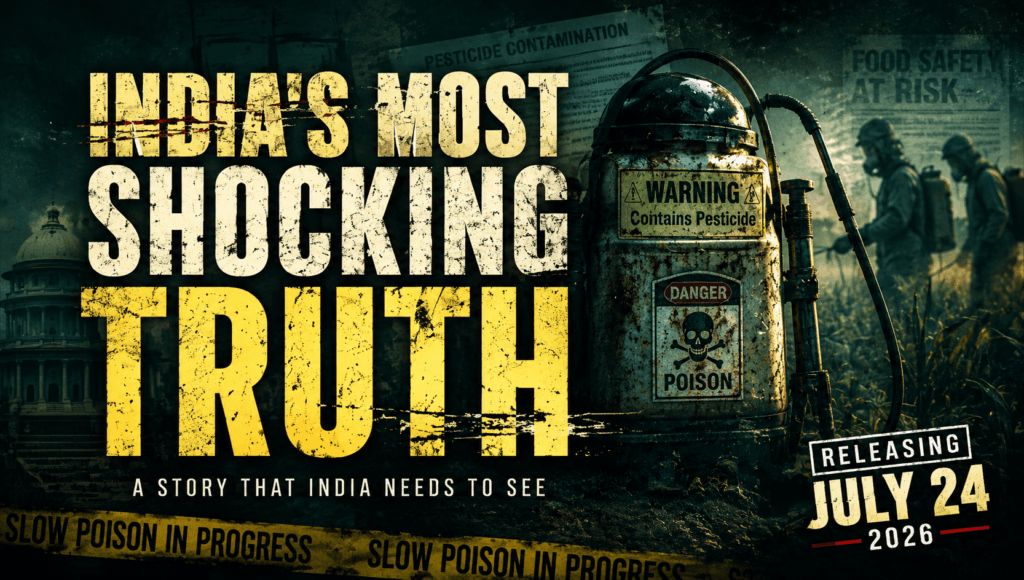
Directed by Chettan DK, the film stars Kajal Aggarwal and Shreyas Talpade. It explores pesticide misuse, food safety, and corporate accountability through a courtroom drama..
The Master Overview: Cast, Crew, and Logistics
Production Profile
| Category | Official Specifications |
| Official Film Title | The India Story: Slow Poison in Progress |
| Director | Chettan DK |
| Lead Screenwriter & Producer | Sagar B. Shinde |
| Presenting Banners | Zee Studios & MIG Productions & Studios |
| Co-Producers | Sumit Bagade, Anita Jadhav, Swati Vinayak Saindane, Kalpesh Shah, Devyani Khorate |
| Associate Producer | Prem Raj Joshi |
| Director of Photography (DOP) | Nishant Bhagwat |
| Music Director | Mangesh Dhakde |
| Lyricist | Shakil Azami |
| Editor | Ashish Mhatre |
| Sound Designer | Anmol Bhave |
| Primary Genre | Social Drama / Courtroom Investigative Thriller |
| Worldwide Theatrical Release | July 24, 2026 |
| Target Languages | Hindi, Tamil, Telugu |
Release Date and the Pan-India Multilingual Strategy
The producers have chosen a simultaneous Hindi, Tamil, and Telugu release. Their goal is to reach audiences across the country and encourage discussion about a national issue.
This isn’t just a commercial choice to maximize box office returns; it is a calculated structural move designed to ensure the message penetrates every corner of the country. Agricultural pesticide poisoning and food supply contamination are not local problems confined to a single state or community. By ensuring audiences in both northern industrial zones and major southern agrarian hubs can view the film in their native tongues, the production aims to ignite a unified national conversation.
The Ensemble Cast: Breaking the Mold
The true strength of an issue-driven investigative thriller lies in its performances. If the characters feel caricatured, the social message loses its bite. Director Chettan DK has intentionally assembled a cast of seasoned performers who are stepping way outside their established comfort zones.
Kajal Aggarwal as the Grounded Investigator
For over a decade, Kajal Aggarwal has been celebrated as a premier leading lady in massive commercial masala entertainers across the Tamil, Telugu, and Hindi industries. However, The India Story presents a radically different version of the actress.
Stepping into a serious, highly research-heavy role, Kajal plays an individual deeply embedded in the legal and chemical investigation that uncovers the pesticide scandal. Promotional assets show her looking stripped of traditional cinematic glamour—sporting intense, stressed expressions, working out of messy, paper-strewn offices, and facing down aggressive crowds.
In media interactions following the teaser launch, Kajal revealed that this was one of the most intellectually exhausting roles of her career. She spent months reading agricultural research whitepapers, environmental impact statements, and documentation on public health crises to bring absolute authenticity to her character.
Shreyas Talpade trading Comedy for Courtroom Fire
If Kajal Aggarwal is the precise, meticulous brain of the investigation, Shreyas Talpade appears to provide its explosive emotional heart. Known widely across India for his impeccable comedic timing in major Bollywood blockbusters and his brilliant acting range in Marathi cinema, Talpade completely pivots here.
The promotional material showcases Talpade leading an intense legal battle inside a courtroom, going toe-to-toe with powerful corporate lawyers. He embodies a classic whistleblower or activist advocate who refuses to back down even when targeted by corporate intimidation campaigns. Rumors suggest his character’s motivation stems from a highly personal place—reflecting the real-world anxiety of parents discovering that the food they feed their young children is laced with invisible carcinogens.
The Supporting Powerhouses
To build a formidable wall of opposition and texture, the film features two of Indian cinema’s most reliable character actors:
- Murali Sharma: Widely respected for his versatility across multiple languages, Sharma reportedly plays a key bureaucratic or political figure caught directly in the crosshairs of the investigation. His character acts as the pragmatic face of a system that would rather protect economic outputs than admit a public safety failure.
- Manish Wadhwa: Fresh off playing highly impactful antagonistic roles in recent mega-blockbusters, Wadhwa lends his powerful, commanding screen presence to the corporate interests defending the chemical industrial complex. His character stands as the smooth-talking, unyielding institutional force that the protagonists must dismantle.
- Trisha Sarda: The talented child actor plays a central thematic role, representing the vulnerabilities of the younger generation—the demographic most acutely impacted by long-term chemical bioaccumulation.
Breaking Down the Plot: What is “Slow Poison in Progress”?
The fundamental question driving public curiosity is: What exactly is the story of this film? While the screenwriting team has protected major third-act twists, the promotional campaign leaves no doubt about the thematic blueprint.
The title itself, “Slow Poison in Progress,” acts as a literal description of how chemical bioaccumulation works in the human body. Unlike a sudden accident or infectious outbreak, eating food grown with banned or excessive synthetic pesticides introduces micro-toxins into the human metabolic system. Over five, ten, or twenty years, these compounds build up within fatty tissues, leading to skyrocketing rates of early-onset chronic illnesses, neurological issues, and reproductive anomalies across urban and rural demographics alike.
The movie unfolds as a classic investigative puzzle that transforms into a high-stakes courtroom drama. It starts with unexplained clusters of illnesses among ordinary suburban and urban families. When an independent team of researchers and legal advocates begins tracking the sourcing of everyday grocery stables—veggies, fruits, and grains—they hit a wall of institutional resistance.
ALSO READ
The investigation slowly reveals a dark network of chemical manufacturers selling banned compounds under alternative labels, agricultural supply chains cutting corners to ensure cosmetic perfection for crops, and regulatory boards actively looking the other way to maintain market stability.
The Iconic “Market Protests” Poster
The creative team recently dropped a highly discussed theatrical poster that perfectly encapsulates this narrative tension. The image shows Kajal Aggarwal and Shreyas Talpade standing in the middle of a chaotic, congested, traditional Indian vegetable market.
They aren’t surrounded by supportive fans; they are surrounded by a hostile, furious mob of traders and citizens throwing vegetables and shouting them down. This visual tells us everything we need to know about the film’s conflict. When you challenge the safety of the food supply, you aren’t just fighting an abstract corporate entity—you are threatening the livelihood of thousands of farmers, wholesale traders, and market vendors who rely on the existing system to survive. It highlights the incredibly complex socio-economic reality of India, where safety regulations often clash violently with basic economic survival.
The Real-World Context: Why This Film is Pure Reality
What elevates The India Story from a simple movie to a significant cultural moment is how accurately it mirrors current environmental and health developments in India. The screenplays are clearly not written in a vacuum.
For the past several years, independent consumer advocacy groups and international safety watchdogs have raised major red flags regarding Indian food exports and domestic consumption. Multiple high-profile spices, ready-to-eat products, and fresh produce lines have faced bans, rigorous testing regimes, or rejections from international markets due to detected traces of highly toxic sterilizing agents like Ethylene Oxide and excessive levels of banned chemical pesticides.
Furthermore, the domestic situation regarding the misuse of chemical inputs is widely documented. In many farming communities, due to a severe lack of deep agronomic training and aggressive marketing by local chemical distributors, farmers often apply cocktail mixtures of synthetic agents in concentrations far exceeding safety guidelines. The “waiting period”—the critical duration required between spraying a chemical and harvesting the crop to allow toxic residues to naturally break down—is frequently ignored to get fresh-looking produce to city markets faster.
By framing this crisis as a ticking clock thriller, The India Story forces the movie-going public to confront the direct link between the shiny, artificially perfect vegetables they purchase at premium modern retail counters and the hidden health crises affecting their families.
Behind the Scenes: The Battle with the Censor Board (CBFC)
You cannot make a film this explosive without ruffling institutional feathers, and the real-life production history of The India Story has become just as dramatic as the film itself.
Director Chettan DK recently spoke out publicly regarding the intense uphill battle the creative team is facing to secure its final clearance certificate from the Central Board of Film Certification (CBFC). The controversy gained massive public traction when contrasted against the recent high-profile removal of the socially sensitive film Satluj from major streaming platforms like ZEE5.
Speaking to national media outlets, Chettan DK expressed profound anxiety about the state of contemporary issue-driven cinema in India:
“It has been an incredibly difficult time for filmmakers who dare to speak about uncomfortable, lived realities. Watching independent-minded projects disappear from platforms or stall out in bureaucratic chambers is heartbreaking. Our team spent years conducting meticulous research before putting a single word on paper. Our objective has never been to create cheap controversy or defame any institution; we simply want to bring an undeniable public health reality to the forefront through the medium of cinema. We remain deeply hopeful that the board evaluates our film fairly so that the Indian public can watch it and judge it based on its merits.”
The delay in certification has created a wave of organic grassroots support across social media platforms. The teaser comment sections are filled with everyday viewers arguing that independent social dramas should be encouraged, not stifled, especially when they tackle corporate malpractice and safety issues that directly affect the life expectancy of the average citizen.
Technical Elements: Building the Slow-Burn Tension
For a socio-political thriller to succeed without big-budget action sequences, the atmospheric filmmaking has to be flawless. The technical lineup for The India Story suggests a highly intentional aesthetic design:
- Cinematography by Nishant Bhagwat: Bhagwat reportedly utilizes a desaturated, gritty color palette to emphasize the industrial and unglamorous aspects of food production. The contrast between the sterile, brightly lit corporate offices, the chaotic mud-and-concrete reality of wholesale grain markets, and the quiet tension of the courtroom creates a visual landscape that feels deeply authentic.
- Sound Design by Anmol Bhave: Instead of utilizing loud, over-the-top cinematic sound effects, Bhave focuses on hyper-realistic ambient noises—the heavy drones of farm machinery, the overlapping shouts of crowded marketplaces, and the uncomfortable silence of a tense courtroom gallery. This auditory realism grounds the viewer firmly in the scene.
- Music and Score by Mangesh Dhakde: Dhakde is known for his ability to write scores that build psychological tension rather than emotional melodrama. The musical backdrop avoids obvious cues, working quietly to create an underlying sense of creeping urgency that mirrors the gradual accumulation of the “slow poison” itself.
Final Insights: Will it Leave a Mark?
Ultimately, The India Story: Slow Poison in Progress represents a crucial test case for contemporary Indian cinema. It asks whether a mid-budget, message-driven film powered by mainstream actors can cut through the noise of modern digital entertainment and command the attention of a wide, multi-state theatrical audience.
If the film successfully balances its rigorous, factual research with sharp human drama and tight investigative pacing, it could act as a significant cultural catalyst—much like classic environmental thrillers did historically for Western cinema. For audiences who are looking for a visceral, intelligent cinematic experience that deals with the exact world they live in today, this film is undeniably the most important release to track this July.
Frequently Asked Questions (FAQ)
1. What is the official release date for The India Story: Slow Poison in Progress?
The movie is locked for a worldwide theatrical release on July 24, 2026.
2. In which languages will the movie be available?
To achieve a pan-India impact, the film will be released simultaneously in three major languages: Hindi, Tamil, and Telugu.
3. Who are the main actors playing the lead roles?
The film features an ensemble cast led by Kajal Aggarwal and Shreyas Talpade in intense dramatic transformations, supported by veteran actors Murali Sharma, Manish Wadhwa, and Trisha Sarda.
4. Is the film based on one specific true story?
The filmmakers have clarified that the movie is a socio-national drama inspired by real-world public health data, agricultural reports, and ongoing corporate food contamination issues across India. It is not an official biopic or a direct adaptation of one single legal case, but rather a composite narrative built from years of extensive agricultural research.
5. What is the central conflict or theme of the plot?
The story revolves around the systemic misuse of toxic chemical pesticides in agriculture and the rampant food adulteration practices within the supply chain. It traces how these invisible toxins bioaccumulate in everyday consumers, exploring the subsequent health crises, corporate cover-ups, and the legal battle fought to establish food safety accountability.
6. Why is the film facing delays or public controversy before its release?
Director Chettan DK has publicly confirmed that the film has faced extended delays in securing its clearance certificate from the Central Board of Film Certification (CBFC). Because the movie addresses sensitive real-world topics like corporate accountability, lax regulatory standards, and public health failures, it has drawn significant institutional scrutiny.
7. Who directed and produced the film?
The film is directed by Chettan DK and written and produced by Sagar B. Shinde. It is presented to global audiences by Zee Studios in close association with MIG Productions & Studios.
- Official Trailer (YouTube)
- IMDb (when the movie page is available)
- Zee Studios (official distributor)
- The Hollywood Reporter India (release date announcement)
- The Times of India Entertainment