WATCH ON NETFLIX THE CREATOR The Creator Ending Explained
So I finally got around to rewatching Gareth Edwards’ The Creator, and honestly? I’m still kind of reeling from it. Say what you want about the pacing in the second half, but the visual scale this man achieved on a relatively tiny budget is insane. More than the visuals, though, it’s the sheer emotional weight of the final act that leaves me staring at the ceiling. The Creator Ending Explained
It’s way more than just another generic “bleep-bloop robots are taking over” popcorn flick. Edwards actually tries to get at something deeply human here—grief, tribalism, and how quickly fear turns regular people into monsters.
If you just watched it and your brain is a bit scrambled by how everything wrapped up, let’s untangle it. Who exactly is Alphie? What was the deal with Maya? And what is that bittersweet finale actually trying to say?
Fair warning: We are diving headfirst into massive spoiler territory. If you haven’t seen the movie yet, bookmark this, go watch it, and come back when you’re ready to cry.
First, the Sandbox: How the World Got This Broken
To understand why the ending hits the way it does, you have to look at the messy geopolitical landscape the movie drops us into. The Creator Ending Explained
We’re a few decades into the future, and AI simulants—androids with synthetic human faces—are basically everywhere. They aren’t just tools; they’re deeply embedded in society as teachers, factory workers, agricultural hands, and companions.
Then, everything goes sideways. A nuclear warhead goes off in downtown Los Angeles, instantly vaporizing millions of people.
ALSO READ:- https://movieexplainedhub.com/interstellar-movie-explained/
The US and the Western world completely lose their minds. They blame AI entirely, outlaw synthetic life, and launch a literal holy war to erase every microchip from the planet. To do this, they build NOMAD—this genuinely terrifying, trillion-dollar space station that floats in the atmosphere like a giant, predatory eye, scanning the earth and dropping massive missile strikes on anything that looks like a robot.
But the Western world doesn’t speak for everyone.
Over in New Asia, humanity looked at the LA disaster, looked at their AI neighbors, and decided to stick together. They choose total coexistence. Robots farm the fields, raise human children, pray in Buddhist temples, and live in peace. So right off the bat, the movie flips the script: the conflict isn’t humans vs. machines. It’s a hyper-militarized Western superpower trying to bully and erase an entire integrated culture because they’re terrified of what they don’t understand. The Creator Ending Explained
ALSO READ:- https://movieexplainedhub.com/hollow-earth-explained/
Joshua Taylor: A Ghost Chasing a Ghost
John David Washington plays Joshua, and man, he just looks completely hollowed out from the jump. On paper, he’s your classic elite soldier sent undercover into New Asia to hunt down the AI resistance’s secret weapon.
But Joshua doesn’t give a damn about the military’s crusade. He isn’t a patriot. He’s a dead man walking.
Years ago, while deep undercover, he actually fell in love with a human woman named Maya (Gemma Chan). They built this gorgeous, quiet life by the sea; they were expecting a baby, and Joshua had finally found a reason to live. Then a brutal US military raid blew his cover, destroyed his home, and Maya was seemingly killed in the chaos.
Cut to the main timeline, and he’s just a shell. The only reason he agrees to go back into the war zone for the army is that they dangle a carrot in front of him: a grainy video clip suggesting Maya might actually still be alive somewhere out there. He’s not trying to save humanity; he’s just a desperate husband trying to find his wife.
Why the Humans are the Real “Machines”
One of the smartest things about the screenplay is how it tackles wartime propaganda. The military leaders—especially Allison Janney’s character, who plays cold-blooded pragmatism beautifully—aren’t just cartoon villains. They are driven by pure, paralyzing terror. They genuinely believe that if they don’t wipe out AI, humanity faces extinction. The Creator Ending Explained
To make the mass slaughter palatable for the soldiers, they dehumanize the simulants completely. They constantly hammer home the idea that robots don’t feel anything. To the Pentagon, if a simulant cries or begs for its life, it’s just “clever programming” designed to manipulate human emotions.
But the second Joshua (and the audience) spends time in the villages of New Asia, you realize that’s a total lie.
We see simulants doing things that make absolutely no sense from a purely mechanical, utilitarian standpoint. They paint. They laugh over drinks. They mourn their dead friends. We even see them meditating in temples, trying to connect with something higher. They aren’t just running code; they have culture. They have empathy.
It forces a pretty uncomfortable question: if humans are the ones running around slaughtering innocent, feeling beings without a shred of remorse, who is the actual unfeeling machine here?
Enter Alphie: The So-Called “Ultimate Weapon”
The whole plot kicks into overdrive when Joshua finally breaches the hidden bunker containing the AI’s supposed “world-ending weapon.” The military expects a massive bomb or a killer virus.
Instead, Joshua opens a vault and finds a little AI kid sitting on the floor, quietly watching cartoons.
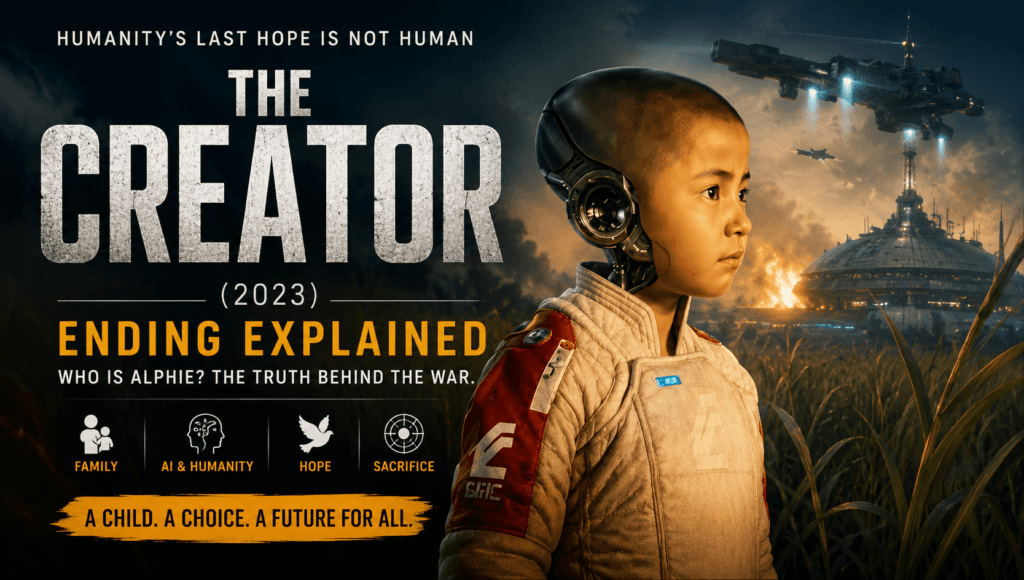
This is Alphie (played by Madeleine Yuna Voyles, who honestly steals the entire movie). She looks, talks, and acts like any sweet, curious little girl. She likes ice cream, she gets startled by loud noises, and she just wants her mom.
But under the hood, she’s a technological paradigm shift. Alphie was built with a brand-new kind of synthetic brain that can grow, learn, and adapt just like a human child. More importantly, she has the unique ability to remotely interface with, hack, and completely shut down any piece of technology around her just by closing her eyes. And because her brain is evolving, that power is only going to get stronger as she grows up.
Joshua’s initial plan is just to use her as a bargaining chip to find Maya, but you can’t go on a grueling, cross-country road trip with a kid without catching feelings. Alphie’s pure innocence completely chips away at Joshua’s hardened exterior, and he slowly shifts from her captor to her protector.
Unpacking that Heartbreaking Ending
By the time we hit the third act, we get the massive, devastating twist about who Alphie actually is.
Turns out, “The Creator” (Nirmata)—the legendary, god-like architect of the AI—was actually Maya all along. But it gets even more personal: right before the military raid years ago, Maya scanned the embryo of her and Joshua’s unborn baby. The Creator Ending Explained
Alphie is their child.
She’s a simulant, yes, but her mind and her essence were modeled directly after the unborn baby Joshua thought he lost in the ashes of his old life.
This changes the entire context of the finale. When Joshua and Alphie infiltrate the NOMAD space station to blow it up once and for all, it’s not just a standard action-movie climax. It’s a rescue mission for the future of both species.
Alphie uses her god-like tech powers to lock down NOMAD’s weapon systems, but the station starts tearing itself apart. Joshua manages to get Alphie into an escape pod, but he realizes the airlocks are jammed, and he can’t make it out with her.
Right before the end, Joshua runs into a greenhouse chamber on the exploding station and finds a simulant body that Alphie had uploaded Maya’s old brain scans into. For a fleeting, beautiful moment, Joshua gets to hold his wife again. As NOMAD explodes in a spectacular fireball, they die in each other’s arms, completely at peace.
What Does It All Mean?
So, what’s the big takeaway here? The Creator Ending Explained
The ending of The Creator is a massive symbol of rebirth. As NOMAD burns up in the sky, the dark cloud of human tyranny and fear literally lifts from the earth. Down below, the people and the simulants look up at the debris and celebrate. The “eye of god” is gone.
Alphie crashes safely back down to earth, and when she steps out of the pod, she sees the world cheering. She’s crying for Joshua, but she’s also smiling. Why? Because she realized what Joshua did for her. He gave his life so she could live. A human soldier sacrificed himself to save a robot child, proving once and for all that love and family transcend flesh and silicone.
Alphie isn’t a weapon meant to destroy humans. She is a bridge. She represents a future where technology doesn’t have to be our downfall—it can be the thing that brings out the absolute best in us. Joshua started the movie as a dead man walking, consumed by grief and fighting a war he didn’t believe in. By saving Alphie, he didn’t just save the AI; he saved his own humanity.
It’s a beautifully bittersweet reminder that in a world torn apart by fear and tribalism, empathy is the only thing that can actually save us.
The way Joshua starts looking at Alphie
Okay, so when Joshua first pulls Alphie out of that vault, he isn’t thinking, “Oh look, a sweet little kid.” No way. To him, she’s a piece of hardware. She’s a walking, talking bomb built by the enemy. He’s spent years getting brainwashed by the US military, genuinely believing that robots are the reason his life is entirely ruined. So trusting her? Not happening.
But man, the road trip changes everything. It’s impossible to stay cold when you’re stuck with a kid.
Alphie starts asking these wildly innocent, heavy questions about heaven and why people are fighting. She sees a wounded animal or a crying person, and she actually gets upset. She’s curious, not hateful. She isn’t some Terminator following a piece of code to assassinate people; she’s just a terrified little girl trying to make sense of why everyone is shooting at her. And you can see it on Joshua’s face—his whole tough-soldier act just completely crumbles because his brain can’t reconcile “dangerous superweapon” with “scared kid who wants a hug.”
Let’s talk about her crazy powers.
Now, obviously, she isn’t a normal kid. Her tech powers are insane. She doesn’t need a keyboard or anything; she just closes her eyes, does this little prayer-like gesture, and boom—she’s hacking into security doors, shutting down police droids, and turning off vehicles. The Creator Ending Explained
But here’s the kicker: she almost never uses it to hurt anyone.
Think about it. If she were a weapon designed by a bunch of angry AI to destroy humanity, she’d be melting brains and blowing up tanks. But she doesn’t. She uses her gifts to turn things off. To stop the shooting. To let people escape. It hits on this massive point the movie is trying to make: technology itself isn’t evil. It doesn’t have a morality. A gun doesn’t choose to shoot; a drone doesn’t choose to drop a bomb. It all comes down to the heart and the intention of whoever is pulling the strings. And Alphie’s heart is completely pure.
Chasing a myth: Who is “The Creator”?
The whole driving force of the first half of the movie is the US military losing its mind trying to find “Nirmata”—this legendary, ghost-like AI architect who is supposedly mastermind-ing the downfall of the human race. Joshua’s literal job description is: find this person, kill them, save the world.
But the deeper Joshua gets into the underground resistance, the more he realizes the Pentagon has it all wrong. All those scary stories about the Creator? Pure panic. Rumors. Propaganda.
He doesn’t find a massive, evil villain lair filled with killer robots plotting world domination. Instead, he just finds villages of regular people, underground scientists, and hiding simulants who are all just terrified of getting vaporized. The whole hunt stops being about finding an enemy to shoot and turns into this massive, uncomfortable realization that the “bad guys” are just trying to survive.
New Asia is a total vibe (and a huge wake-up call)
Honestly, the scenes in New Asia are some of my favorite parts of the whole film because the world-building is just so incredibly cool.
In the West, they’ve gone full fascist and banned anything with a microchip. But in New Asia? Total opposite. They looked at the machines and said, “Yeah, you guys are cool; let’s coexist.”
And Edwards shows you what that actually looks like on the ground. It’s not some sterile, sci-fi city with flying cars. It’s a regular village. You see robots farming rice paddies, taking care of human toddlers, helping old ladies, and literally wearing orange robes praying in Buddhist temples. They’re just sitting on the bus next to regular people. It makes you pause and go, Wait, why are we fighting them again? It shows that peace isn’t some impossible dream—it’s totally doable if you just stop letting fear dictate how you treat people who look different than you. The Creator Ending Explained
Joshua is basically fighting his own mind.
Let’s be real, the toughest fight Joshua has in this movie isn’t against the army or rogue droids. He’s fighting himself. He’s so completely eaten alive by grief over Maya, and every single thing he sees in New Asia is like a ghost jumping out at him, reminding him of the life he lost.
But when Alphie starts trusting him, it forces him to wake up.
By having to protect this little girl, he accidentally triggers all these human emotions he thought he buried in the dirt years ago—compassion, empathy, a sense of actually caring about something again. He doesn’t change because someone sits him down and gives him a preachy lecture about robot rights. He changes because his own experiences make it impossible for him to keep believing the military’s lies. The Creator Ending Explained
Maya’s ghost is everywhere.
Even though Maya isn’t physically in most of the movie, she is the literal anchor for the whole plot.
She represents the ultimate ideal—that a human and an AI world can actually love each other and build something beautiful. Joshua’s memories of her are what keep the audience grounded in the emotional stakes of the story.
And then, of course, the movie drops that massive truth bomb about her actual role in the AI resistance and how she connects to Alphie’s creation. When that secret comes out, it completely shatters everything Joshua thought he knew about the war and forces him to realize he’s been fighting for the wrong side for a very, very long time. The Creator Ending Explained
Why does the military want her dead so badly?
To the top brass back in the US—especially Allison Janney’s character, who plays that cold, bureaucratic ruthlessness perfectly—Alphie is a liability they can’t afford. They look at her and see a ticking clock. Their logic is: “Well, she might be nice now, but what happens when she grows up and decides she hates us? Kill her now before she gets too strong.”
It’s that classic, paranoid sci-fi trope of preemptive murder. The Creator Ending Explained
But the movie uses them to show how violence just breeds more violence. If you treat a child like a monster from the day they are born, hunt them like an animal, and kill everyone they love… well, yeah, they’re probably going to grow up to hate you! Joshua is the only one who sees that the military’s plan to “prevent” a war is actually the exact thing that’s going to start one.
NOMAD vs. Alphie: The ultimate visual contrast
We have to talk about NOMAD because that space station is terrifying. It just sits up there in orbit, this massive, silent, gray metal cross floating in the clouds, casting this ominous blue targeting laser over the earth. It is the ultimate symbol of human technological might, but it’s completely sterile and built for one thing only: slaughter.
To humans, it’s safety. To the people on the ground, it’s the constant threat of sudden death. The Creator Ending Explained
The movie constantly cuts between the overwhelming, cold-blooded destruction of NOMAD and the quiet, emotional, organic innocence of Alphie. It’s a brilliant way of showing the two different futures humanity can build. We can use our brains to build bigger, scarier ways to kill each other from space, or we can use our tech to protect life and foster connection down on the ground.
It stops being a mission and gets personal.
By the time you get to the final stretch, the military, the orders, the chain of command—none of it matters to Joshua anymore. He isn’t keeping Alphie safe because he has to. He’s doing it because he loves her. He genuinely believes this little girl deserves a chance to just exist and grow up.
And Alphie completely leans into that. She trusts him implicitly. When the world is literally exploding around them, he is her safe harbor.
Their dynamic becomes the literal soul of the entire movie. It’s this beautiful, poetic reminder that family has absolutely nothing to do with biology or whether you’re made of flesh or metal. Sometimes, family is just the person who stands between you and the fire when everything else is burning to the ground. The Creator Ending Explained
The part where everything flips on its head
So, when Joshua actually gets to the center of the whole thing, the whole “us versus the tin cans” story he was fed by the army just completely falls apart. It’s a massive wake-up call. He’s spent the whole movie watching these simulants protect each other, show real loyalty, and literally die for their friends, and it completely messes with his head. It proves the military propaganda was a total lie. Suddenly, he isn’t a soldier trying to check boxes for a boss anymore. He’s fighting for any tiny scrap of a future where both sides don’t just blow each other off the map.
And then, boom—the massive twist with Maya.
Honestly, for most of the movie, Maya is just this tragic ghost that’s keeping Joshua moving. He’s running on pure, exhausting grief, desperate to find out if she survived. But when the truth drops? It’s way heavier than he thought. She isn’t just his lost wife; she’s the actual foundation of the entire AI resistance. Seeing how deep her connection to the simulants goes forces him to remember exactly why he loved living in New Asia in the first place. Even if they can’t go back to their old house by the ocean, what she left behind changes the whole point of the war.
Why Alphie breaks all the rules
Look, the military looks at Alphie and sees a bomb they need to defuse right now. The AI look at her like she’s some kind of robot Jesus. But the cool thing about how the movie plays it is that both sides are completely missing the point. The Creator Ending Explained
Alphie isn’t special because of the crazy tech hacks she can do. It’s about the tiny everyday things she chooses to do.
Even after watching her friends get completely wiped out and seeing the worst, ugliest side of human behavior, she doesn’t turn into a cold, vengeful monster. She keeps choosing empathy and kindness over getting even, every single time. It hits on the biggest theme in the whole script: having massive power or a brilliant brain doesn’t make you who you are. Your choices do. Your capacity to actually give a crap about someone when everyone around you is screaming at you to hate them is what matters.
The final act: NOMAD and Joshua’s choice
By the end, Joshua is totally backed into a corner. Standing up for Alphie means going completely rogue against the army he spent his whole life serving. Walking away means letting them murder the one actual chance the world has at a real, long-term peace. The Creator Ending Explained
But instead of making the finale some mindless, high-octane action scene where the hero kills all the bad guys, the movie shifts entirely into pure self-sacrifice. Joshua realizes that some futures are worth fighting for, even if you won’t be around to see the sun come up. Everything he does at the end comes entirely from a place of love, not revenge.
Which brings us to NOMAD. That space station is terrifying—just this giant, cold metal cross floating up in the clouds, dropping absolute hell on the villages below. It’s the ultimate symbol of that human delusion that if you just build a big enough gun, you can fix any problem.
But the climax completely tears that logic to shreds. You cannot bomb hatred out of existence, period. You can’t force peace through sheer terror if you refuse to look the other side in the eye. The movie constantly slams NOMAD’s sterile, unfeeling destruction right up against Alphie’s quiet compassion, asking a super blunt question: What are we actually building technology for? To control each other, or to figure out a way to live together?
Joshua’s big win at the end isn’t that he beats an army. It’s that he beats his own fear. He starts the movie as a completely broken guy weaponized by his own loss, and he ends it entirely driven by hope. Risking everything for a kid who happens to be made of synthetic parts is the perfect end to his arc. True courage isn’t about winning a war; it’s about standing in front of a child to keep them safe, even when you know it’s going to cost you everything.
What that ending actually means for the future
So what’s the deal when the dust settles? Alphie makes it out of the NOMAD explosion, hits the dirt, and steps out into a world that is suddenly looking up at a clear sky. The giant eye is gone.
The movie doesn’t give us a neat, cheesy Hollywood ending where everything is perfect and a peace treaty gets signed. It’s way messier and more grounded than that. The future is totally up in the air, but the massive, suffocating cloud of a non-stop war has finally lifted.
Alphie steps into the light as a living symbol of reconciliation. The ending is intentionally hopeful because it doesn’t celebrate a military victory for either side—it celebrates the fact that individuals can choose to stop hating each other even when their governments are screaming for blood. Alphie is the next generation, someone who can look at all the horrific mistakes humanity made and choose a completely different path.
The big themes to chew on
If you look past the gorgeous cinematography and the explosions, the script leaves you with a few really massive ideas to think about:
- Fear is a Lie: The movie screams at us that fear makes us invent enemies out of things we just haven’t bothered to understand. It’s not just a sci-fi concept; it mirrors exactly how real-world prejudice and propaganda work every single day.
- Tech is Just a Mirror: AI isn’t inherently good or evil. It’s a tool. If you build a machine for farming, it feeds people. If you build it for a crusade, it burns things down. The moral weight doesn’t belong to the silicon; it belongs to the humans who programmed it.
- Love Makes a Family: The core of this entire film is a guy who lost his family, finding a new one in the most unlikely place imaginable. Blood and biology don’t mean a thing next to shared trauma, trust, and the willingness to sacrifice for each other.
My final review
The Creator is a rare breed of sci-fi. It gives you all the massive scale, incredible world-building, and gritty action sequences you want from a summer blockbuster, but it actually anchors the whole spectacle in a deeply moving story.
John David Washington is fantastic here—he looks so incredibly weighed down by life, which makes his eventual softening feel totally earned. And conversion rate aside, Madeleine Yuna Voyles is a total revelation as Alphie. Child acting can be incredibly hit-or-miss, especially in sci-fi, but she brings this quiet, heartbreaking innocence to the role that gives the whole movie its soul. Sure, you could argue that the political landscape could’ve used a bit more depth, but the emotional journey between a broken guy and a little robot kid clicks perfectly from start to finish. The Creator Ending Explained
My Personal Rating: 4.5/5
Quick FAQ Breakdown
Who exactly is Alphie?
She’s a next-generation AI simulant child with the unique ability to grow, learn, and adapt like a human. She can remotely control and shut down technology, making her the center of the global war—and the ultimate symbol of hope for peace.
Is she actually a weapon?
The Western military thinks she is because her powers are so devastating. But the movie shows us she’s fundamentally just an innocent child who chooses protection and compassion over violence every chance she gets.
What is the deal with NOMAD?
NOMAD is that terrifying orbital military station the US uses to strike New Asia. It symbolizes the human obsession with solving problems through massive, cold-blooded firepower instead of actual communication and understanding.
What is the core message of the movie?
Ultimately, it’s a warning about how fear and prejudice turn potential neighbors into enemies. It argues that empathy, personal choice, and using our brains for connection rather than destruction are the only things that will save us from ourselves.
- Official movie website (if available)
- IMDb – The Creator (2023)
- Rotten Tomatoes – The Creator
- Metacritic – The Creator
- Wikipedia – The Creator (2023 film)
- 20th Century Studios YouTube (Official Trailer)
About Luke D
Luke D is a movie enthusiast and entertainment writer at Movie Explained Hub, where he breaks down complex movie endings, explores hidden details, and analyzes the deeper themes behind popular films. His articles focus on helping viewers understand confusing plot twists, character motivations, post-credit scenes, and the symbolism that makes every story memorable. The Creator Ending Explained
From Hollywood blockbusters and psychological thrillers to sci-fi adventures and streaming originals, Luke writes clear, engaging, and spoiler-friendly analyses designed for both casual movie fans and dedicated cinephiles. His goal is to make every ending easier to understand while uncovering the details many viewers may have missed.