
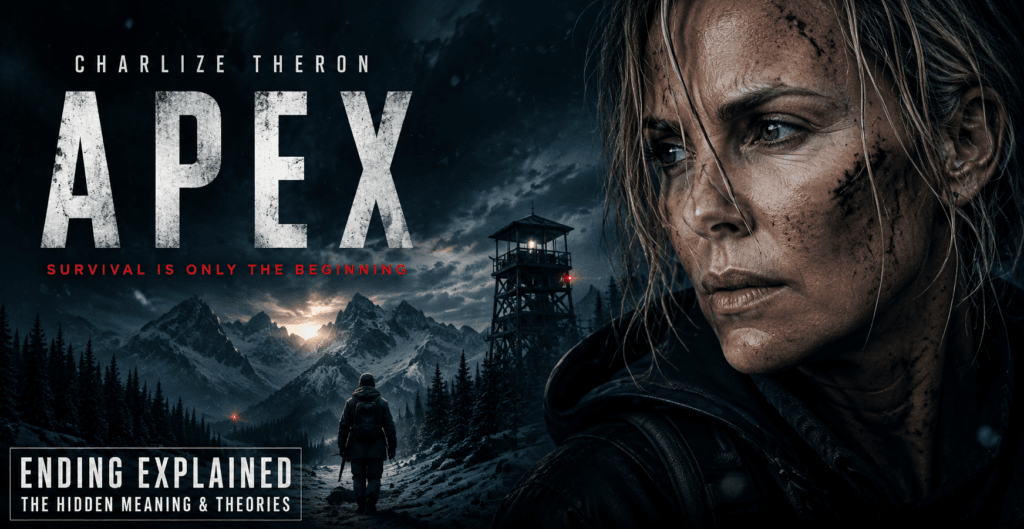
There’s a moment near the end of Apex where Sasha suddenly stops running. Apex ending explained.
Not because she’s trapped.
Not because she’s injured.
She just… stops.
The soundtrack disappears. Wind pushes through the trees. Her breathing becomes uneven while the camera stays locked on her face for several uncomfortable seconds. And for the first time in the movie, Sasha doesn’t look afraid of dying.
She looks afraid of remembering.
That scene genuinely caught me off guard.
Because Apex isn’t really about survival. At least not in the way Netflix marketing initially suggests. On the surface, it looks like another polished wilderness thriller: remote mountains, military-trained hunters, brutal weather conditions, and a protagonist forced into increasingly violent situations.
But underneath that tension, the film quietly becomes something much darker.
It’s a story about survivor’s guilt disguised as an action movie.
And honestly, that hidden layer is probably why audiences connected with it so quickly.
The movie works on two completely different levels:
- Casual viewers get suspense and adrenaline.
- attentive viewers get a slow breakdown of identity, guilt, and emotional numbness
That second layer is what makes Apex linger after the credits.
Introduction: Why Everyone Is Talking About Apex
Directed with a cold visual style that feels somewhere between The Revenant and Sicario, Apex immediately stands out from most Netflix thrillers because it refuses to move like a traditional action movie.
The pacing is slower.
The silences are longer.
And the movie seems much more interested in Sasha’s internal collapse than the mechanics of the hunt itself. Apex ending explained.
The story follows Sasha, a former military tracker recruited into a remote wilderness operation that quickly spirals into something far more disturbing. What begins as a tactical mission slowly transforms into a manipulated human experiment where participants are psychologically pushed toward violence, paranoia, and exhaustion.
At first, I honestly thought the movie was leaning too heavily into vague symbolism.
But somewhere around the river crossing sequence, it clicked.
The film isn’t hiding its meaning.
It’s slowly trapping the audience inside Sasha’s fractured perspective.
That’s why even simple scenes start feeling strangely oppressive.
And Charlize Theron absolutely carries that atmosphere with an intensely restrained performance.
Apex Ending Explained: What Really Happened to Sasha?
The ending of Apex works because it refuses to provide an easy closure.
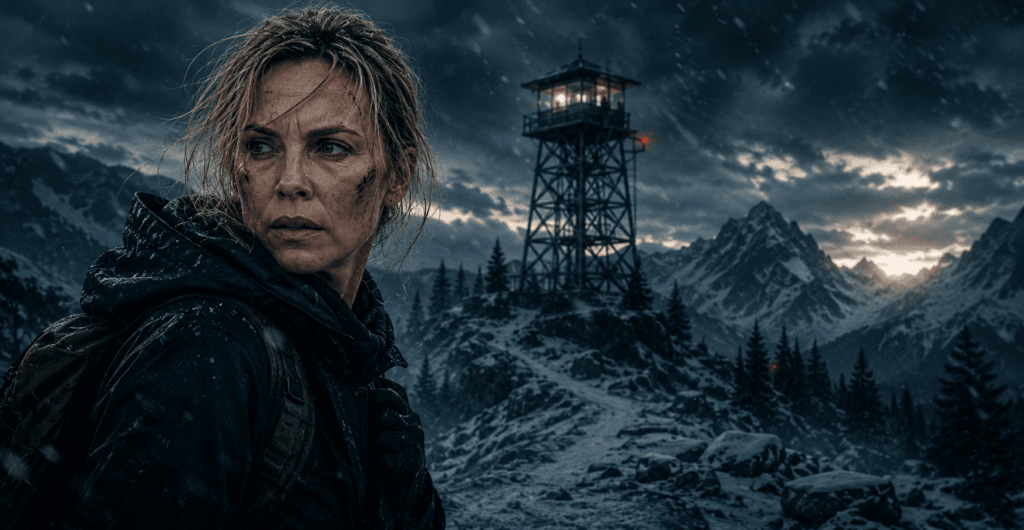
After surviving the final confrontation in the mountains, Sasha reaches the extraction zone expecting rescue. Instead, the film quietly reveals something deeply unsettling: the operation itself may never have been about military testing at all.
The hunters.
The manipulated radio signals.
The selective communication blackouts.
Even the terrain routes.
Everything appears intentionally designed to mentally destabilize participants.
The final radio transmission completely changes the meaning of the story. Instead of sounding relieved that Sasha survived, the operator speaks with almost clinical detachment, as if her suffering was simply data being monitored.
That detail matters more than the movie initially lets on.
Because suddenly, Apex stops looking like a survival mission and starts resembling a behavioral experiment.
And honestly, I wasn’t fully convinced by this reveal at first.
But the more the movie hints at repeated operational patterns, the more unsettling it becomes.
Sasha’s Real Battle Was Never Physical
Throughout the film, Sasha experiences fragmented flashbacks connected to a failed rescue mission from years earlier.
Initially, these scenes look like standard PTSD imagery.
But the ending reframes them entirely.
Sasha’s obsession with endurance isn’t really about staying alive.
It’s about punishment.
The film subtly suggests she believes she deserves suffering because she survived when others didn’t.
That idea appears repeatedly through her behavior:
- refusing medical treatment
- continuing despite severe injuries
- isolating herself from other survivors
- rejecting moments of vulnerability
- Repeatedly placing herself in danger unnecessarily.
After Sasha injures her leg near the abandoned ranger tower, the movie visually reinforces this mindset brilliantly. The forest suddenly feels tighter and more suffocating. Branches constantly block the frame while handheld camera movement becomes shakier, visually trapping her inside her own panic.
This is where Apex becomes far more interesting than a normal thriller.
The environment itself starts behaving like guilt.
Why Sasha Stops Running in the Final Scene
This might be the single most important moment in the movie.
And honestly, it’s probably the scene audiences will debate the most online.
By the final act, Sasha has spent the entire film operating on instinct:
- run
- hide
- attack
- survive
But when she suddenly stops near the extraction ridge, the movie quietly breaks that cycle.
For the first time, she’s no longer reacting.
She’s confronting herself.
The film repeatedly suggests that Sasha views survival as an obligation rather than freedom. Every action she takes feels driven by survivor’s guilt instead of hope.
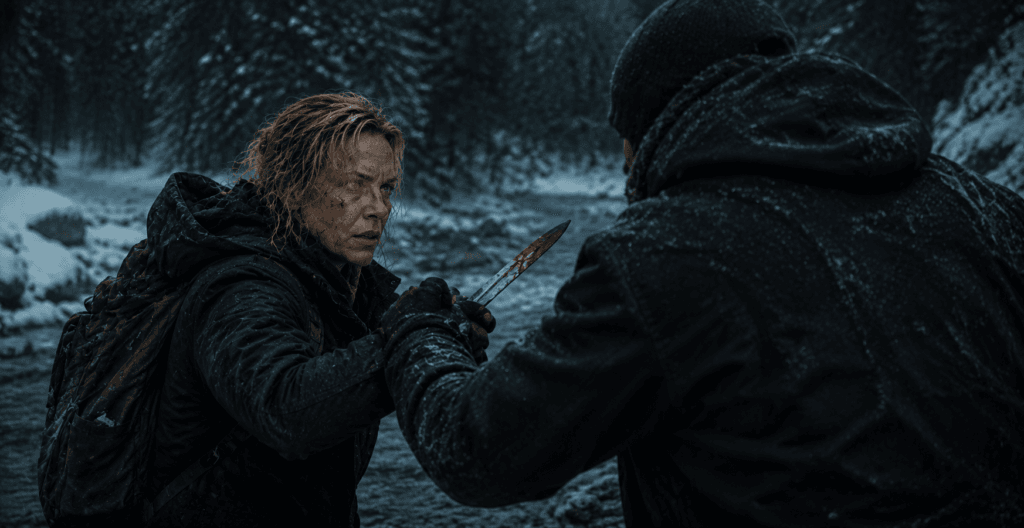
That’s why the final refusal to kill the wounded hunter matters so much.
Earlier in the movie, survival always justified violence.
Now it doesn’t.
And the movie never frames this moment heroically.
There’s no triumphant soundtrack.
No victorious speech.
She just looks exhausted.
Physically.
Mentally.
Existentially.
That restraint honestly makes the ending much stronger.
The Hidden Meaning of Apex: Survival as Emotional Punishment
Most survival thrillers focus on physical endurance.
Apex is much more interested in moral fatigue and internal collapse.
The movie constantly asks:
What happens when survival itself stops feeling meaningful?
That theme appears everywhere:
- emotionally disconnected conversations
- empty frozen landscapes
- Repeated references to instinct
- muted sound design
- isolated framing choices
Even the title Apex carries multiple meanings.
On one level, it refers to apex predators.
But emotionally, it also represents Sasha reaching the peak of psychological fragmentation.
The mountain setting reinforces this idea constantly.
Every climb feels less like physical movement and more like confrontation.
The One Detail That Completely Changes Apex
Near the end of the film, Sasha notices the same numerical code from the opening briefing repeated during the extraction signal.
At first, it seems insignificant.
But it quietly suggests the operation was never truly over.
That detail completely changes the movie because it implies:
- The mission may be cyclical
- Participants may be intentionally selected
- Sasha may never have fully escaped the system.
- Previous “survivors” may have gone through identical conditioning
Honestly, this is the kind of hidden detail audiences immediately start discussing online.
And the movie smartly refuses to explain it directly.
That ambiguity is frustrating at first.
But it also keeps the ending alive in your head longer.
Scene Breakdown: The Campfire Conversation Is the Emotional Core of the Film
Midway through the movie, Sasha shares a quiet conversation with another survivor beside a fire during a snowstorm.
Nothing dramatic happens.
No attacks.
No reveals.
But this scene quietly explains the entire movie.
The survivor says:
“People don’t run from death. They run from memory.”
That line completely reframes Sasha’s behavior.
Why the Scene Works So Well
Cinematography
The camera remains unusually close to Sasha’s face while the background stays blurred and unstable. It creates emotional claustrophobia without drawing attention to itself.
Lighting
The firelight flickers unevenly across her face, visually splitting her between shadow and warmth.
Subtle symbolism.
But very effective.
Sound Design
The storm outside becomes quieter as the conversation deepens, almost like the world itself temporarily disappears.
Performance
Charlize Theron barely moves during this sequence. But her expression changes almost imperceptibly after hearing the line about memory.
You can literally watch Sasha emotionally shut down in real time.
This scene is probably going to divide audiences because of how quiet it is.
But honestly, I think it’s the strongest sequence in the film.
Charlize Theron’s Performance Is More Physical Than Emotional — And That’s Why It Works
One criticism some viewers had was that Sasha feels emotionally distant.
But I actually think that’s intentional.
Charlize Theron plays Sasha like someone whose nervous system is permanently exhausted.
Instead of dramatic monologues, most of the performance happens physically:
- stiff posture
- delayed reactions
- shallow breathing
- refusal to make eye contact
- hyper-awareness of surroundings
It reminded me a little of her work in Mad Max: Fury Road, where physical behavior communicated more than dialogue ever could.
And honestly, if another actor had played Sasha with more obvious vulnerability, the movie probably would’ve felt less believable.
This character doesn’t process grief normally anymore.
She survives it.
Barely.
The Whiteout Sequence Is One of the Film’s Smartest Scenes
During the whiteout sequence immediately after the frozen river crossing, Sasha’s flashbacks become fragmented and visually overexposed. The camera briefly loses focus while distant radio chatter overlaps with the wind, making memory and environment feel almost indistinguishable.
That scene is where the movie fully commits to psychological fragmentation.
And honestly, I think it’s visually brilliant.
The editing becomes disorienting without turning chaotic. The audience loses spatial clarity at the exact same moment Sasha loses emotional control.
That synchronization between filmmaking and character perspective is something many thrillers fail to achieve.
What the Wolves Symbolize in Apex
The wolf imagery throughout the movie isn’t random.
Characters repeatedly reference: Apex ending explained.
- pack behavior
- hunting instincts
- predator hierarchy
But the symbolism becomes more interesting when Sasha herself starts behaving less like prey and more like something emotionally detached from humanity altogether.
At several points, the film frames her alone against massive snowy landscapes using extremely wide aerial shots. During quieter scenes, the camera often positions her at the edge of the frame instead of centered, visually reinforcing her separation from the world around her.
That’s not just style.
It’s identity symbolism.
ALSO READ:- https://movieexplainedhub.com/exit-8-ending-explained/
https://movieexplainedhub.com/spider-man-brand-new-day-movie-explained/
https://movieexplainedhub.com/interstellar-movie-explained/
https://movieexplainedhub.com/dune-2-movie-explained-full-story-ending/
https://movieexplainedhub.com/gladiator-2-movie-explained-ending-breakdown/
https://movieexplainedhub.com/18th-rose-ending-explained/
https://movieexplainedhub.com/godzilla-x-kong-the-new-empire-explained/
https://movieexplainedhub.com/hollow-earth-explained/
https://movieexplainedhub.com/scar-king-explained/
https://movieexplainedhub.com/godzilla-x-kong-the-new-empire-explained/
https://movieexplainedhub.com/monsterverse-movies-in-order/
https://movieexplainedhub.com/avatar-movie-ending-explained/
https://movieexplainedhub.com/dust-bunny-movie-explained/
https://movieexplainedhub.com/godzilla-x-kong-supernova-explained/
https://movieexplainedhub.com/spacegodzilla-explained/
https://movieexplainedhub.com/remarkably-bright-creatures-netflix-movie/
https://movieexplainedhub.com/person-of-interest-explained/
https://movieexplainedhub.com/kongs-axe-explained-monsterverse-secrets/
https://movieexplainedhub.com/mortal-kombat-2-ending-explained/
https://movieexplainedhub.com/upcoming-american-movies-september-2026/
https://movieexplainedhub.com/resident-evil-reboot-explained/
https://movieexplainedhub.com/upcoming-american-movies-september-2026/
https://movieexplainedhub.com/the-sheep-detectives-netflix-mystery/
https://movieexplainedhub.com/takeover-explained-may-2026/
https://movieexplainedhub.com/swapped-ending-explained/
https://movieexplainedhub.com/couples-weekend-hidden-secrets/
https://movieexplainedhub.com/obsession-movie-hidden-horror-themes/
https://movieexplainedhub.com/something-very-bad-is-going-to-happen-ending-explained/
https://movieexplainedhub.com/greenland-migration-ending-explained/
Was the Operation Real or Manipulated?
This is probably the movie’s biggest debate.
Theory 1: The Operation Was a Psychological Experiment
Supporting clues:
- detached radio operators
- inconsistent extraction protocols
- Repeated mission codes
- Participants selected based on trauma history
This theory honestly feels the most convincing.
Theory 2: Sasha Never Fully Escaped
Some viewers noticed that the final extraction scene looks visually different: Apex ending explained.
- brighter lighting
- smoother camera movement
- cleaner sound mix
This has led to theories that Sasha may still be trapped inside a controlled simulation or conditioning environment.
Personally, I think this interpretation is slightly overcomplicated.
But the film absolutely encourages ambiguity.
Cinematic Analysis: Why Apex Feels So Oppressive
One reason Apex feels more intense than most streaming thrillers is pacing discipline.
The movie understands that silence can be more stressful than action.
Camera Movement
Handheld shots dominate panic sequences, while static framing appears during moments of emotional paralysis.
That contrast subtly manipulates audience anxiety.
Sound Design
Instead of relying on constant music, the film uses low-frequency ambient sound and environmental noise to create subconscious tension.
Sometimes the soundtrack disappears entirely.
And honestly, those moments are scarier than the action scenes.
Editing
The film avoids rapid-cut editing during emotionally important moments. Shots linger slightly too long, forcing discomfort.
That pacing briefly frustrated me during the middle act.
But I also think that discomfort was intentional.
Hidden Details and Easter Eggs
The Broken Compass
The damaged compass symbolizes moral disorientation rather than navigation.
The Child’s Drawing
A drawing hidden inside Sasha’s backpack resembles victims from her failed rescue mission. Apex ending explained.
The movie never explains this directly.
Which honestly makes it more disturbing.
Repeated Radio Static
Radio interference becomes louder whenever Sasha approaches moments connected to memory or guilt.
Small detail.
Very effective.
Apex Timeline Breakdown
Timeline Structure
- Failed rescue mission
- Sasha was recruited into the operation.
- River crossing sequence
- Campfire confession
- Ranger tower injury
- Final hunt
- Extraction reveal
Psychological Breakdown Stages
| Stage | Sasha’s Mental State |
| Beginning | Controlled detachment |
| Midpoint | Moral exhaustion |
| Campfire Scene | Forced self-reflection |
| Final Hunt | Identity collapse |
| Ending | Partial acceptance |
What Doesn’t Fully Work
The movie is impressive.
But not flawless.
The Second Act Loses Momentum
Some supporting characters disappear before becoming emotionally meaningful.
I actually think the movie almost loses itself here.
Certain Mysteries Stay Too Vague
Ambiguity works best when grounded emotionally. Sometimes, Apex withholds information so aggressively that scenes risk feeling detached instead of mysterious.
Some Dialogue Feels Overwritten
A few philosophical lines sound more scripted than natural.
Still, the atmosphere remains strong enough to carry the weaker moments.
IMDb: IMDb – Apex (2026) Rotten Tomatoes: Rotten Tomatoes – Apex Reviews Wikipedia Overview: Apex (2026 Film) Overview Filming Locations Article: Where Apex Was Filmed True Story Explanation: Is Apex Based on a True Story?
FAQs
What does the ending of Apex mean?
The ending suggests Sasha’s journey was less about physical endurance and more about escaping a cycle of guilt and manipulation.
Was the operation real?
The movie strongly implies the mission functioned as a psychological conditioning experiment.
Why does Sasha stop running?
It represents the first moment she stops treating suffering as punishment.
What do the wolves symbolize?
Predatory instinct, isolation, and Sasha’s gradual emotional detachment from humanity.
Is Apex getting a sequel?
The repeated mission code heavily suggests the operation may continue with future participants.
Final Thoughts
What makes Apex memorable isn’t just tension.
It’s exhaustion.
The movie understands something many survival thrillers completely miss: physical danger becomes much scarier when characters are already emotionally broken before the story even begins.
And honestly, that’s why the ending lingers. Apex ending explained.
Not because it answers every question.
But it quietly asks whether surviving something automatically means escaping it.
That idea stays with you long after the credits end.