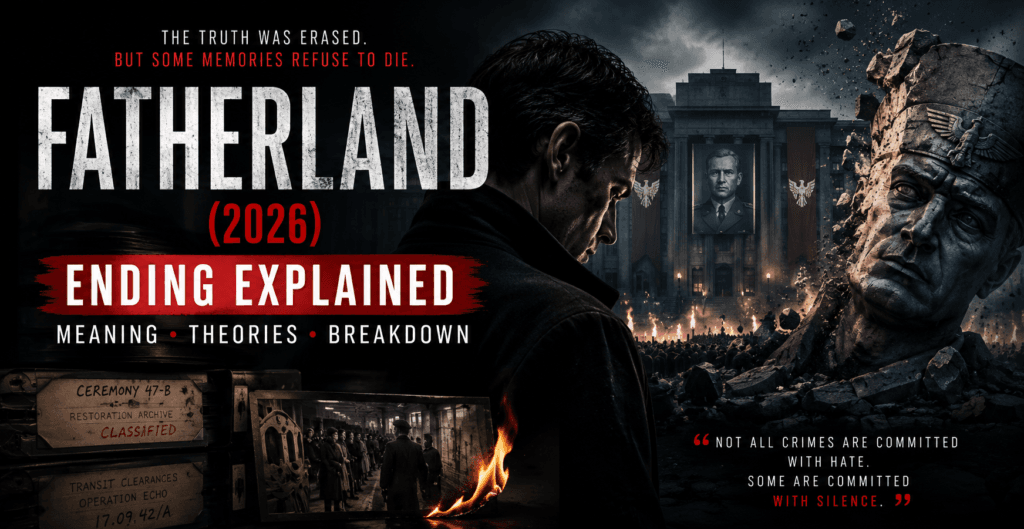
Some movies entertain you for two hours.
Others quietly invade your head afterward.
Fatherland belongs to the second category — the kind of film that becomes heavier the more you think about it. Honestly, I didn’t even fully process the ending the first time. The final memorial sequence looked visually stunning on the surface, but emotionally, it felt almost suffocating.
And that discomfort seems completely intentional.
Premiering at the Cannes Film Festival, Fatherland immediately divided audiences. Some viewers called it a masterpiece about inherited guilt and nationalism. Others thought it was cold, overly slow, and emotionally distant.
I can already imagine some people absolutely hating this movie.
But weirdly, I think that’s part of why it works.
The film refuses to comfort the audience. It never gives us an easy villain, an inspirational speech, or a satisfying emotional release. Instead, it presents a terrifyingly believable world where people slowly normalize moral compromise until it becomes invisible.
And by the time the ending arrives — with Elias standing silently beside the collapsing memorial while crowds continue singing patriotic hymns through the falling debris — the film reveals its real horror:
Not that history repeats itself.
But ordinary people quietly help it survive.
Quick Overview: What Is Fatherland Actually About?
7
Set in a fictional European nation decades after the fall of an authoritarian regime, Fatherland follows Elias Voss, a quiet government archivist assigned to restore damaged historical recordings before an upcoming national unity celebration.
At first, the job feels bureaucratic and emotionally distant.
But during restoration work, Elias discovers fragments of hidden recordings connected to his deceased father — a military officer publicly celebrated as a national hero.
The deeper Elias investigates, the more disturbing the truth becomes.
Instead of uncovering battlefield heroism, he begins finding evidence linked to forced disappearances, civilian transport operations, and erased government crimes.
What starts as a mystery slowly transforms into something much heavier:
a story about inherited identity, emotional denial, and the frightening power of national mythology.
Genre-wise, the film feels like a mixture of:
- Children of Men
- The Zone of Interest
- Nineteen Eighty-Four
- Blade Runner 2049
But Fatherland feels more intimate than any of them.
It’s less interested in spectacle and more obsessed with emotional decay.
Fatherland Ending Explained: What Really Happened?
What Does Ceremony 47-B Mean?
The emotional turning point of the film begins when Elias restores the final damaged archive reel labeled:
“Ceremony 47-B.”
Throughout the movie, Elias desperately wants to believe his father was misunderstood. Maybe he followed orders. Maybe the accusations were exaggerated. Maybe history became distorted over time.
The film intentionally encourages that hope.
Then the footage plays.
And suddenly, the entire movie changes tone.
Instead of military heroism, the recording shows exhausted civilians being processed through a transit terminal under armed supervision. Fluorescent lights buzz overhead while officials mechanically stamp transport papers. No dramatic music plays. No one screams.
That quietness makes the scene horrifying.
Elias’ father appears only briefly in-frame, calmly approving transportation clearances while avoiding eye contact with the civilians.
Honestly, that detail hit me harder than if the film had shown explicit violence.
Because he doesn’t look monstrous.
He looks ordinary.
That’s what Fatherland understands better than most political thrillers:
Systems survive because normal people emotionally adapt to cruelty through routine.
Who Was Elias’ Father Really?
The movie never fully answers this question, which honestly makes the story stronger.
Was he evil?
Cowardly?
Complicit?
Brainwashed?
Or simply emotionally obedient?
Probably all of them at once.
One subtle detail I completely missed initially happens during an early dinner flashback. Elias remembers his father carefully cleaning dirt from military boots while ignoring political discussions playing on the radio nearby.
At first, it feels insignificant.
Later, it becomes symbolic:
His father constantly cleans surfaces while refusing to confront moral contamination underneath.
That’s brilliant visual writing.
Why Did Elias Burn the Archive?
After discovering the truth, Elias faces the film’s central moral dilemma:
- expose the recordings publicly
- or destroy them forever
Initially, the answer seems obvious.
Reveal the truth.
But the movie complicates that instinct in uncomfortable ways.
Throughout the film, politicians repeatedly discuss “national healing.” Civil tensions are rising. Violent protests are already happening outside government buildings. Public trust feels fragile.
Elias slowly realizes something terrifying:
Truth may not heal society.
It may fracture it permanently.
So when he partially burns the archive, the moment feels emotionally conflicting instead of heroic.
The scene itself is incredibly restrained. No dramatic speeches. No emotional breakdown.
Just projector reels melting slowly while orange firelight reflects across Elias’ face.
And honestly, I think some viewers will hate this choice.
But that frustration is exactly what makes the scene work.
Did Elias Destroy the Evidence?
This is where the ending becomes fascinating.
The movie strongly implies Elias destroys only part of the archive.
During the burning sequence, we briefly see him remove a smaller reel before the fire spreads fully through the storage room.
The camera barely focuses on it.
It lasts maybe two seconds.
I genuinely didn’t notice it the first time.
If that interpretation is correct, Elias may have secretly preserved the truth while publicly appearing to destroy it.
Which changes the ending completely.
Instead of surrendering to denial, Elias may simply be waiting for the right moment.
Why Did the Memorial Collapse?
The Most Important Scene in Fatherland
6
The memorial collapse scene is honestly one of the strongest cinematic sequences I’ve seen from a political drama in years.
As patriotic music echoes across the ceremony plaza, cracks begin spreading across the giant memorial structure. Dust falls quietly at first. Officials continue speaking. The orchestra keeps playing.
Then, sections of concrete begin collapsing while crowds continue singing.
That detail matters.
The danger is no longer ignorance.
It’s chosen denial.
Symbolically, the meaning feels obvious:
The nation itself was built on unstable foundations.
But the scene works emotionally because nobody reacts fast enough.
People hesitate.
Freeze.
Pretend things are normal.
Which feels painfully realistic.
Why Fatherland’s Ending Is So Divisive
I completely understand why audiences are split on this ending.
Some viewers expected:
- public revelations
- emotional confrontation
- political revolution
Instead, Elias says almost nothing.
At first, I found that frustrating too.
But the more I thought about it, the more devastating it became.
Elias realizes something horrifying by the end:
People already know the truth emotionally.
Not fully.
Not consciously.
But deeply enough to sense it.
The entire country survives through selective forgetting.
And the film’s final argument becomes terrifyingly clear: Fatherland Ending Explained
Truth alone does not change societies.
People must want truth more than comfort.
That’s what makes the finale so bleak.
The Real Hidden Meaning Behind Fatherland
Fatherland Is Really About Inherited Identity
On the surface, the film explores political corruption and historical crimes.
Emotionally, though, it’s about children discovering painful truths about the generations before them.
Elias spends most of the movie trying to preserve his image of his father.
That instinct feels deeply human.
Most people want to believe their families were morally decent. Fatherland weaponizes that emotional reflex against the audience.
Even the title works symbolically: Fatherland Ending Explained
- nation as parent
- inherited ideology
- loyalty to history
- emotional nationalism
- identity through ancestry
The country itself becomes a symbolic father figure:
protective, authoritative, flawed, and impossible to fully abandon.
Memory as Political Control
One of the smartest filmmaking choices is the repeated use of damaged footage.
Static.
Missing audio.
Burned frames.
Projector flickering.
This isn’t just visual style.
It represents historical memory itself.
Governments in the Fatherland don’t erase history completely. They blur it just enough to create emotional uncertainty.
And honestly, that idea feels disturbingly modern.
Propaganda often works better through confusion than direct lies.
Fatherland Timeline Explained
Phase 1: The Regime Years
- Elias’ father serves within the authoritarian government.
- Civilian disappearances increase
- National archives become manipulated.
- Resistance movements begin forming.
Phase 2: Government Collapse
- International pressure weakens leadership.
- Secret evidence destruction begins.
- Historical records are selectively erased.
Phase 3: Reconstruction Era
- New leaders promote unity over accountability.
- Elias restores damaged state recordings.
- Hidden archive reels are discovered.
Phase 4: Revelation
- Elias uncovers evidence connected to his father.
- Political tensions escalate nationwide.
- Memorial ceremony preparations intensify.
Phase 5: Finale
- Elias partially burns the archive.
- Memorial structure collapses
- Crowds continue singing
- Elias remains silent
- ALSO READ:- https://movieexplainedhub.com/exit-8-ending-explained/
- ALSO READ:- https://movieexplainedhub.com/spider-man-brand-new-day-movie-explained/
- ALSO READ:- https://movieexplainedhub.com/interstellar-movie-explained/
- ALSO READ:- https://movieexplainedhub.com/oppenheimer-movie-explained-full-story-ending-explained-complete-breakdown/
- ALSO READ:- https://movieexplainedhub.com/dune-2-movie-explained-full-story-ending/
- ALSO READ:- https://movieexplainedhub.com/gladiator-2-movie-explained-ending-breakdown/
- ALSO READ:- https://movieexplainedhub.com/18th-rose-ending-explained/
- ALSO READ:- https://movieexplainedhub.com/godzilla-x-kong-the-new-empire-explained/
- ALSO READ:- https://movieexplainedhub.com/hollow-earth-explained/
- ALSO READ:- https://movieexplainedhub.com/scar-king-explained/
- ALSO READ:- https://movieexplainedhub.com/godzilla-x-kong-the-new-empire-explained/
- ALSO READ:- https://movieexplainedhub.com/monsterverse-movies-in-order/
- ALSO READ:- https://movieexplainedhub.com/avatar-movie-ending-explained/
- ALSO READ:- https://movieexplainedhub.com/dust-bunny-movie-explained/
- ALSO READ:- https://movieexplainedhub.com/godzilla-x-kong-supernova-explained/
- ALSO READ:- https://movieexplainedhub.com/spacegodzilla-explained/
- ALSO READ:- https://movieexplainedhub.com/remarkably-bright-creatures-netflix-movie/
- ALSO READ: –https://movieexplainedhub.com/person-of-interest-explained/
- ALSO READ:- https://movieexplainedhub.com/kongs-axe-explained-monsterverse-secrets/
- ALSO READ:- https://movieexplainedhub.com/mortal-kombat-2-ending-explained/
- ALSO READ:- https://movieexplainedhub.com/upcoming-american-movies-september-2026/
- ALSO READ:- https://movieexplainedhub.com/resident-evil-reboot-explained/
- ALSO READ:- https://movieexplainedhub.com/upcoming-american-movies-september-2026/
- ALSO READ:- https://movieexplainedhub.com/the-sheep-detectives-netflix-mystery/
- ALSO READ:- https://movieexplainedhub.com/takeover-explained-may-2026/
- ALSO READ:- https://movieexplainedhub.com/swapped-ending-explained/
- ALSO READ:- https://movieexplainedhub.com/couples-weekend-hidden-secrets/
- ALSO READ:-https://movieexplainedhub.com/obsession-movie-hidden-horror-themes/
- ALSO READ:- https://movieexplainedhub.com/something-very-bad-is-going-to-happen-ending-explained/
- ALSO READ:- https://movieexplainedhub.com/greenland-migration-ending-explained/
- ALSO READ:- http://movieexplainedhub.com/takeover-ending-explained/
- ALSO READ:- https://movieexplainedhub.com/takeover-2026-cast/
- ALSO READ:- https://movieexplainedhub.com/war-machine-ending-explained/
- ALSO READ:- https://movieexplainedhub.com/war-machine-cast-and-filming-locations/
- ALSO READ:- https://movieexplainedhub.com/fatherland-2026-release-date-production-details/
- ALO READ:- https://movieexplainedhub.com/couples-weekend-hidden-emotional-meaning-explained/
- ALO READ:- https://movieexplainedhub.com/influenced-hidden-emotional-meaning-explained/
- ALSO READ:- https://movieexplainedhub.com/obsession-underrated-horror-film/
- ALSO READ:- https://movieexplainedhub.com/in-the-grey-hidden-meaning-guy-ritchie/
- ALSO READ:-https://movieexplainedhub.com/the-sheep-detectives-ending-explained/
Hidden Details & Easter Eggs You Probably Missed
The Broken Clock Motif
7
Multiple clocks throughout the film stop at 8:14.
The movie never explains this directly, but it likely references the exact time emergency arrest orders officially began during the regime era.
Honestly, I love that the film trusts viewers enough not to explain every detail.
The Red Gloves Symbolism
In archival footage, Elias’ father repeatedly wears dark red leather gloves.
Later, Elias unconsciously purchases nearly identical gloves from a street vendor.
No dialogue calls attention to it.
But visually, the symbolism is obvious: Fatherland Ending Explained
moral inheritance passes down quietly.
The Background Radio Broadcasts
One detail I only noticed during rewatch:
Many radio broadcasts subtly contradict official public statements.
While politicians speak about “national unity,” background reports mention protests, disappearances, and supply shortages.
Truth exists openly in the film.
People simply learn to emotionally filter it out.
Fatherland Theories Explained
Theory 1: Elias Always Knew the Truth
This theory honestly makes the movie even sadder.
Evidence includes: Fatherland Ending Explained
- Elias is delaying restoration work.
- Repeated rewatches of incomplete footage
- emotional numbness feeling rehearsed
- avoiding direct questions about his father
The investigation may not be about discovery.
It may be about emotional confirmation.
Theory 2: The Memorial Collapse Was Intentional
Some viewers believe resistance groups sabotaged the memorial structure.
The film hints at this through: Fatherland Ending Explained
- missing maintenance reports
- security blackouts
- unexplained structural damage
If true, the ending becomes politically explosive instead of a symbolic coincidence.
Theory 3: Elias Saved the Most Dangerous Evidence
The final archive reel may still exist somewhere.
Waiting.
That possibility quietly transforms the ending from hopeless into something more threatening.
Or maybe hopeful.
The movie intentionally leaves that unclear.
Emotional Analysis: Why the Film Feels So Heavy
This movie understands emotional avoidance almost too well.
Elias barely cries throughout the story. Instead, he emotionally disappears piece by piece.
And honestly, that restraint feels more realistic than dramatic breakdown scenes.
One sequence genuinely stayed with me:
Elias is listening to his father’s voice recording alone inside the archive room while fluorescent lights buzz overhead and projector reels click mechanically in the dark.
Nothing dramatic happens.
But you can physically feel his identity collapsing.
That’s rare filmmaking.
And I honestly think some audiences will find the film emotionally exhausting because of it.
Cinematic Analysis: Why Cannes Audiences Reacted So Strongly
Cinematography
The cinematography uses: Fatherland Ending Explained
- cold blue-gray palettes
- symmetrical framing
- brutalist architecture
- long static compositions
Characters constantly appear trapped inside government structures.
Even simple hallways feel oppressive.
Camera Movement
The movie rarely uses handheld camerawork until the finale.
Once the memorial collapses, the camera suddenly becomes unstable and chaotic.
That technical shift reflects societal breakdown psychologically.
Subtle.
Smart.
Very effective.
Sound Design
The sound design deserves huge credit.
During the archive restoration scenes, the soundtrack almost disappears entirely except for:
- projector clicks
- fluorescent buzzing
- tape hiss
- distant ventilation sounds
That silence becomes deeply uncomfortable over time.
Honestly, I think the movie would feel weaker with traditional dramatic music.
Final Thoughts: Why Fatherland Feels So Uncomfortably Real
Fatherland is not an easy film.
It’s slow.
Emotionally cold.
Intentionally frustrating at times.
I honestly think the second act drags slightly in places. Fatherland Ending Explained
But strangely, that slowness also makes the finale hit harder.
The film forces audiences to sit inside emotional discomfort instead of escaping it.
And maybe that’s why the ending feels so believable.
The movie understands something deeply unsettling about modern society:
People don’t always reject truth because they hate it.
Sometimes they reject it because living with it feels impossible.
And that final image — citizens continuing to sing while the memorial collapses around them — may end up becoming one of the defining cinematic moments of 2026.
Not because it shocks.
Because it feels real.
FAQs
What does the ending of Fatherland mean?
The ending symbolizes societal denial. Even after the truth becomes visible, people continue emotionally protecting national myths rather than confronting reality.
Is Fatherland based on a true story?
No, but the film clearly draws inspiration from historical authoritarian regimes and real-world debates about historical memory and nationalism.
What happened in the finale?
Elias discovers evidence implicating his father in state crimes while a national memorial literally collapses during a patriotic ceremony.
Are the Fatherland theories true?
The film intentionally leaves many details ambiguous. Several theories are supported through visual hints rather than direct exposition.
Will there be a sequel?
No sequel has been officially announced, though the world-building leaves room for expanded stories.
https://www.festival-cannes.com/https://www.imdb.com/https://variety.com/https://www.indiewire.com/https://www.rottentomatoes.com/https://letterboxd.com/https://deadline.com/https://www.theguardian.com/filmhttps://www.empireonline.com/movies/https://www.hollywoodreporter.com/movies/