Introduction
What makes a fake painting valuable?
At first glance, Forge looks like a stylish crime drama about art forgery, family loyalty, and a dangerous game between criminals and law enforcement. But the longer the film sits with you, the clearer it becomes that Jing Ai Ng’s directorial debut is interested in something much deeper than counterfeit masterpieces.
The real question at the heart of Forge is not whether a painting is authentic.
It is whether people are.
Why do some individuals spend their lives pretending to be someone else? Why do talented people feel invisible until they receive recognition from powerful institutions? And what happens when society values appearance more than truth?
These questions quietly drive every major character in the film.
On the surface, the story follows siblings Coco and Raymond Zhang as they operate an underground art forgery ring while FBI agent Emily Lee investigates a growing network of counterfeit masterpieces. But beneath the crime-thriller framework lies a surprisingly emotional exploration of identity, belonging, ambition, and self-worth. (Wikipedia)
What impressed me most about Forge is how it refuses easy answers. Characters are rarely divided into heroes and villains. Instead, almost everyone is chasing validation in one form or another. Some seek wealth. Some seek artistic recognition. Others seek moral certainty.
By the time the final scenes arrive, the film transforms from a crime caper into a meditation on authenticity itself.
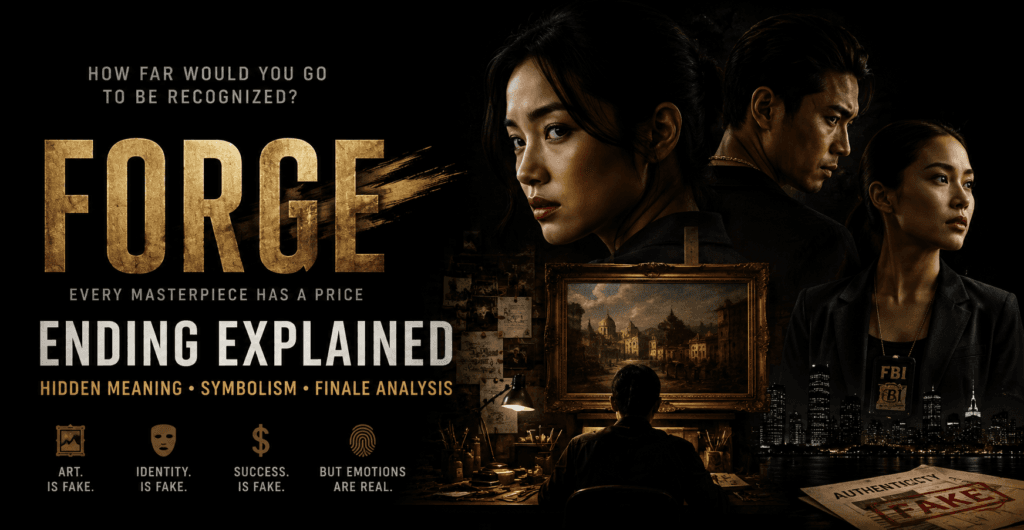
This Forge Ending Explained analysis explores the movie’s deeper themes, character psychology, symbolism, hidden details, and the emotional meaning behind its unforgettable finale.
Movie Information
| Detail | Information | |
| Title | Forge | |
| Director | Jing Ai Ng | |
| Writer | Jing Ai Ng | |
| Release Year | 2025 (festival premiere) | |
| Runtime | 114 minutes | |
| Genre | Crime, Comedy-Drama | |
| Main Cast | Kelly Marie Tran, Andie Ju, Brandon Soo Hoo, Sonya Walger, Edmund Donovan, Eva De Dominici | |
| Setting | Miami Art World | (Wikipedia) |
One reason the film feels unusually focused is that Jing Ai Ng serves as both writer and director. The screenplay originated through Film Independent’s Screenwriting Lab before becoming her feature directorial debut. That dual role gives the movie a consistent thematic voice centered on authenticity, identity, and artistic value. (Wikipedia)
What Is Forge About?
Quick Answer
Forge follows siblings Coco and Raymond Zhang, who run an art-forgery operation and become entangled with a disgraced millionaire while FBI agent Emily Lee investigates a new wave of counterfeit masterpieces. Beneath the crime story, the film explores authenticity, ambition, family loyalty, and the price of reinvention. (Wikipedia)
Forge Story Overview
Rather than focusing on conventional heists, Forge introduces viewers to a world where art, money, and identity constantly overlap.
Coco and Raymond possess extraordinary artistic abilities, but instead of receiving recognition through traditional channels, they survive by creating counterfeit masterpieces. Their operation grows increasingly dangerous when wealthy collectors and influential figures become involved.
At the same time, FBI agent Emily Lee begins tracking a sophisticated forgery network.
The setup creates an engaging cat-and-mouse dynamic.
However, the true conflict is internal rather than criminal.
Every major character is wrestling with a question:
How much of yourself are you willing to fake in order to succeed?
Forge Ending Explained
The final act works because it shifts attention away from the criminal investigation and toward emotional truth.
By the finale, the characters have reached a point where continuing their deception becomes impossible.
The most important revelation is not whether the forged artwork is discovered.
The real revelation is that the characters themselves have become trapped inside identities they created.
Coco’s journey reaches its emotional peak because she finally confronts the contradiction that has defined her life.
She desperately wants recognition for her artistic talent.
Yet every success she achieves is hidden behind somebody else’s signature.
That irony forms the emotional center of the movie.
The forged paintings become symbolic mirrors.
They receive admiration.
They receive attention.
They receive value.
But the actual creator remains invisible.
The ending forces Coco to choose between safety and authenticity.
Raymond experiences a similar realization. Throughout the film, he treats forgery as survival. By the conclusion, he recognizes that survival alone is not enough. Living without ownership of one’s identity creates a different form of imprisonment.
Emily Lee’s role in the finale is equally important.
Rather than functioning purely as law enforcement, she becomes a moral counterweight. Her investigation gradually transforms into an examination of value itself.
The ending leaves some ambiguity regarding future consequences, but emotionally, the message is clear:
Authenticity requires sacrifice.
The characters may lose security, money, or status.
Yet they regain something more important:
ownership of themselves.
The Hidden Meaning of Forge
Identity
Identity is the film’s strongest theme.
Every major character performs a version of themselves.
Collectors perform sophistication.
Criminals perform legitimacy.
Artists perform with confidence.
Even investigators perform certainty.
The movie suggests identity is partly constructed—but becomes dangerous when the performance replaces reality.
Purpose
The siblings possess genuine artistic talent.
Ironically, they use that talent to imitate rather than create.
The film asks whether purpose comes from skill alone or from honest self-expression.
The answer appears to be the latter.
Guilt
Guilt appears in subtle ways throughout the story.
Characters rarely confess wrongdoing openly.
Instead, guilt emerges through hesitation, silence, and emotional distance.
These moments often reveal more than dialogue.
Isolation
Despite being surrounded by people, several characters feel profoundly alone.
The art world depicted in Forge rewards image over connection.
As a result, meaningful relationships become increasingly difficult.
Sacrifice
The film repeatedly argues that transformation requires sacrifice.
Nobody changes without losing something first.
That principle drives the emotional impact of the ending.
Character Psychology Analysis
Coco Zhang
Coco is perhaps the most fascinating character in the film.
Her central wound is invisibility.
She knows she is talented.
Yet the world only values her work when somebody else’s name is attached.
That creates resentment, frustration, and self-doubt.
Her forgery career becomes a psychological coping mechanism.
Instead of risking rejection as herself, she succeeds anonymously.
The tragedy is obvious:
Every forged masterpiece proves her brilliance while simultaneously erasing her identity.
Symbolically, Coco represents the artist struggling for recognition.
Raymond Zhang
Raymond functions as the pragmatist.
Unlike Coco, he focuses less on artistic validation and more on survival.
Yet beneath that practicality lies fear.
He fears instability.
He fears failure.
Most importantly, he fears losing family.
His decisions often emerge from protection rather than greed.
That complexity prevents him from becoming a simple criminal archetype.
Emily Lee
Kelly Marie Tran’s Emily Lee is more than an investigator.
Psychologically, she represents accountability.
However, the character avoids becoming self-righteous.
Instead, she embodies the uncomfortable reality that truth often creates pain.
Her pursuit of justice frequently places her in morally complicated territory.
Most Important Scenes Explained
The First Forgery Reveal
When viewers first witness the sophistication of the operation, the sequence establishes the film’s central paradox.
The work is fake.
The talent is real.
Visually, the camera emphasizes precision and craftsmanship, creating admiration rather than immediate condemnation.
This ambiguity becomes crucial later.
Museum Sequence
This scene explores institutional validation.
A forged piece receives praise because experts believe it is authentic.
The moment raises an uncomfortable question:
Do people value art itself or the reputation attached to it?
Coco’s Confrontation
One of the film’s strongest emotional scenes occurs when Coco directly confronts questions about artistic ownership.
The dialogue matters less than the subtext.
For the first time, she acknowledges her frustration openly.
This scene genuinely surprised me because it shifts the movie from a crime thriller into a character study.
Emily’s Discovery
The investigative breakthrough works because it is framed emotionally rather than procedurally.
The discovery exposes not only criminal activity but personal vulnerabilities.
The Final Choice
The climactic decision matters because it resolves the film’s thematic conflict.
Characters stop asking how to succeed.
Instead, they ask how to live honestly.
That distinction changes everything.
Cinematic Analysis
Direction
Jing Ai Ng demonstrates impressive confidence for a feature debut.
Rather than relying on constant plot twists, she prioritizes character perspective.
Many scenes allow emotional tension to develop gradually.
This restraint strengthens the payoff.
Cinematography
Leo Purman’s cinematography frequently contrasts wealth with uncertainty. Miami’s glamorous spaces often feel emotionally empty. (Wikipedia)
Reflections, glass surfaces, and framed images appear repeatedly.
These visual choices reinforce themes of duplication and identity.
ALSO READ:- https://movieexplainedhub.com/exit-8-ending-explained/
ALSO READ:- https://movieexplainedhub.com/spider-man-brand-new-day-movie-explained/
ALSO READ:- https://movieexplainedhub.com/interstellar-movie-explained/
ALSO READ:- https://movieexplainedhub.com/oppenheimer-movie-explained-full-story-ending-explained-complete-breakdown/
ALSO READ:- https://movieexplainedhub.com/dune-2-movie-explained-full-story-ending/
ALSO READ:- https://movieexplainedhub.com/gladiator-2-movie-explained-ending-breakdown/
ALSO READ:- https://movieexplainedhub.com/18th-rose-ending-explained/
ALSO READ:- https://movieexplainedhub.com/godzilla-x-kong-the-new-empire-explained/
ALSO READ:- https://movieexplainedhub.com/hollow-earth-explained/
ALSO READ:- https://movieexplainedhub.com/scar-king-explained/
Sound Design
One subtle strength of the film is its use of silence.
Important emotional moments are rarely overwhelmed by music.
Instead, pauses create discomfort and intimacy.
Editing
The pacing balances crime-story momentum with character introspection.
Transitions often mirror the film’s thematic concern with duality and deception.
Symbolism Breakdown
Paintings
The paintings symbolize identity itself.
They possess value because people believe a particular story about them.
The same principle applies to many characters.
Signatures
Signatures represent ownership.
Throughout the movie, characters struggle with who deserves credit and recognition.
The recurring focus on names reinforces this theme.
Mirrors and Reflections
Reflections appear frequently.
They visually reinforce questions about authenticity.
Is the reflection real?
Is it imitation?
Does the distinction matter?
Miami
The city itself becomes symbolic.
It is a place built on reinvention, image, and aspiration.
That environment perfectly complements the film’s themes.
Hidden Details & Easter Eggs
Several subtle details reward attentive viewers:
- Repeated references to authenticity in seemingly unrelated conversations.
- Background artwork that mirrors character conflicts.
- Visual callbacks involving framed images and reflections.
- Dialogue that foreshadows later revelations about identity.
- Moments where characters describe themselves using language later applied to forged art.
These details create stronger thematic cohesion upon rewatch.
Original Theory Section
Theory 1: The Art World Is the Real Villain
Evidence
Collectors repeatedly value reputation over artistic merit.
Why It Matters
The movie may be criticizing institutions rather than individuals.
Theory 2: Coco’s Greatest Forgery Is Herself
Evidence
She constantly hides her true ambitions and emotions.
Why It Matters
The title may refer as much to personal identity as to artwork.
Theory 3: Emily Represents the Audience
Evidence
She gradually questions assumptions about value and authenticity.
Why It Matters
Her journey mirrors the viewer’s evolving perspective.
Emotional Interpretation
The reason audiences connect with Forge is simple:
Most people understand what it feels like to be overlooked.
Not everyone can relate to art forgery.
Almost everyone can relate to wanting recognition.
That emotional universality gives the film surprising power.
One scene in particular stayed with me long after the credits.
Not because it was dramatic.
Because it felt painfully honest.
The film quietly earns its emotional payoff by allowing characters to reveal vulnerability gradually rather than through grand speeches.
Comparison Section
Fans of films like Parasite, Catch Me If You Can, and Nightcrawler may appreciate aspects of Forge.
Like those films, it explores ambition and performance.
However, Forge is less interested in suspense than identity.
Its strongest moments emerge from emotional contradiction rather than shocking twists.
That distinction gives it a unique voice.
What the Finale Really Means
Ultimately, the finale argues that authenticity is more valuable than success built on deception.
The characters spend much of the story chasing validation.
By the end, they realize validation without ownership is empty.
The film’s final message is not that mistakes disappear.
It is that transformation begins when people stop hiding behind carefully constructed versions of themselves.
In other words:
The masterpiece was never the painting.
It was the courage to be seen honestly.
FAQ
What happens at the end of Forge?
The finale forces major characters to confront the consequences of deception and choose authenticity over comfort.
What does the ending mean?
It explores identity, accountability, and the emotional cost of living behind a false image.
Is Forge based on a true story?
No, but it draws inspiration from real-world art forgery culture. (Wikipedia)
Who plays Emily Lee?
Kelly Marie Tran portrays FBI agent Emily Lee. (Wikipedia)
What is the hidden meaning of Forge?
The film uses art forgery as a metaphor for identity and self-worth.
Why is Coco important?
She embodies the struggle between artistic talent and public recognition.
What genre is Forge?
Crime drama with comedic and psychological elements. (Rotten Tomatoes)
Who directed Forge?
Jing Ai Ng wrote and directed the film. (Wikipedia)
Suggested Internal Links
- SpaceGodzilla Explained
- Lord of the Flies Explained
- Person of Interest Explained
- Psychological Movie Ending Explained Articles
Outbound Sources
- IMDb – Forge (2025) (IMDb)
- Rotten Tomatoes – Forge (2025) (Rotten Tomatoes)
- SXSW Film Festival Listing (SXSW 2026 Schedule)
- Wikipedia Film Information (Wikipedia)
Personal Opinion
What impressed me most about Forge is its confidence.
Many debut crime films focus entirely on plot mechanics.
Jing Ai Ng chooses a more interesting path.
She uses crime as a vehicle for discussing identity and artistic validation.
Not every subplot lands perfectly, and there are moments where the narrative feels slightly compressed. Yet the emotional core remains strong throughout.
Most importantly, the film trusts its audience.
It asks questions instead of delivering easy answers.
That restraint makes the ending more memorable.
Final Thoughts
This Forge Ending Explained analysis ultimately comes down to one idea:
Authenticity has a cost.
Throughout the film, characters attempt to manufacture value through deception, imitation, and performance. Yet the ending reveals that genuine identity cannot be forged indefinitely.
Jing Ai Ng’s debut is at its best when exploring the emotional space between who people are and who they pretend to be.
Long after the mystery is resolved, that question remains:
If the world only loves the version of you that isn’t real, what are you willing to risk in order to be yourself?