Published: June 11, 2026
Last Updated: June 11, 2026
Author: Luke Loki Jonathan Sobol’s Vision for Signal One
What We Know So Far
Transparency Note: This article is based on the officially released synopsis, promotional materials, cast announcements, and publicly available information about Signal One (2026). Where this article explores symbolism or theories, those sections represent interpretation rather than confirmed plot details. The goal is to help readers think more deeply about the film instead of presenting speculation as fact. Jonathan Sobol’s Vision for Signal One
Introduction: What If the Most Important Discovery Was Just One Message?
Imagine spending decades searching the universe for intelligent life only to discover that someone has been trying to reach us all along.
That’s the idea that immediately makes Signal One (2026) stand out.
Modern science fiction often begins with explosions, invasions, or giant spacecraft appearing above cities. Signal One appears to take a quieter and potentially more unsettling approach. Instead of asking what happens when aliens arrive, it asks something even more fascinating:
What happens when humanity finally hears a reply?
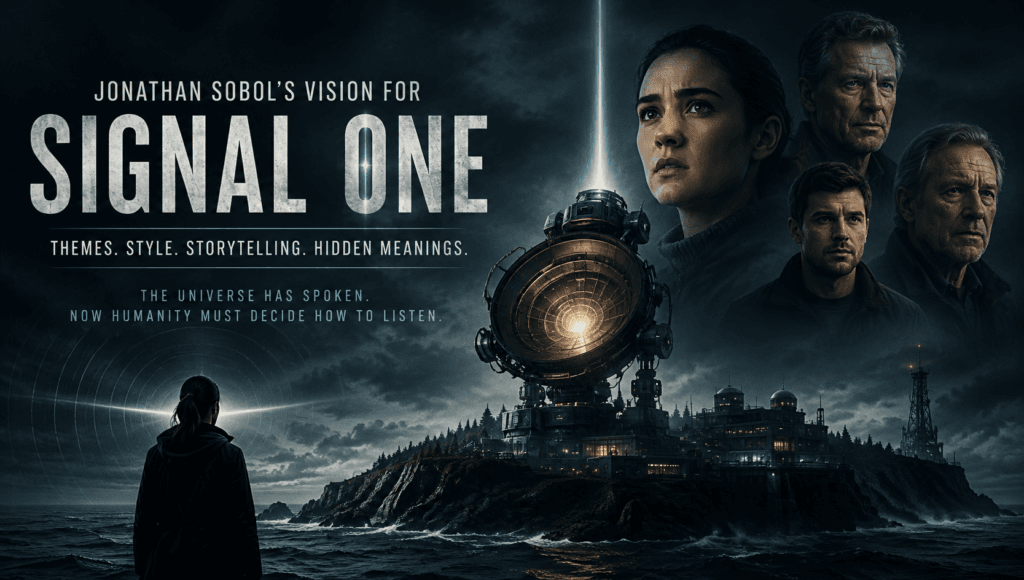
The premise follows Annika, a computer scientist recruited to work at a secret island research facility where a mysterious machine called LITTLEMOUTH can communicate with extraterrestrial intelligence. On paper, that sounds like classic science fiction. But the deeper you think about it, the more philosophical the concept becomes.
Personally, that’s exactly why the movie caught my attention. Communication is unpredictable. A war has obvious rules. A conversation with another civilization does not.
Why Jonathan Sobol’s Direction Matters
Jonathan Sobol has often shown interest in stories driven by people rather than spectacle.
While many directors use science fiction primarily as a backdrop for visual effects, Sobol’s involvement suggests that Signal One could prioritize ideas over explosions.
That creative decision alone changes audience expectations.
Rather than asking: Jonathan Sobol’s Vision for Signal One
“How do humans defeat aliens?”
The film appears to ask:
“How do humans react when everything they believed about the universe changes overnight?”
Those are fundamentally different questions.
The first creates action.
The second creates introspection.
And introspection often leads to more memorable cinema.
A Different Kind of Science Fiction
One reason the premise feels refreshing is that communication itself becomes the conflict.
Traditional alien invasion films establish clear enemies.
Communication-based stories create uncertainty.
Every message creates another question.
Who sent it?
Why now?
Should we answer?
Can we trust it?
Could misunderstanding one sentence have catastrophic consequences?
Those possibilities make conversation more suspenseful than combat.
In many ways, silence becomes scarier than noise.
Why Slower Science Fiction Often Lasts Longer
Fast-paced action movies can be entertaining.
But history shows that many science-fiction classics survive because they challenge audiences intellectually. Jonathan Sobol’s Vision for Signal One
Films centered around philosophy often remain relevant decades later because they invite repeated interpretation.
Every viewing reveals something new.
Every conversation uncovers another possibility.
If Signal One successfully embraces that style, it could become the kind of film people discuss long after leaving the theater.
Communication Is More Frightening Than Invasion
This is one thought I kept returning to while researching the film.
An invasion tells humanity exactly what it’s dealing with.
Communication creates uncertainty.
Imagine receiving a message from a civilization thousands of years more advanced.
Would we understand it?
Would mathematics be enough?
Would language even matter?
Or would the biggest challenge simply be interpreting intent?
History shows that even human civilizations frequently misunderstand one another.
Now imagine communicating across light-years.
That possibility alone creates extraordinary tension.
Understanding LITTLEMOUTH
The most fascinating element of Signal One is unquestionably LITTLEMOUTH.
According to official information, it is capable of communicating with extraterrestrial intelligence.
Even without knowing every detail, the machine immediately becomes symbolic.
Technology has always represented humanity’s desire to extend its reach.
Telescopes let us see farther.
Satellites let us communicate farther.
LITTLEMOUTH appears to represent humanity taking the next logical step.
Instead of merely observing the universe…
It starts talking back.
That shift transforms passive curiosity into active participation.
And active participation always carries responsibility.
Could LITTLEMOUTH Be More Than a Machine?
One interpretation I find particularly interesting is that LITTLEMOUTH may symbolize humanity itself.
Machines are built to solve problems.
Humans are driven to ask questions.
Perhaps the machine isn’t simply contacting aliens.
Perhaps it’s exposing humanity’s deepest desire:
To know whether we are alone.
Sometimes technology reveals more about its creators than its purpose.
LITTLEMOUTH may ultimately become less about extraterrestrials and more about the people operating it.
The Island as a Character
The isolated Caribbean research facility isn’t merely a backdrop. Jonathan Sobol’s Vision for Signal One
It functions almost like another character.
Remote locations create emotional pressure.
There are fewer witnesses.
Less oversight.
Greater secrecy.
History has repeatedly shown that scientific breakthroughs often happen away from public attention before eventually transforming society.
By placing this project on an island, the filmmakers create natural isolation while reinforcing themes of hidden knowledge.
The location itself becomes symbolic.
The ocean surrounding the facility mirrors humanity’s separation from whatever exists beyond Earth.
Annika: Curiosity Personified
Annika appears positioned as more than just the protagonist. Jonathan Sobol’s Vision for Signal One
She represents curiosity itself.
Scientists in first-contact stories often become emotional stand-ins for humanity.
They ask questions that ordinary people cannot.
But they also carry extraordinary responsibility.
Every decision has consequences.
If she chooses to continue communication, she risks changing civilization forever.
If she chooses to stop, she may deny humanity its greatest discovery.
That’s an impossible position.
And that’s exactly what makes her compelling.
Why Scientists Make Great Protagonists
Action heroes solve problems with force.
Scientists solve problems with understanding.
That distinction changes the emotional tone of a story.
Instead of asking:
“Can we survive?”
The audience begins asking:
“Can we understand?”
Signal One appears built around that second question.
And personally, I find that much more interesting.
The greatest discoveries in history weren’t won through violence.
They were earned through curiosity.
Real-World Inspiration Behind the Premise
Although Signal One is fictional, its central idea echoes genuine scientific debates.
Organizations studying extraterrestrial intelligence have long discussed whether humanity should actively transmit messages into space.
Some experts believe contact could transform civilization positively.
Others worry that broadcasting our location could expose humanity to unknown risks.
The film appears positioned directly between optimism and caution.
That ambiguity makes the premise intellectually engaging.
It refuses easy answers.
Why the Premise Feels Surprisingly Human
Ironically, the aliens may not be the story’s most important element. Jonathan Sobol’s Vision for Signal One
The real subject appears to be humanity itself.
How do people react to uncertainty?
How much truth can society handle?
Who gets to decide whether communication continues?
The extraterrestrials may simply become catalysts for revealing human nature.
And that’s often what the best science fiction accomplishes.
My Personal Reaction
The more I examined Signal One’s premise, the more one thought stayed with me:
Communication is harder than conflict.
Conflict has winners.
Communication requires understanding.
Personally, I find that infinitely more unsettling.
A war ends.
A conversation can change civilization forever.
That possibility alone makes Signal One one of the more intriguing science-fiction concepts in recent years.
Cinematic Style: Why Atmosphere Can Be More Powerful Than Action
One of the first things that stands out about Signal One is its apparent commitment to atmosphere over spectacle.
Many science-fiction blockbusters try to overwhelm audiences with visual effects. Massive battles, collapsing cities, and endless explosions dominate the screen.
Signal One appears to take a different route.
Based on the promotional material and premise, the film seems interested in building tension through silence, isolation, and anticipation.
Personally, I think this approach is more effective.
Silence gives viewers time to think.
Dark hallways become threatening.
A simple radio transmission suddenly feels more dangerous than an entire fleet of spaceships.
The unknown becomes the villain.
Jonathan Sobol’s Storytelling Philosophy
Although every director evolves with each project, Jonathan Sobol’s involvement suggests an emphasis on character-driven storytelling rather than pure spectacle. Jonathan Sobol’s Vision for Signal One
Instead of making audiences ask:
“What happens next?”
The film appears designed to make viewers ask:
“What would I do?”
That’s an important distinction.
The strongest science-fiction stories don’t simply entertain.
They force audiences into uncomfortable moral territory.
Would you answer an alien message?
Would you tell the public?
Would you trust governments to make that decision?
Those questions stay with viewers long after the credits roll.
Comparing Signal One to Arrival
Perhaps the closest comparison is Arrival.
However, the similarities may stop at communication itself.
Arrival explores language as a tool that changes perception.
Signal One appears more focused on technology as the bridge between civilizations.
Both stories seem interested in patience rather than action.
But while Arrival examines understanding another species, Signal One may be asking whether humanity is emotionally prepared for contact in the first place.
Communication is not automatically comprehension.
Comparing Signal One to Contact
Contact approached extraterrestrial communication with optimism.
Discovery became hope.
Signal One appears more cautious.
The existence of LITTLEMOUTH immediately introduces questions of control.
Who owns the machine?
Who decides what messages get sent?
Who interprets the replies?
Knowledge can unite people.
It can also divide them.
That uncertainty creates fascinating dramatic potential.
Comparing Signal One to Ex Machina
At first glance, these films seem unrelated.
One deals with artificial intelligence.
The other deals with extraterrestrial life.
But both share an underlying theme:
Humanity’s relationship with technology.
Technology doesn’t simply solve problems.
It creates entirely new ones.
LITTLEMOUTH may become less important as a machine and more important as a test of human responsibility.
Comparing Signal One to Annihilation
Annihilation challenged audiences by refusing simple answers.
Transformation became both physical and philosophical.
Signal One may follow a similar path.
Perhaps the greatest change won’t happen to the aliens.
Perhaps humanity itself will be transformed simply by receiving knowledge it never expected.
Sometimes understanding changes the observer more than the observed.
The Symbolism of LITTLEMOUTH
I don’t think LITTLEMOUTH should be viewed only as technology.
It may represent humanity’s oldest desire:
To know.
Civilizations have always looked toward the stars.
Ancient astronomers.
Religious thinkers.
Scientists.
Philosophers.
All have asked variations of the same question:
“Is someone else out there?”
LITTLEMOUTH simply gives humanity a microphone.
Whether speaking into that microphone is wise remains another matter entirely.
The Island Represents Isolation
The island setting may carry symbolic weight beyond practicality.
An island separates people.
It creates boundaries.
It limits escape.
It encourages secrecy.
Most importantly, it removes characters from society.
When world-changing discoveries happen in isolation, ethical oversight disappears.
The audience begins wondering whether scientific progress should ever exist without public accountability.
Water as Symbolism
The surrounding ocean may itself represent the unknown.
Human beings know surprisingly little about the deepest parts of Earth’s oceans.
Space is even more mysterious.
By surrounding the research facility with endless water, the filmmakers create a visual metaphor.
The island becomes humanity.
The ocean becomes the universe.
The signal arrives from beyond both.
Darkness and Light
Science-fiction frequently uses lighting symbolically.
Darkness represents uncertainty.
Light represents discovery.
If LITTLEMOUTH glows against an otherwise dark environment, it may visually communicate humanity’s search for understanding.
Knowledge illuminates.
But it also exposes.
Sometimes learning the truth creates new fears.
Why Communication Is More Dangerous Than War
This is perhaps my strongest personal opinion about Signal One.
War follows rules.
Communication does not.
Misunderstanding one phrase could reshape civilization.
Imagine receiving instructions from an advanced species.
Would humanity follow them?
Would governments hide them?
Would religions reinterpret them?
Would markets collapse?
A single message could transform everything.
That’s terrifying.
Scientific Ethics at the Center
The premise naturally raises ethical questions.
Should scientists continue experiments simply because they can?
Should discoveries belong to everyone?
Or only those capable of understanding them?
History repeatedly shows technology advancing faster than ethics.
Signal One appears positioned directly within that debate.
LITTLEMOUTH may become the latest example.
https://movieexplainedhub.com/grogu-star-wars-future-without-din-djarin/
https://movieexplainedhub.com/signal-one-2026-littlemouth-mystery-explained/
https://movieexplainedhub.com/masters-of-the-universe-2026-guide/
https://movieexplainedhub.com/signal-one-2026-explained/
Curiosity: Humanity’s Greatest Strength and Greatest Weakness
Every major discovery began with curiosity.
Fire.
Electricity.
Flight.
Computers.
Space exploration.
Curiosity built civilization.
But curiosity has also created unintended consequences.
Signal One appears to recognize both sides.
Annika’s desire to understand may simultaneously become her greatest achievement and greatest burden.
Trust as a Central Theme
One question keeps resurfacing.
Who should audiences trust?
The billionaire funding the project?
The scientists?
Governments?
The machine?
The extraterrestrials?
Perhaps nobody.
Perhaps trust itself becomes the film’s central conflict.
After all, receiving information is easy.
Believing it is much harder.
Knowledge Changes Civilization
History demonstrates that information changes societies.
Printing presses.
Telescopes.
The internet.
Artificial intelligence.
Every breakthrough reshapes culture.
Receiving proof of extraterrestrial intelligence would likely become the single greatest discovery in human history.
Signal One appears interested in exploring that possibility before asking whether humanity is emotionally prepared for it.
Hidden Meaning: The Signal Could Be a Mirror
One interpretation I find particularly compelling is that the aliens may not be the true subject.
The signal itself could simply reflect humanity back upon itself.
Fear.
Greed.
Hope.
Curiosity.
Division.
Unity.
The extraterrestrial message might reveal less about another civilization than about our own reactions.
Sometimes the mirror matters more than the reflection.
Questions That Stayed With Me
While thinking about Signal One, I kept returning to several uncomfortable questions.
If tomorrow we received undeniable proof of intelligent life…
Would governments reveal it immediately?
Would people panic?
Would society unite?
Or would humanity continue arguing exactly as before?
Those questions feel more important than whether aliens actually appear on screen.
That’s the mark of thought-provoking science fiction.
What Does the Title “Signal One” Really Mean?
The title itself is deceptively simple.
At first glance, “Signal One” sounds like a technical term or military code. But after thinking about the premise, it feels much more symbolic.
There are several possible interpretations.
1. Humanity’s First Confirmed Contact
The most obvious explanation is that “Signal One” represents the first verified communication between humanity and extraterrestrial intelligence.
If that’s true, the title marks a historical turning point rather than a single event.
2. The Beginning of Everything
The word “One” suggests a sequence.
If there is a Signal One…
Could there be a Signal Two?
Signal Three?
The title subtly implies that this conversation may only be the beginning.
3. A Warning Instead of a Greeting
Another possibility is more unsettling.
Perhaps the first signal isn’t meant to welcome humanity.
Perhaps it’s a warning.
The best science-fiction often turns optimism into uncertainty, and Signal One’s title leaves enough room for both interpretations.
Why This Story Could Age Well
Many blockbuster movies disappear from public conversation within months.
Idea-driven science fiction often survives for decades.
Why?
Because people revisit it.
They debate it.
They interpret it differently as society changes.
If Signal One successfully explores communication, ethics, and responsibility instead of relying purely on visual spectacle, it may remain relevant long after newer movies arrive.
Technology changes.
Questions about humanity rarely do.
The Philosophy Beneath the Science Fiction
One aspect that keeps drawing me back is the possibility that the aliens themselves are secondary.
The real subject may be knowledge.
Throughout history, every major breakthrough has forced civilization to adapt.
Printing presses.
Electricity.
Computers.
Artificial intelligence.
Each innovation expanded possibilities while creating new fears.
LITTLEMOUTH may simply represent the next step.
The challenge isn’t building the machine.
The challenge is deciding what humanity should do after it works.
Could the Film Really Be About Trust?
Imagine receiving a message from another civilization.
Who should interpret it?
Scientists?
Governments?
Private companies?
Military organizations?
The public?
Signal One seems uniquely positioned to ask difficult questions about trust.
Knowledge without trust becomes chaos.
Trust without evidence becomes belief.
Finding the balance may become one of the film’s most interesting ideas.
My Biggest Takeaway
The more I thought about Signal One, the less interested I became in aliens.
Instead, I became interested in people.
How quickly would fear spread?
Who would control information?
Would nations cooperate?
Would social media amplify panic?
Would curiosity overcome suspicion?
Ironically, humanity may become the most unpredictable species in the story.
Why Communication Stories Feel More Personal
An invasion creates enemies. Jonathan Sobol’s Vision for Signal One
A conversation creates responsibility.
When someone talks to you, you’re expected to respond.
Ignoring the message becomes a decision.
Replying becomes another.
That emotional pressure feels more relatable than traditional conflict.
Personally, I find communication-based science fiction much more unsettling because it forces audiences to participate mentally.
You begin imagining what your own response would be.
Jonathan Sobol’s Greatest Opportunity
If Signal One succeeds, it won’t be because of visual effects.
It will succeed because audiences leave the theater asking questions.
That’s often the mark of memorable cinema.
Great directors don’t always provide answers.
Sometimes they simply ask better questions.
Based on the available information, Jonathan Sobol appears to be aiming for exactly that.
What Could the Ending Ultimately Mean?
Without inventing events, it’s worth considering what a satisfying conclusion might accomplish philosophically.
A meaningful ending wouldn’t necessarily reveal everything.
Instead, it could leave audiences reflecting on:
- Whether curiosity should have limits.
- Whether knowledge always improves society.
- Whether humanity deserves the answers it seeks.
- Whether communication itself changes civilization.
An effective finale doesn’t need explosions.
Sometimes one unanswered question is enough.
When the complete story becomes publicly available, a dedicated Signal One Ending Explained analysis can explore these ideas using the actual events of the film rather than speculation.
Why the Film’s Message Could Extend Beyond Science Fiction
One interpretation I find compelling is that extraterrestrial communication serves as a metaphor for everyday human communication. Jonathan Sobol’s Vision for Signal One
People constantly misunderstand one another.
Cultures clash.
Languages evolve.
Intentions become distorted.
If humanity struggles to understand itself, how difficult would understanding another civilization become?
Perhaps the movie isn’t asking whether aliens exist.
Perhaps it’s asking whether humans are capable of genuine understanding at all.
Cast Guide
Isabelle Fuhrman
As Annika, Isabelle Fuhrman appears positioned to carry the emotional weight of the story. Her previous performances often balance vulnerability with intelligence, making her a fitting choice for a scientist facing impossible decisions.
Josh Hutcherson
Josh Hutcherson frequently portrays grounded, relatable characters. His presence may provide an audience perspective that contrasts with the scientific focus of the project.
Dennis Quaid
Dennis Quaid brings authority and experience that could represent institutional power or leadership within the research initiative.
David Thewlis
David Thewlis has built a reputation for portraying morally complex characters, making his role one of the most intriguing unknowns in the cast.
Kiera Allen
Kiera Allen’s inclusion suggests additional perspectives within the isolated research environment and may broaden the ethical discussions surrounding the project.
Why Movie Fans Should Watch Signal One
If you’re expecting nonstop action, Signal One may not be that film.
But if you enjoy stories that make you think long after they end, its premise offers enormous potential.
The movie appears designed for audiences who appreciate questions more than easy answers.
That alone makes it stand out in today’s blockbuster landscape.
How This Article Was Created
This analysis was written using officially available information about Signal One (2026), including promotional materials, public cast announcements, and the film’s synopsis.
Interpretations, symbolism, and philosophical discussions reflect original analysis and personal opinion rather than confirmed plot details. Jonathan Sobol’s Vision for Signal One
The purpose is to help readers better understand the ideas surrounding the film while remaining transparent about what is known and what remains speculative.
Frequently Asked Questions
What is Jonathan Sobol’s vision for Signal One?
Based on publicly available information, the film appears to emphasize communication, ethics, and philosophical questions over traditional alien invasion spectacle.
What does LITTLEMOUTH represent?
It functions as a communication device but may also symbolize humanity’s endless curiosity and desire for discovery.
Is Signal One about aliens or humanity?
The premise suggests both, but the deeper focus may ultimately be humanity’s reaction to knowledge rather than extraterrestrials themselves.
Why is the island setting important?
The isolated environment reinforces secrecy, tension, and ethical dilemmas surrounding scientific discovery.
Is Signal One an action movie?
Its premise suggests a thoughtful science-fiction thriller centered on ideas rather than constant action.
Could the title have symbolic meaning?
Yes. It may represent humanity’s first contact, the beginning of a larger sequence, or even a warning.
Will there be a Signal One Ending Explained article?
Once verified plot details are available, a dedicated ending analysis can explore the film’s actual finale and themes in greater depth.
Is LITTLEMOUTH based on real technology?
While fictional, it echoes real-world discussions around SETI research and humanity’s search for extraterrestrial intelligence.
Suggested Internal Links
Suggested External References
- Official Signal One Trailer
- Official Film Synopsis
- IMDb Listing
- Distributor Press Materials
- Director Interviews (when available)
Final Verdict
Signal One’s greatest strength may not be its technology or even its extraterrestrial mystery.
Its greatest strength could be its willingness to ask uncomfortable questions.
What happens when curiosity succeeds?
What responsibilities come with knowledge?
Can humanity truly understand something beyond itself?
And perhaps the biggest question of all:
If the universe finally speaks…
Are we prepared to listen?
For me, that’s what makes Jonathan Sobol’s vision so compelling. Not because it promises answers, but because it reminds us that the most powerful science fiction doesn’t predict the future—it helps us understand ourselves.
About the Author
Luke Loki is the founder and editor of Movie Explained Hub, where he explores movie endings, hidden meanings, fan theories, character arcs, and cinematic storytelling. His work focuses on helping audiences look beyond the surface of a film and appreciate the ideas, symbolism, and emotional layers that make great stories unforgettable.