
Most comedies make you laugh. 72 Hours quietly asks what happens when you realize you’ve been living someone else’s version of success.
Kevin Hart has made plenty of loud comedies over the years, but 72 Hours surprised me because underneath the partying, drinking, and ridiculous misunderstandings, there’s actually a story about growing older without feeling like you’ve truly lived. The jokes may be what pull audiences in, but the emotional payoff is what lingers after the credits. 72 Hours Ending Explained
That’s also why the ending has sparked discussion. Some viewers saw it as a simple feel-good conclusion, while others felt it was setting up something bigger. Personally, I think the movie is less interested in the bachelor party itself and more interested in Joe’s identity crisis. The three-day trip becomes the catalyst that forces him to confront everything he’s been avoiding.
Introduction
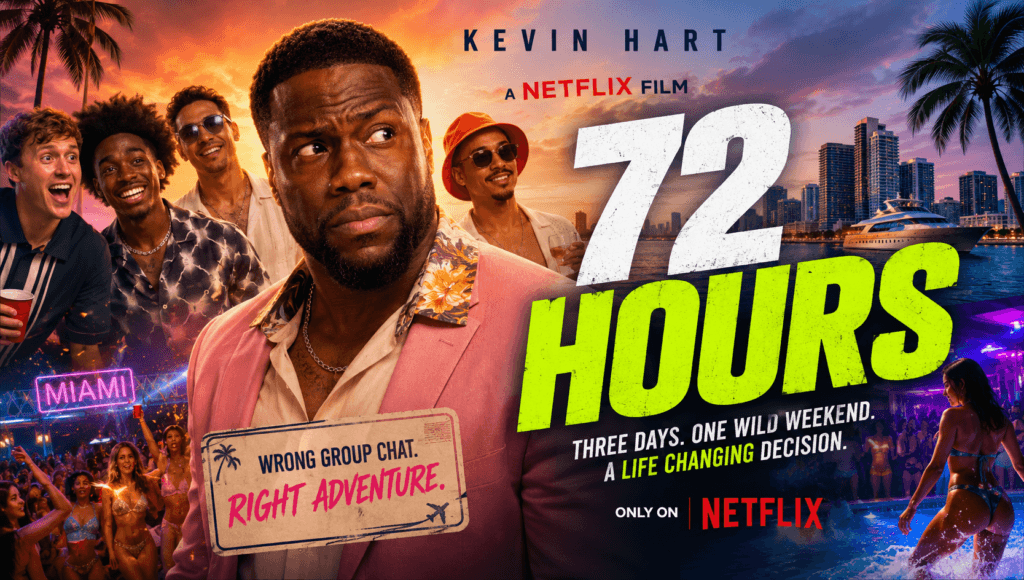
Released in 2026, 72 Hours is a Netflix comedy directed by Tim Story and starring Kevin Hart alongside Marcello Hernández, Mason Gooding, Kam Patterson, Ben Marshall, Zach Cherry, Teyana Taylor, Michael Mando, and Andy Garcia. The film follows Joe, a forty-year-old advertising executive whose ordinary life is upended when he’s accidentally added to a Gen Z bachelor party group chat. Instead of ignoring the mistake, he joins the weekend in Miami, hoping it might also rescue his struggling career. 72 Hours Ending Explained
At first glance, the premise sounds like another fish-out-of-water comedy. And yes, there are plenty of outrageous moments involving luxury yachts, clubs, awkward conversations, and escalating disasters. But hidden beneath those laughs is a surprisingly relatable story about aging, friendship, and wondering whether you’ve become too comfortable with mediocrity.
I honestly didn’t expect the final act to become this reflective. It’s still a comedy first, but it occasionally slows down just enough to ask some uncomfortable questions.
If you’ve enjoyed movies like The Hangover, Old School, or even Kevin Hart’s own Me Time, you’ll probably recognize the formula. What makes 72 Hours different is that it tries to balance absurd comedy with a midlife crisis narrative instead of relying entirely on nonstop jokes.
The Atmosphere: Chaos With a Surprisingly Honest Core
One of the film’s strengths is how quickly it throws Joe into a world where he doesn’t belong.
The opening scenes are deliberately structured to feel repetitive. Joe’s office routine, endless meetings, and predictable conversations are shot in a way that almost feels trapped. The camera rarely moves with much energy, and the colors lean toward muted grays and blues.
Then Miami arrives. 72 Hours Ending Explained
Suddenly everything becomes brighter.
The camera starts moving more freely.
The soundtrack becomes louder.
Even the editing speeds up.
That contrast immediately tells us this isn’t just a vacation. It’s Joe stepping into a completely different stage of life.
I especially liked how the movie occasionally pauses after the loudest jokes. Those quiet moments—usually when Joe is alone for a few seconds—say much more than the dialogue does. The silence almost feels heavier than the comedy.
Not every joke lands, though.
There are stretches where the film leans a little too hard into over-the-top party humor. Some scenes probably run longer than necessary, and a tighter edit could have kept the momentum stronger. That said, whenever Kevin Hart shares quieter scenes with the younger cast, the movie finds its emotional rhythm again.
Cinematic Analysis: More Than Just Party Scenes
Director Tim Story understands that comedy isn’t only about punchlines. 72 Hours Ending Explained
The cinematography constantly reminds us that Joe is out of place.
During the early party sequences, the camera frequently frames him slightly behind everyone else, making him look disconnected even when he’s standing in the middle of the group.
The lighting also tells its own story.
Nightclubs explode with colorful neon lights, but Joe often finds himself standing under softer or dimmer lighting compared to the younger characters. It’s a subtle visual reminder that he isn’t trying to relive his twenties—he’s trying to rediscover himself.
Another small detail I appreciated was the pacing.
Instead of rushing from joke to joke, the movie occasionally lets awkward conversations breathe. Those pauses create some genuinely funny moments because the characters have time to react naturally.
It’s not groundbreaking filmmaking, but it’s more thoughtful than many recent streaming comedies.
Act One Breakdown: The Wrong Group Chat Changes Everything
Every good comedy begins with one ridiculous mistake.
In 72 Hours, that mistake is surprisingly believable.
Joe is introduced as an experienced advertising executive whose career has become painfully stagnant. His professional confidence hides a growing fear that he’s becoming irrelevant, both at work and in his personal life.
Meanwhile, a group of twenty-somethings is busy preparing for an unforgettable bachelor weekend in Miami.
Through a simple digital mix-up, Joe is accidentally added to their private group chat.
Most people would leave immediately. 72 Hours Ending Explained
Joe doesn’t.
At first, he treats the messages like harmless entertainment. But as the conversations continue, he becomes fascinated by the freedom these younger strangers seem to enjoy. Their lives feel spontaneous compared to his carefully scheduled routine.
The movie smartly uses the group chat as more than a comedy device.
It’s symbolic.
Joe isn’t just entering another conversation.
He’s stepping into another generation.
Why Joe Accepts the Invitation
This is where I think the film becomes more interesting than its trailers suggested.
Joe doesn’t join the bachelor party simply because it’s funny.
He joins because he’s desperate.
His work life is collapsing.
His confidence has disappeared.
His personal relationships have become predictable.
The bachelor party offers something he hasn’t experienced in years:
Uncertainty.
Sometimes people don’t need a vacation.
They need permission to stop being the person they’ve become.
Kevin Hart plays these early scenes with just enough restraint that Joe never feels completely pathetic. He’s embarrassed by his decision, but also quietly excited.
That emotional contradiction makes him surprisingly relatable.
Miami Feels Like Another Character
Once Joe arrives in Miami, the energy shifts immediately.
The city isn’t simply a backdrop. 72 Hours Ending Explained
It’s designed to overwhelm him.
Luxury hotels.
Crowded beaches.
Nightlife.
Party boats.
Everything feels louder, faster, and younger than the world Joe came from.
The bachelor party itself is exactly as chaotic as you’d expect, introducing several personalities who initially see Joe as an outsider before gradually warming up to him. Their chemistry becomes one of the movie’s biggest strengths, especially as generational differences lead to both awkward misunderstandings and genuine friendships.
Hidden Detail You May Have Missed
One clever detail during the first act is how often Joe checks his phone.
Early on, it’s because he’s worried about work.
Later, it’s because he’s genuinely enjoying the people around him.
It’s a subtle character progression that the movie never points out directly.
Sometimes the best character development happens in the background.
When the Weekend Stops Being Funny
Up until this point, 72 Hours plays like the kind of comedy you’d expect from Kevin Hart. The misunderstandings keep escalating, Joe keeps trying to fit in with people half his age, and every plan seems to end in complete disaster.
But somewhere around the middle of the movie, the tone quietly changes.
The laughs are still there, but they’re no longer the only point.
This is where 72 Hours starts asking whether Joe is chasing youth—or simply trying to remember who he used to be.
Personally, this is the strongest section of the film. It isn’t perfect, and the pacing occasionally slows down, but it’s where the characters begin feeling like real people instead of comedy stereotypes.
Act Two Breakdown: From Outsider to One of the Guys
After surviving the disastrous first night, Joe slowly becomes accepted by the bachelor party group.
At first, everyone sees him as the “old guy.”
Every conversation reminds him of the age gap.
His references are outdated.
His jokes don’t always land.
Even the way he dresses makes him stand out.
Instead of pretending those differences don’t exist, the movie leans into them.
That honesty makes the comedy work much better. 72 Hours Ending Explained
The younger guys gradually realize Joe has something they don’t—life experience.
Meanwhile, Joe begins admiring their confidence, spontaneity, and willingness to take risks.
It’s no longer one generation making fun of another.
They’re learning from each other.
Joe’s Biggest Internal Conflict
Joe keeps telling everyone he’s only in Miami for work.
That’s technically true.
But it isn’t the whole truth.
Deep down, he’s terrified that his best years are already behind him.
One of my favorite scenes comes when Joe quietly watches everyone laughing together without him.
Nothing dramatic happens.
No emotional speech.
No sad background music.
Just silence.
For a comedy, it’s an unexpectedly honest moment.
The movie lets Kevin Hart act rather than simply deliver punchlines.
The Party Begins to Spiral
As expected, the bachelor weekend becomes increasingly chaotic. 72 Hours Ending Explained
Plans fall apart.
Arguments break out.
People disappear.
Embarrassing secrets are revealed.
Every attempt to fix one problem somehow creates three more.
The screenplay cleverly stacks these disasters on top of each other until complete chaos feels inevitable.
Still, I do think this section runs a little too long.
A few party sequences repeat the same joke in different locations.
They’re entertaining enough, but trimming ten minutes could have improved the pacing considerably.
That’s probably my biggest criticism of the movie.
Joe Starts Changing
Without realizing it, Joe begins making decisions differently.
Earlier in the movie, every choice was based on avoiding mistakes.
Now he’s taking chances.
He’s speaking honestly.
He’s laughing at himself.
He’s even admitting when he’s wrong.
Those aren’t huge moments individually.
Together, though, they completely reshape his character.
That’s why I think 72 Hours works better as a character comedy than a party comedy.
Character Analysis: Joe
Kevin Hart gives one of his more restrained performances here. 72 Hours Ending Explained
Joe isn’t trying to become twenty-five again.
He’s trying to reconnect with the version of himself that still believed life could surprise him.
Joe’s Motivations
- Save his career.
- Escape routine.
- Feel relevant again.
- Prove he’s capable of change.
His biggest fear isn’t failure.
It’s becoming invisible.
That’s a surprisingly relatable conflict, especially for viewers who feel stuck in the same routine every day.
Character Analysis: The Bachelor Party Crew
Initially, the younger characters appear to exist only for comic relief.
Thankfully, the film gives several of them genuine personalities.
Some are reckless.
Some are insecure.
Some are quietly anxious about marriage and adulthood.
Their conversations reveal that even though they’re younger, they’re dealing with many of the same fears Joe has.
The difference is that they’re just encountering those fears for the first time.
Joe has been living with them for years. 72 Hours Ending Explained
Hidden Details You Might Have Missed
One thing I appreciated is how often the film uses phones throughout the story.
Early in the movie:
Phones create misunderstandings.
Later:
Phones reconnect people.
By the final act, they’re no longer symbols of distraction.
They’re symbols of communication.
It’s a subtle visual progression that reflects Joe’s emotional journey.
Symbolism Explained
The Group Chat
The group chat isn’t just the movie’s inciting incident.
It represents opportunity.
One accidental notification completely changes Joe’s life.
The movie quietly suggests that major life changes often begin with random moments we almost ignore.
Miami
Miami symbolizes freedom.
Everything Joe has avoided—risk, spontaneity, embarrassment, failure—is waiting there.
The city constantly challenges him to leave his comfort zone. 72 Hours Ending Explained
The Bachelor Party
On the surface, it’s a celebration.
Symbolically, it’s about transition.
The groom is preparing for married life.
Joe is preparing for an entirely different future.
Both are standing at crossroads.
That’s why their stories mirror each other throughout the film.
Cinematic Details Worth Noticing
Director Tim Story uses surprisingly effective visual storytelling.
Whenever Joe feels confident, the camera becomes more fluid.
When he’s uncomfortable, shots become tighter and more static.
The editing also changes.
Early scenes rely on quick comedic cuts.
Later conversations last longer, allowing emotional moments to breathe.
The soundtrack deserves credit too.
Instead of overpowering every scene, the music occasionally steps back completely.
Those quiet moments often carry more emotional weight than the biggest jokes.
Fan Theory #1: The Weekend Was Never Really About the Bachelor Party
One interesting interpretation is that the bachelor party itself is almost irrelevant. 72 Hours Ending Explained
Its real purpose is forcing Joe into situations he would normally avoid.
Every embarrassing moment pushes him closer to confronting his own insecurities.
If that’s true, the movie isn’t really about surviving seventy-two hours.
It’s about rediscovering yourself before time runs out.
Fan Theory #2: Joe’s Career Was Already Over
Another theory is that Joe subconsciously knows his professional life has reached a dead end before he ever arrives in Miami.
That’s why he commits so completely to the trip.
He’s chasing more than a business opportunity.
He’s searching for proof that his life can still change.
The film never confirms this outright, but several conversations hint that Joe has emotionally checked out of his old routine long before the story begins.
My Thoughts on the Middle Act
This is where I think audiences will be divided.
Some viewers will love the constant party energy.
Others may feel the comedy occasionally overshadows the emotional story.
Personally, I sit somewhere in the middle.
I laughed more than I expected, but I also found myself wishing the film trusted its quieter scenes even more.
Ironically, those quieter moments are where 72 Hours feels the most authentic. 72 Hours Ending Explained
Ending Explained: Does Joe Finally Change?
By the time we reach the third act, the movie has transformed from a simple fish-out-of-water comedy into a story about commitment, self-worth, and finally taking control of your life.
The final hours of the bachelor weekend are the most chaotic.
What started as an innocent trip to Miami spirals into misunderstandings, criminals chasing the group over a misplaced briefcase, betrayals, and friendships being put to the test. Joe also loses the trust of the bachelor party after they discover he secretly planned to use footage from the weekend to help create an advertising campaign aimed at Gen Z. His attempt to understand them now looks like exploitation instead of friendship.
For a moment, it feels like Joe has lost everything.
- His promotion.
- His new friends.
- His relationship with Jennifer.
- His confidence.
Ironically, that’s exactly what he needed.
Sometimes you don’t realize what’s truly important until every safety net disappears.
Joe’s Biggest Decision
One of the smartest choices the screenplay makes is refusing to solve Joe’s problems with a single lucky break.
Instead, Joe changes himself. 72 Hours Ending Explained
When he returns to New York, he learns his company still wants the campaign idea he developed over the weekend. Earlier in the movie, Joe would have grabbed the promotion without hesitation.
This time, he makes a different choice.
Instead of staying at a company that no longer values him, he quits and finally decides to start the advertising agency he’s dreamed about for years. It’s a decision his coworker Barry had encouraged him to make long before the Miami trip.
Personally, I think this is the emotional payoff the entire movie has been building toward.
The bachelor party didn’t save Joe’s career.
It helped him realize he no longer wanted the career he had.
Jennifer Was Always the Emotional Ending
It’s easy to assume the story is about Joe and the bachelor party.
I don’t think it is.
The real emotional journey has always been about Jennifer.
Throughout the movie, Jennifer repeatedly asks Joe for something surprisingly simple:
Commitment.
Not expensive gifts.
Not grand speeches.
Just certainty.
Joe spends most of the film postponing important life decisions because he’s afraid of making the wrong choice.
By the ending, that fear finally disappears.
He rushes to Jennifer before she leaves, tells her he loves her, and admits he’s been running from adulthood for far too long. Jennifer gives him another chance, and by the epilogue they’re engaged.
That reunion feels earned because Joe doesn’t promise perfection. 72 Hours Ending Explained
He promises change.
There’s a difference.
The Wedding Epilogue
Several weeks later, the movie returns to the wedding that started everything.
The atmosphere is completely different now.
Nobody is trying to impress anyone.
Nobody is pretending to be someone they’re not.
Joe isn’t the awkward outsider anymore.
He’s genuinely part of the group.
One small detail I really liked is seeing Barry working with Joe at his new company while Nick also joins the business. It’s a quiet reminder that the relationships Joe built over seventy-two chaotic hours actually changed the direction of his life.
What Does the Final Scene Mean?
The movie ends with Joe joking that it might be time to plan his own bachelor party.
Then he gives a playful wink.
On the surface, it’s just another joke.
But it also carries two meanings.
1. Joe Has Finally Embraced His Future
Earlier in the film, Joe avoided commitment.
Now he’s excited about it.
The man who feared growing older is finally looking forward to the next chapter.
2. A Possible Sequel Tease
That final wink has sparked speculation among fans.
Some viewers believe it’s simply the movie ending on a laugh.
Others see it as an obvious tease for another adventure before Joe’s own wedding. Online discussions have largely interpreted it as a potential sequel setup, although Netflix hasn’t announced a follow-up.
I lean toward the second interpretation.
It feels intentionally open-ended without forcing a cliffhanger. 72 Hours Ending Explained
The Real Meaning Behind 72 Hours
At first glance, this looks like another outrageous bachelor-party comedy.
But underneath all the jokes, the film is really about time.
Not the seventy-two hours.
Your own.
Joe keeps postponing happiness.
He delays proposing.
He delays chasing his dream.
He delays believing in himself.
The movie quietly argues that the biggest risk isn’t making the wrong decision.
It’s never making one at all.
That’s a stronger message than I expected from a Kevin Hart comedy.
Symbolism Explained
The Seventy-Two Hours
The title isn’t only referring to the bachelor weekend.
It represents a brief window where an entire life can change.
Three days become enough time for Joe to discover who he wants to become.
The Lost Briefcase
The briefcase creates most of the third-act chaos.
Symbolically, it represents misplaced priorities.
Everyone spends so much time chasing what’s inside that they almost lose the people standing beside them.
Money creates conflict.
Relationships resolve it.
Jennifer’s Engagement Ring
The ring appears only near the end.
Its significance isn’t romance alone.
It symbolizes Joe finally choosing certainty over fear.
Throughout the movie, he’s trapped between possibilities.
The ring represents commitment.
Fan Theory #3: Joe Needed to Lose Everything
One interpretation is that Joe could never have changed while his old life remained comfortable.
Only after losing his promotion, disappointing his friends, and nearly losing Jennifer does he realize what truly matters.
In that sense, every disaster in Miami was necessary.
Without them, Joe would’ve returned to exactly the same life.
Fan Theory #4: Miami Was Never the Real Adventure
The bachelor party feels like the adventure.
Personally, I think that’s misleading.
Joe’s real adventure begins after he gets home.
Starting a business.
Building a future with Jennifer.
Trusting himself again.
The Miami trip is simply the first chapter.
My Final Review
I won’t pretend 72 Hours is a flawless comedy.
Some jokes miss.
The criminal subplot occasionally feels borrowed from movies like The Hangover, and a few supporting characters deserved more development. Critics have made similar observations about its reliance on familiar comedy formulas.
But I also think the film succeeds in places where I didn’t expect it to.
Kevin Hart gives one of his more restrained performances.
The generational humor feels surprisingly relatable.
And the emotional ending lands because it grows naturally from Joe’s character arc instead of relying on a last-minute twist.
Movie Explained Hub Rating: 7.8/10 ⭐
It’s not the funniest comedy of the year.
It probably isn’t Kevin Hart’s best movie either.
But it’s warmer, more sincere, and more thoughtful than its premise suggests.
Final Thoughts
Long after you’ll forget the yacht parties, awkward misunderstandings, and outrageous bachelor-party disasters, you’ll probably remember one simple idea:
Life doesn’t usually change because of one perfect decision.
Sometimes it changes because you finally stop being afraid to make one.
Frequently Asked Questions (FAQ)
Is 72 Hours based on a true story?
No. 72 Hours is an original comedy film. While its situations feel relatable—especially the themes of workplace burnout, friendship, and finding purpose—the story and characters are fictional.
What does the ending of 72 Hours really mean?
The ending shows that Joe’s greatest obstacle was never the bachelor party or the chaos in Miami—it was his fear of change. By leaving his unfulfilling career and committing to Jennifer, he finally takes control of his own future.
Does Joe lose his job?
Not exactly. Joe realizes that chasing a promotion at a company where he no longer belongs isn’t what he wants. Instead of waiting to be validated, he chooses to start a new chapter by building his own advertising business.
Does Joe end up with Jennifer?
Yes. Joe confesses his feelings, admits his mistakes, and proves he’s ready for commitment. Jennifer gives him another chance, and the film’s epilogue confirms they are moving forward together.
What is the significance of the bachelor party?
The bachelor party represents transition. While the groom prepares for marriage, Joe prepares for a completely different life. Both are stepping into adulthood in different ways.
Why is the movie called 72 Hours?
The title refers to the three-day bachelor weekend, but symbolically it represents how a short period of time can completely transform a person’s perspective and future.
Is there a post-credit scene?
No. The film does not include a major post-credit scene. Once the credits begin, Joe’s story has reached its emotional conclusion.
Will there be a sequel?
Netflix has not officially announced a sequel. However, Joe’s joke about planning his own bachelor party leaves the door open for another adventure if the film performs well.
Related Articles (Internal Links)
Add links to these pages on MovieExplainedHub:
- Musafir Cafe Ending Explained
- Sniper: No Nation Ending Explained
- Netflix Movies Explained
- Best Netflix Comedy Movies (2026)
- Movie Endings Explained
- Upcoming Netflix Movies 2026
- Hollywood Movie Reviews
- Ending Explained Archive
These internal links help readers discover more content and improve your site’s SEO.
Outbound Authority Links
Include links to trusted sources where relevant:
- Netflix (Official Streaming Page)
- IMDb
- Rotten Tomatoes
- Variety
- Collider
- The Hollywood Reporter
These sources improve credibility and provide readers with additional information.
Social Media Excerpt
What really happened at the end of 72 Hours?
Kevin Hart’s latest Netflix comedy is more than just a bachelor party gone wrong. We break down the ending, hidden meanings, character arcs, fan theories, and why Joe’s final decision changes everything.
Read the full explanation on MovieExplainedHub.com
Author Bio
About the Author
Lokesh Dhanure is the founder and editor of Movie Explained Hub, where he explores movie endings, hidden details, fan theories, symbolism, and cinematic storytelling. His goal is to help readers understand the deeper meaning behind films and TV series through engaging, spoiler-filled analyses that are both entertaining and SEO-friendly.
Final Verdict
⭐⭐⭐⭐☆ 7.8/10
72 Hours may not reinvent the comedy genre, but it delivers enough laughs, heart, and personal growth to stand out from many recent streaming comedies. Kevin Hart’s more grounded performance gives the film emotional weight, and beneath the bachelor-party chaos lies a relatable story about taking risks, embracing change, and refusing to let fear dictate your future.
Whether you came for the laughs or stayed for the emotional payoff, 72 Hours proves that sometimes 72 hours are all it takes to change a life.