Spoiler Warning: This article contains major spoilers for Don’t Move (2024), including the ending.
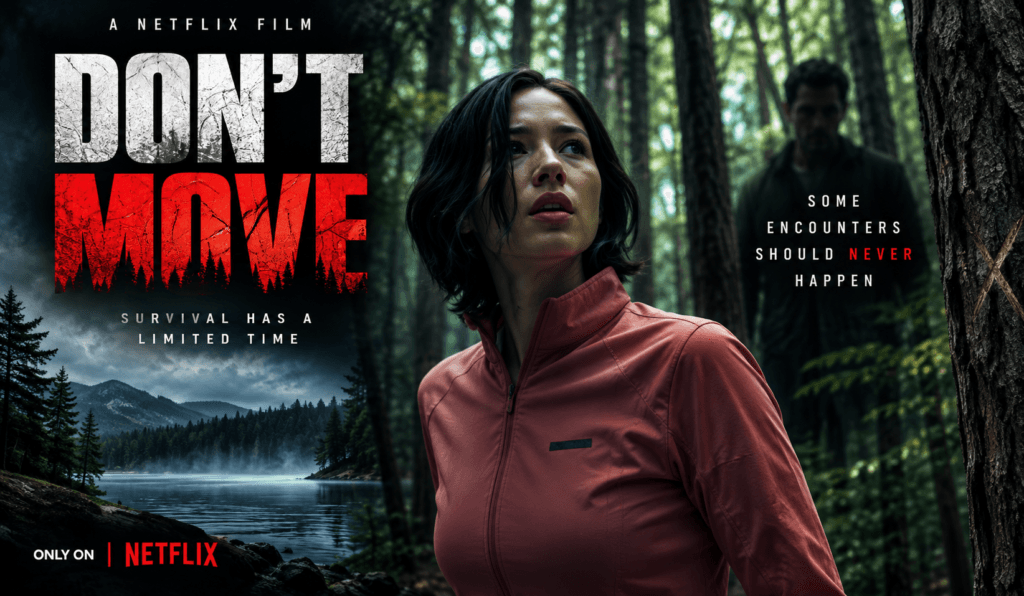
Netflix’s Don’t Move takes a simple survival idea and turns it into a race against time. A grieving woman is trapped in the wilderness after a stranger injects her with a paralytic drug. As the drug gradually takes control of her body, she has less and less ability to run, speak, fight, or even ask for help.
But beneath the survival thriller is another story.
Iris is not only fighting Richard. She is also fighting the emotional paralysis caused by the death of her young son, Mateo.
The movie stars Kelsey Asbille as Iris, Finn Wittrock as Richard, and Moray Treadwell as Bill. It was directed by Brian Netto and Adam Schindler and released on Netflix on October 25, 2024.
So what really happens at the end of Don’t Move?
And why does Iris say “Thank you” to Richard?
Let’s break it down.
What Is Don’t Move About?
The movie begins with Iris visiting the location where her young son died.
Mateo’s death has completely changed her. She is grieving, isolated and emotionally exhausted. The opening makes it clear that Iris is not simply sad. She has reached a point where she no longer sees much reason to continue living.
At the same time, the movie introduces Richard.
At first, Richard appears to be the exact person Iris needs to meet.
He seems calm.
He listens to her.
He tells her about his own tragic experience.
He even convinces Iris not to take her own life.
But this apparent act of kindness is actually part of Richard’s trap.
Richard is a serial killer who targets women. He injects Iris with a paralytic agent that gradually prevents her from moving.
The filmmakers deliberately connect Iris’s emotional condition with her physical condition. The paralysis becomes more than a survival-device in the story. It reflects the emotional state Iris has been trapped in since Mateo’s death.
That connection becomes extremely important when we reach the ending.
The Timeline of Don’t Move
The movie is designed to feel almost like one continuous countdown.
1. Iris visits the place where Mateo died
Iris is still struggling with her son’s death.
She is considering ending her own life.
This is important because Iris is already emotionally “paralyzed” before Richard enters the story.
2. Richard approaches Iris
Richard appears to be a sympathetic stranger.
He tells Iris about losing someone he loved, Chloe, in a terrible accident.
His story creates a connection between them.
But Richard is manipulating Iris.
3. Richard reveals his true intentions
After gaining Iris’s trust, Richard attacks her and injects her with a paralytic drug.
The movie establishes a limited window before the drug completely takes control of Iris’s body.
This creates the central countdown.
4. Iris escapes
Before the paralysis completely takes over, Iris manages to escape Richard’s vehicle.
She eventually reaches Bill’s property.
But her body is becoming increasingly difficult to control.
5. Bill tries to help
Bill initially does not understand what is happening.
Richard arrives pretending to be someone searching for Iris.
Richard’s ability to manipulate people becomes another weapon.
He doesn’t always need physical strength.
He uses his personality and lies.
6. Iris becomes almost completely immobile
Iris can barely move.
She cannot properly explain what is happening.
Her eyes, facial expressions and tiny movements become important ways of communicating.
7. Richard continues hunting her
Richard eventually finds Iris again.
The situation becomes even more dangerous when he decides to take her to the water.
His plan is to kill her and dispose of her body.
8. The drug begins wearing off
This is the turning point.
Iris slowly begins getting movement back.
She doesn’t immediately become completely mobile.
Instead, the movie makes her wait for tiny pieces of control to return.
That delay creates the final suspense sequence.
9. Iris fights back
Richard takes Iris onto the water.
But he makes one critical mistake.
He assumes Iris is still helpless.
She isn’t.
When she gets enough control back, Iris uses the opportunity to fight Richard.
She stabs him and manages to shoot him.
Richard falls into the water.
Iris escapes toward the shore.
10. Richard reaches the shore
Richard survives long enough to reach the shore badly wounded.
Iris sees him.
Instead of simply running away, she approaches him.
And then she says:
“Thank you.”
That is where the deeper meaning of the movie becomes clear.
Why Does Iris Say “Thank You” to Richard?
This is the most important question in the entire movie.
At first, the line sounds strange.
Why would Iris thank the man who kidnapped her, paralyzed her and tried to kill her?
The answer is not that Richard did something good.
He didn’t.
Iris is thanking him for something completely different.
Richard unintentionally forced Iris to discover that she still wanted to live.
Before meeting Richard, Iris was already close to giving up.
She had survived Mateo’s death physically, but emotionally she had stopped moving forward.
Richard then literally paralyzes her.
The movie turns her emotional condition into a physical one.
She cannot move.
She cannot speak.
She cannot fight.
Yet inside that powerless body, something changes.
Iris starts fighting for every second of her life.
That’s why the final “Thank you” works on two levels.
On one level, it is revenge
Richard previously uses the language of gratitude when discussing Chloe’s death.
Iris turns that idea back toward him.
The person who believed he understood suffering suddenly becomes the person being confronted by someone who has survived him.
On another level, it is about Iris herself
Iris realizes that she has rediscovered something she had lost:
the desire to live.
That doesn’t mean Richard helped her in any moral sense.
He is still responsible for what he did.
Instead, Iris takes something terrible that happened to her and gives it a different meaning.
So the final line isn’t forgiveness.
It isn’t approval.
It is Iris taking control of the meaning of what happened to her.
Iris Character Analysis
Iris is the emotional center of the movie.
At the beginning, she isn’t presented as a traditional horror heroine.
She doesn’t enter the story looking for adventure.
She doesn’t want to fight anyone.
She is broken by grief.
That makes her transformation more interesting.
Beginning: Iris wants to disappear
At the beginning, Iris is emotionally exhausted.
Mateo’s death has made her question the purpose of continuing.
She isn’t fighting for her future.
She is thinking about ending it.
Middle: Iris wants to survive
Once Richard attacks her, everything changes.
Suddenly, the woman who was ready to give up is desperate to stay alive.
The irony is powerful.
Richard believes he has found a helpless victim.
Instead, his attack gives Iris something she had been missing:
a reason to fight.
Ending: Iris takes control
By the final sequence, Iris is no longer simply reacting to Richard.
She is making decisions.
She waits.
She observes.
She takes opportunities.
She fights back.
The important change isn’t that Iris suddenly becomes fearless.
It’s that she refuses to surrender.
Richard Character Analysis
Richard is frightening because he doesn’t initially behave like a typical movie villain.
He is charming.
He appears sympathetic.
He knows exactly what to say.
That’s what makes him dangerous.
Richard understands people’s emotions and uses them against them.
His story about Chloe is particularly important.
He presents himself as someone who understands grief because he has experienced loss himself.
But later, his story becomes much darker.
Richard explains that Chloe’s death changed something inside him.
Instead of simply grieving her, he discovered something disturbing about himself.
The filmmakers deliberately leave some uncertainty about how much of Richard’s story should be believed. Director Adam Schindler has discussed the idea that there are “glimmers of truth” in Richard’s story, while also emphasizing that Richard is a manipulator.
That ambiguity makes Richard more interesting than a simple villain.
He wants to understand why he feels the way he does.
But instead of confronting himself honestly, he turns other people into experiments.
The Most Important Clue: Richard’s Story About Chloe
Richard’s conversation about Chloe isn’t just background information.
It prepares us for the ending.
Richard tells Iris about Chloe’s death and explains that he discovered something about himself during that traumatic experience.
Later, Iris is able to use Richard’s own emotional story against him.
This creates one of the movie’s most important reversals.
Earlier
Richard controls the conversation.
Later
Iris controls the conversation.
Earlier
Richard studies Iris.
Later
Iris studies Richard.
Earlier
Richard decides what happens next.
Later
Iris decides.
That is the character reversal that makes the ending work.
The Connection Between Iris’s Emotional and Physical Paralysis
This is arguably the strongest idea in Don’t Move.
Iris is physically paralyzed by Richard.
But emotionally, she was already stuck.
She is trapped inside her grief.
She can’t move forward after Mateo’s death.
Richard’s drug therefore becomes more than a thriller device.
It becomes a visual metaphor.
Emotional paralysis
Iris cannot imagine a future without Mateo.
Physical paralysis
Iris cannot move her body.
Recovery
As Iris’s physical control slowly returns, her determination also grows.
The movie doesn’t suggest that trauma disappears instantly.
Instead, it shows Iris finding the will to keep going.
This is why the physical limitation works so well as part of the story. Every small movement becomes meaningful because Iris has already spent most of the movie unable to control her own body.
Why Richard Underestimates Iris
Richard makes a serious mistake.
He thinks physical helplessness means emotional helplessness.
But Iris proves him wrong.
Even when she can’t run, she thinks.
Even when she can’t speak, she communicates.
Even when she can’t fight, she waits.
That patience becomes her weapon.
Richard is physically stronger than Iris.
He has experience.
He has weapons.
He controls the environment.
But Iris has something Richard doesn’t expect:
the determination to survive.
The more Richard tries to control her, the more determined Iris becomes.
Why the Water Matters in the Ending
The lake is more than just the location of the final confrontation.
Water becomes the final place where Richard expects Iris to lose.
He believes he has brought her somewhere where she cannot escape.
But the situation reverses.
Richard’s confidence becomes his weakness.
He assumes Iris is still the helpless woman he attacked earlier.
But by this point, the drug is wearing off.
Her physical control is returning.
And with that control comes the ability to fight.
The location that Richard chooses as the place of Iris’s death becomes the place where he loses control.
That reversal mirrors the entire movie.
Richard thinks he is controlling Iris’s fate.
By the end, Iris is the one making the decision.
Does Richard Die?
The movie leaves a little room for interpretation because Richard is shown badly wounded rather than receiving a long, conventional death scene.
During the final confrontation, Iris stabs and shoots him before escaping to shore. Richard later reaches the shore, badly injured.
The movie presents him as defeated and critically wounded.
But the emotional conclusion isn’t really about whether Richard is technically dead.
The more important question is:
Who controls Iris’s life now?
The answer is Iris.
What Does the Ending Really Mean?
The ending can be understood as Iris taking back control of her life.
Richard tries to make Iris into another victim.
Instead, Iris becomes the person who survives him.
But there is an even deeper layer.
At the beginning, Iris is standing at the edge of death.
At the end, she is fighting desperately to remain alive.
That creates a complete reversal.
Beginning
Iris wants to die.
Middle
Richard wants Iris to die.
Ending
Iris wants to live.
That is the real journey.
The movie doesn’t tell us that Iris’s grief has magically disappeared.
Instead, it shows that grief no longer completely controls her future.
The Meaning of the Title “Don’t Move”
The title has a literal meaning.
Richard’s drug prevents Iris from moving.
But it also has a symbolic meaning.
Iris has been emotionally stuck since Mateo’s death.
She has stopped moving forward with her life.
The entire movie asks a simple question:
What happens when someone who has stopped moving is suddenly forced to fight for every second of her life?
The answer is Iris.
She begins the movie emotionally frozen.
She ends it physically exhausted but psychologically awakened.
Connections Between the Opening and Ending
One of the best ways to understand Don’t Move is to compare its first scenes with its final scenes.
At the beginning, Iris is near the place where Mateo died.
She is thinking about death.
At the end, Iris is standing beside another person who is close to death.
But this time, she isn’t the one who wants to die.
She is the survivor.
That creates a strong circular structure.
At the beginning:
Iris is trying to escape life.
At the end:
Iris is fighting to keep it.
The physical journey through the wilderness therefore mirrors her emotional journey.
She begins trapped by grief.
She ends with a future that is still uncertain, but possible.
My Take on the Ending
For me, the strongest part of Don’t Move isn’t simply the serial-killer story.
It’s the irony behind Iris’s transformation.
Richard thinks he is taking away Iris’s ability to act.
Instead, he forces her to discover how badly she wants to live.
That doesn’t make Richard a hero.
It makes his defeat more meaningful.
Iris doesn’t survive because somebody arrives at exactly the right moment and saves her.
She survives because she keeps looking for a way out.
Even when she has almost no physical control, she continues thinking.
That’s what makes the final “Thank you” interesting.
It can sound cruel.
It can sound sarcastic.
But underneath both interpretations is something more emotional:
Iris has finally chosen life.
Richard unknowingly became part of the event that made her understand how much she still wanted it.
Final Explanation
Don’t Move is ultimately a story about two different kinds of paralysis.
Richard paralyzes Iris physically.
Grief had already paralyzed Iris emotionally.
The survival story slowly connects those two ideas.
Richard believes he has found an easy victim.
Instead, the woman he tries to destroy gradually rediscovers her strength.
By the final scene, Iris isn’t the same person who stood at the cliff at the beginning.
She has a reason to keep going.
That’s why her final words to Richard matter.
“Thank you” isn’t forgiveness.
It isn’t approval.
It’s Iris taking the last piece of meaning from Richard’s control and making it her own.
She survives.
And more importantly, she chooses to live.
Frequently Asked Questions
Is Don’t Move based on a true story?
No. Don’t Move is a fictional survival thriller.
What drug does Richard use on Iris?
Richard uses a paralytic drug that gradually limits Iris’s ability to move. The drug’s effects create the movie’s central time pressure.
Why does Iris say “Thank you” to Richard?
Iris’s words can be understood as a mixture of defiance and recognition. Richard’s attack forces her to fight for her life, helping her realize that she still wants to live.
Does Richard die at the end of Don’t Move?
Richard is left critically wounded after Iris fights back. The movie focuses more on Iris’s survival and transformation than on giving Richard a conventional death scene.
What does the title Don’t Move mean?
The title refers directly to Iris’s paralysis, but it also works symbolically. Iris has been emotionally stuck in grief and must eventually find a way to move forward.
What is the main message of Don’t Move?
The movie explores survival, grief, trauma and the desire to keep living. Iris’s physical struggle becomes a reflection of her emotional struggle.
Sources & Further Reading
For factual information about the movie and its production, readers can refer to:
- Netflix Tudum — Interviews and behind-the-scenes discussion of Don’t Move, including the ending and the filmmakers’ interpretation.
- Netflix — Official information about the movie, cast and release.
- Official interviews with the filmmakers and cast — Useful for understanding the characters and themes discussed in this article.
Note: The interpretation and analysis in this article are the author’s own. Statements about the movie’s plot and production are separated from the author’s interpretation where appropriate.
ALSO READ:- https://movieexplainedhub.com/office-romance-cast-and-character-guide/
Couples Weekend Hidden Secretshttps://movieexplainedhub.com/couples-weekend-hidden-secrets/
Upcoming American Movies September 2026https://movieexplainedhub.com/upcoming-american-movies-september-2026/
Girls Like Girls (2026)https://movieexplainedhub.com/girls-like-girls-2026-movie-explained/
Office Romance Ending Explainedhttps://movieexplainedhub.com/office-romance-ending-explained/