“Most animated movies teach children to understand others. Swapped goes one step further — it forces its characters to become each other.”
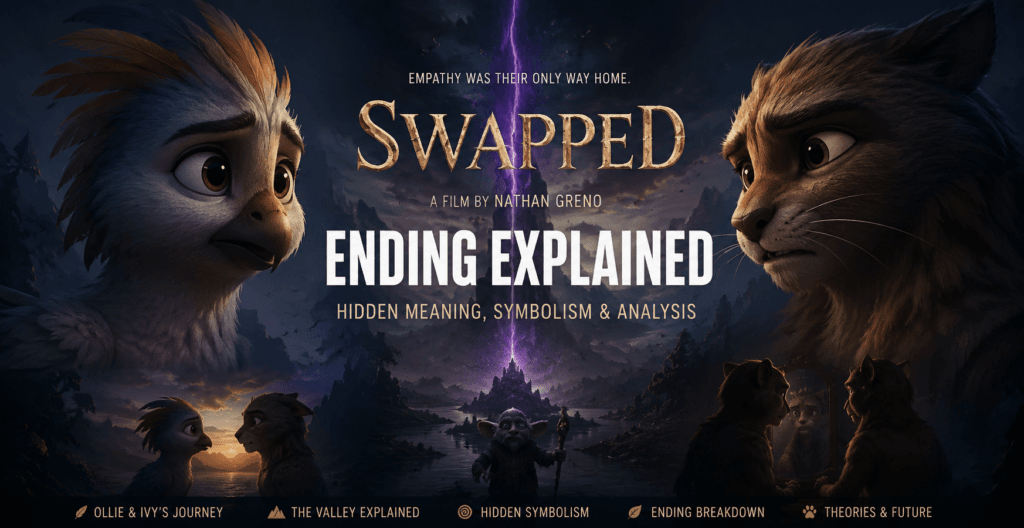
There’s a moment in Swapped when Ollie stares into the water and no longer recognizes the reflection looking back at him. It’s framed like a joke at first — a classic animated body-swap setup — but Nathan Greno quietly transforms that scene into something darker and strangely emotional. Beneath the colorful fantasy world, Netflix’s Swapped is really about identity panic. About inherited fear. About what happens when two people are forced to live inside the pain they once ignored.
That’s why the film hits harder than many expected.
On the surface, Swapped looks like another family-friendly fantasy adventure from Netflix and Skydance Animation. The trailers promise vibrant creatures, comedic chaos, and energetic performances from Michael B. Jordan and Juno Temple. But underneath the humor is a surprisingly mature story about empathy — not the easy kind, but the painful kind. The kind that requires losing your own comfort before you can truly understand someone else’s reality.
Nathan Greno, best known for co-directing Tangled, has always been fascinated by emotional isolation hidden beneath fantasy worlds. In Tangled, Rapunzel’s tower represented emotional imprisonment. In Swapped, the Valley represents something much larger: entire societies trapped by fear they inherited from generations before them.
And that’s what makes the movie interesting.
Because Swapped is not really about magic.
It’s about perspective.
What Swapped Is Really About
At first glance, the movie appears built around a familiar trope. Two opposites accidentally switch bodies and learn life lessons through chaos. Animation has used this structure for decades.
But Swapped weaponizes that idea emotionally.
Ollie and Ivy don’t just exchange appearances — they inherit each other’s vulnerabilities. Suddenly, survival itself changes. Safety changes. Social status changes. The way the world reacts to them changes.
That’s the genius of the film.
The body-swap becomes a metaphor for social division.
Ollie, who once viewed Ivy’s species with suspicion, suddenly experiences what it feels like to be feared. Ivy, who spent her life believing strength means emotional distance, suddenly inhabits a body that survives through trust and connection.
The movie quietly asks a devastating question: Swapped Ending Explained
How different would society look if people were forced to experience the world through someone else’s fear?
That thematic ambition places Swapped closer to films like Zootopia and Brother Bear than traditional body-swap comedies.
Like Zootopia, the film examines inherited prejudice. Like Brother Bear, transformation becomes emotional punishment and spiritual awakening at the same time.
But there’s also something unexpectedly modern about Swapped.
The Valley’s divided ecosystem mirrors real-world tribalism. Every species carries historical resentment. Nobody fully remembers how the hatred began, yet everyone continues protecting it anyway. Fear becomes culture. Distrust becomes identity.
And the movie never simplifies that tension.
Even sympathetic characters struggle to let go of inherited assumptions. That emotional realism gives the film surprising weight.
Because empathy in Swapped isn’t instant.
It’s exhausting.
Ollie & Ivy Character Analysis
Ollie and Ivy work because they are emotionally incomplete in opposite ways.
Ollie’s insecurity hides beneath humor. He talks too much because silence makes him uncomfortable. He constantly seeks approval because deep down, he doesn’t trust his own instincts. Michael B. Jordan gives the character warmth, but also nervous fragility. Ollie feels like someone desperate to prove he belongs in a world that already decided he’s weak.
Ivy is the opposite. Swapped Ending Explained
Juno Temple plays her with controlled sharpness, almost like every sentence is carefully guarded. Ivy survives through emotional distance. Vulnerability, to her, feels dangerous. She views dependence as weakness because weakness gets people hurt.
Their conflict isn’t just personality-based.
It’s survival-based.
That’s why the body swap destroys them psychologically.
Ollie suddenly experiences what it means to be physically feared. Ivy suddenly experiences emotional exposure. Both are forced into realities they previously misunderstood from a safe distance.
The brilliance of Swapped is that neither character becomes “correct.”
Instead, they become human.
Ollie learns courage isn’t optimism. Sometimes courage means existing while terrified.
Ivy learns strength without vulnerability, eventually becoming lonely.
The symbolism throughout their journey reinforces this emotional divide.
Feathers vs Fur
The film constantly contrasts movement styles.
Ollie’s species is associated with flight, openness, speed, and visibility. Ivy’s world is connected to concealment, grounding, and defensive survival.
Flying symbolizes emotional exposure.
Hiding symbolizes emotional protection. Swapped Ending Explained
When the two swap bodies, the symbolism reverses. Each character becomes trapped inside the very emotional state they spent their lives avoiding.
That’s why the transformation scenes feel strangely intimate rather than comedic.
They aren’t just changing shapes.
They’re losing certainty.
The Valley Explained
The Valley is one of the film’s most underrated achievements.
Nathan Greno and the animation team create an ecosystem that feels ancient, unstable, and emotionally symbolic all at once. Different species exist in carefully separated zones, each environment reflecting psychological identity.
Open skies represent freedom but also vulnerability.
Dense forest regions symbolize protection but also paranoia.
The Valley itself feels wounded.
That’s important.
Because the world-building is built around an imbalance.
Predator and prey dynamics aren’t just biological — they’ve become political. Entire communities define themselves by what they fear. Stories passed between generations slowly transformed survival instincts into social ideology.
The body-swap magic appears tied to the Valley’s deeper imbalance. The movie intentionally leaves parts of the lore ambiguous, which actually strengthens the mythological atmosphere.
Rather than explaining every magical rule, Swapped treats the Valley like folklore.
Ancient.
Mysterious.
Emotionally alive.
That decision makes the world feel larger than the story itself.
Some viewers may find the lore underexplained, but emotionally, that ambiguity works. The Valley behaves less like a fantasy map and more like a collective memory — a place shaped by unresolved emotional history.
And perhaps the smartest detail is this: Swapped Ending Explained
The Valley never fully heals by the end. Swapped Ending Explained
Because real societies don’t heal overnight either.
Hidden Symbolism & Psychological Meanings
This is where Swapped becomes much deeper than it initially appears.
The body swap itself represents emotional rebirth, but also identity collapse.
Both characters lose the comforting illusion that identity is fixed.
The film repeatedly uses mirrors and reflections during moments of emotional instability. Characters often avoid looking directly at themselves after emotionally painful scenes. That visual motif suggests a fear deeper than physical transformation.
They’re terrified of self-recognition.
Water Symbolism
Water appears during nearly every major emotional turning point in the film.
Water reflects.
Water distorts.
Water transforms.
In many scenes, characters stand near rivers or rain immediately before emotional breakthroughs. The symbolism is subtle but consistent: emotional clarity only emerges after instability.
Flight Imagery
Flying scenes are framed in two radically different ways.
Early in the movie, flight feels exhilarating.
Later, it feels terrifying.
That tonal shift mirrors Ollie’s emotional arc. Freedom becomes frightening once responsibility enters the equation. The movie suggests that emotional maturity means understanding the weight attached to freedom.
Falling Scenes
Falling represents surrender.
Characters stop falling only after learning trust.
That recurring imagery transforms physical danger into emotional metaphor.
Adult viewers will likely notice another hidden theme beneath the fantasy:
Inherited hatred survives because people fear vulnerability more than conflict.
That’s an unusually mature idea for a family animated film.
Swapped Ending Explained
The ending of Swapped works because it avoids a simplistic resolution.
Yes, Ollie and Ivy return to their original bodies.
But emotionally, they cannot return to who they were before.
That distinction matters.
The swap permanently destroys emotional distance between them. They now carry the memory of each other’s pain. And once empathy becomes personal, ignorance becomes impossible.
That’s why the final scenes feel bittersweet rather than triumphant.
The Valley begins changing, but slowly.
Suspicion still exists.
Fear still exists.
History still exists.
But empathy finally interrupts the cycle.
The emotional climax isn’t about defeating a villain.
It’s about rejecting inherited fear.
That’s far more powerful.
Was Boogle Guiding Destiny?
Tracy Morgan’s Boogle initially appears as comic relief, but the film quietly positions him as something more mysterious.
Boogle seems strangely aware of the Valley’s emotional patterns. Several scenes imply he understands the body-swap magic before anyone else.
One theory suggests that Boogle intentionally manipulated events to force emotional reconciliation between species.
Another theory is even darker:
The Valley itself may have chosen Ollie and Ivy.
That interpretation transforms the body swap into a spiritual correction — the ecosystem fighting against emotional imbalance.
The movie never confirms this directly, but the ambiguity feels intentional.
ALSO READ:- https://movieexplainedhub.com/exit-8-ending-explained/
ALSO READ:- https://movieexplainedhub.com/spider-man-brand-new-day-movie-explained/
ALSO READ:- https://movieexplainedhub.com/interstellar-movie-explained/
ALSO READ:- https://movieexplainedhub.com/oppenheimer-movie-explained-full-story-ending-explained-complete-breakdown/
ALSO READ:- https://movieexplainedhub.com/dune-2-movie-explained-full-story-ending/
ALSO READ:- https://movieexplainedhub.com/gladiator-2-movie-explained-ending-breakdown/
ALSO READ:- https://movieexplainedhub.com/18th-rose-ending-explained/
ALSO READ:- https://movieexplainedhub.com/godzilla-x-kong-the-new-empire-explained/
ALSO READ:- https://movieexplainedhub.com/hollow-earth-explained/
ALSO READ:- https://movieexplainedhub.com/scar-king-explained/
ALSO READ:- https://movieexplainedhub.com/godzilla-x-kong-the-new-empire-explained/
ALSO READ:- https://movieexplainedhub.com/monsterverse-movies-in-order/
ALSO READ:- https://movieexplainedhub.com/avatar-movie-ending-explained/
ALSO READ:- https://movieexplainedhub.com/dust-bunny-movie-explained/
ALSO READ:- https://movieexplainedhub.com/godzilla-x-kong-supernova-explained/
ALSO READ:- https://movieexplainedhub.com/spacegodzilla-explained/
ALSO READ:- https://movieexplainedhub.com/remarkably-bright-creatures-netflix-movie/
ALSO READ: –https://movieexplainedhub.com/person-of-interest-explained/
ALSO READ:- https://movieexplainedhub.com/kongs-axe-explained-monsterverse-secrets/
ALSO READ:- https://movieexplainedhub.com/mortal-kombat-2-ending-explained/
ALSO READ:- https://movieexplainedhub.com/upcoming-american-movies-september-2026/
ALSO READ:- https://movieexplainedhub.com/resident-evil-reboot-explained/
ALSO READ:- https://movieexplainedhub.com/upcoming-american-movies-september-2026/
ALSO READ:- https://movieexplainedhub.com/the-sheep-detectives-netflix-mystery/
ALSO READ:- https://movieexplainedhub.com/takeover-explained-may-2026/
Nathan Greno’s Storytelling Style
Nathan Greno has always balanced humor with emotional loneliness.
In Tangled, Rapunzel’s isolation drove the emotional core. In Swapped, Greno evolves that storytelling approach into something more psychologically layered.
The humor is still present, but sadness lingers beneath nearly every major scene.
That tonal balance gives Swapped emotional texture that many animated films lack.
According to production discussions surrounding the film’s development, Greno reportedly reshaped major parts of the story during rewrites, focusing more heavily on emotional perspective rather than pure comedy. That shift explains why the film sometimes feels more introspective than audiences expect from its premise.
Greno understands something many family films forget:
Animation can exaggerate emotional truth better than realism can.
The expressive visuals allow fear, confusion, and empathy to become physically visible. Characters literally transform under emotional pressure.
That’s why the movie resonates strongest during quieter scenes rather than action sequences.
The emotional intimacy feels genuine.
Why Critics Are Divided
Not everyone connected with Swapped equally.
Some critics praised its emotional ambition and thematic maturity. Others argued the story structure feels overly familiar, borrowing elements from Pixar and Disney classics.
Both perspectives are fair.
Narratively, the film absolutely uses recognizable genre foundations. The body-swap setup isn’t revolutionary. Neither is the “opposing worlds learning empathy” structure.
But execution matters.
What separates Swapped from weaker imitators is emotional sincerity. The movie genuinely cares about its themes instead of simply using them as background decoration.
Still, some viewers may find the symbolism heavy-handed or the pacing uneven in the second act.
That tension explains the divided reactions.
Emotionally receptive audiences often love the film.
Viewers expecting pure comedy may find its introspective tone surprisingly melancholic.
And honestly, that emotional risk is part of what makes the movie memorable.
Franchise & Sequel Potential
Netflix clearly hopes Swapped becomes more than a standalone release.
The world-building leaves enormous room for expansion. Entire regions beyond the Valley remain unexplored, and the film hints at other ancient magical systems connected to emotional imbalance.
Potential sequels could explore:
- new species conflicts
- political instability after the end
- origins of the body-swap magic
- historical wars within the Valley
- emotional consequences of future transformations
A sequel could also deepen the mythology surrounding Boogle.
The smartest direction, however, would avoid repeating the same body-swap premise mechanically. The emotional core works because it feels personal and transformative. Repeating it without evolution could weaken the original film’s meaning.
Still, the universe absolutely has franchise potential.
And visually, it’s easy to imagine Netflix expanding the property through: Swapped Ending Explained
- animated spin-offs
- streaming series
- games
- merchandise
- lore companion content
Whether Swapped becomes a major franchise likely depends on long-term audience connection rather than opening-week numbers alone.
But emotionally?
The movie leaves a stronger impression than many expected.
https://www.imdb.com/title/tt29552248/https://www.netflix.com/https://www.rottentomatoes.com/https://www.cartoonbrew.com/https://www.rogerebert.com/
FAQs
What is Swapped about?
Swapped is a Netflix animated fantasy film about two creatures from opposing worlds who accidentally exchange bodies and are forced to experience each other’s lives, fears, and emotional struggles.
Who voices Ollie and Ivy?
Ollie is voiced by Michael B. Jordan, while Ivy is voiced by Juno Temple.
Is Swapped connected to Tangled?
No, but director Nathan Greno previously co-directed Tangled, and both films share emotional themes involving isolation, identity, and freedom.
What does the ending of Swapped mean?
The ending symbolizes emotional understanding replacing inherited fear. Ollie and Ivy return to their original bodies physically, but emotionally, they are permanently transformed.
Is Swapped getting a sequel?
No sequel has been officially confirmed, though the film’s world-building leaves strong potential for future stories.
Why do Ollie and Ivy swap bodies?
The film suggests the magical event is connected to an imbalance within the Valley and may represent the world forcing opposing sides to understand each other.
What is the Valley in Swapped?
The Valley is the film’s central ecosystem — a divided fantasy world shaped by fear, survival, ancient tensions, and emotional imbalance.